
The numbers behind the American auto industry's wartime conversion are worth sitting with. In the space of about a year, an industry that had spent decades optimizing for stamping fenders and assembling engines redirected itself toward aircraft, tanks, and ammunition, at a scale that still reads as extraordinary. Understanding how that shift actually happened, plant by plant and contract by contract, explains a lot about why the postwar auto industry looked the way it did.
Car Features
6 min read
How Factories Switched From Cars to War
American auto plants converted from cars to war material at remarkable speed in 1942. Here is what the production numbers show about how that pivot happened.
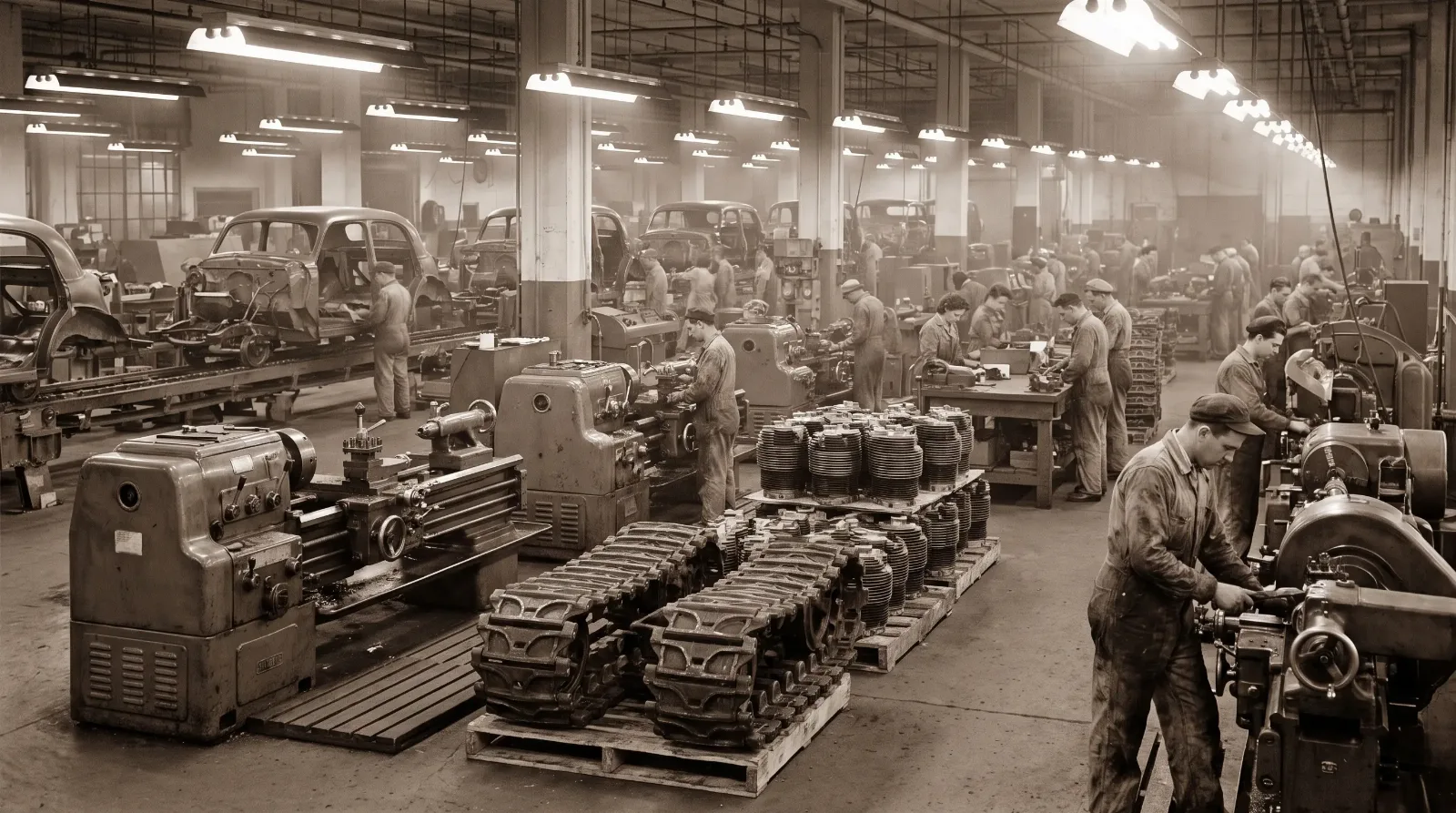
The scale of the conversion
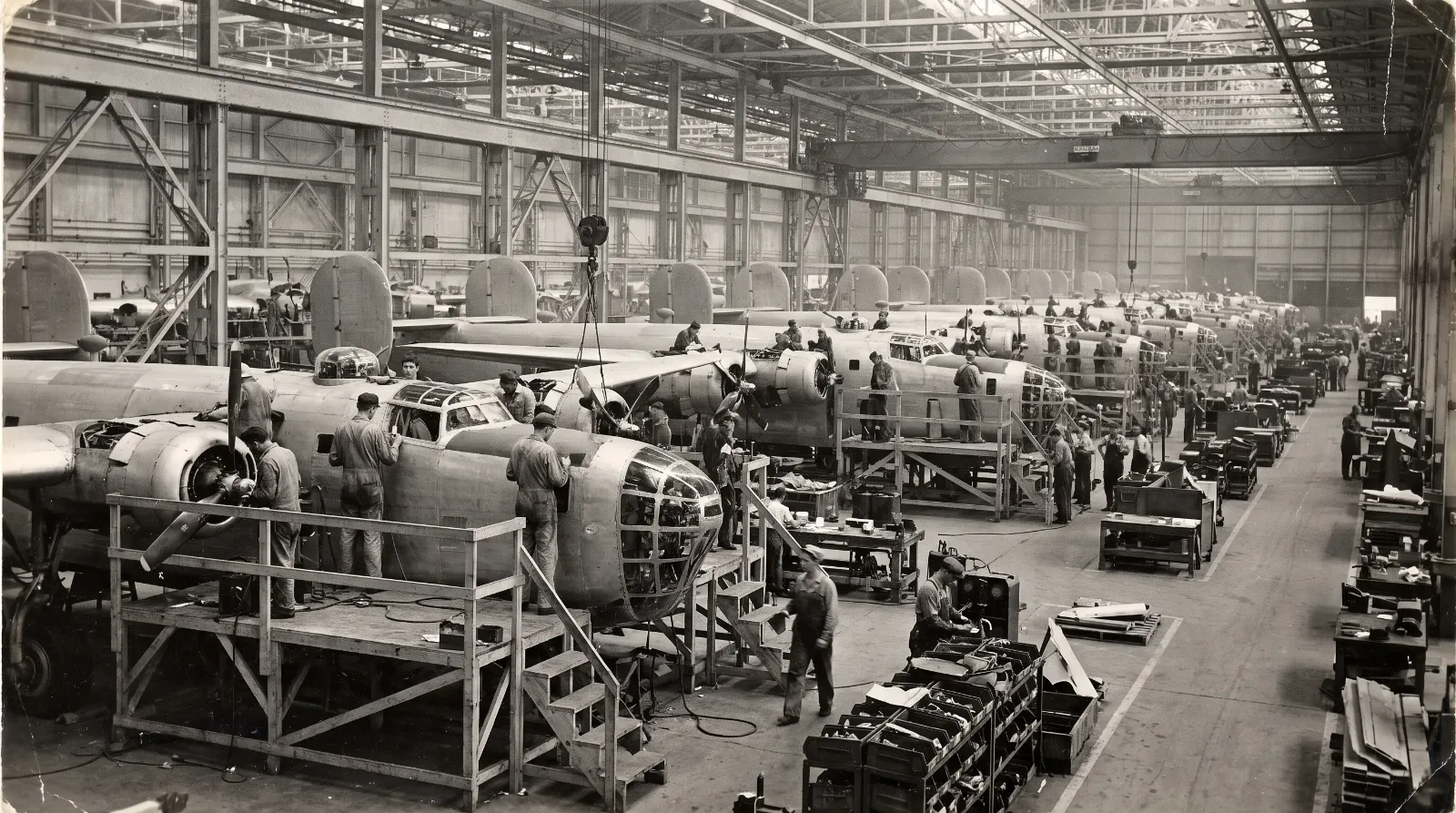
Before the freeze order of February 1942, the major automakers were already ramping up defense contracts alongside regular car production, a dual track that had been building since 1940. Once the freeze hit, that dual track collapsed into a single one. Ford, General Motors, Chrysler, and the independents committed their full manufacturing capacity, plant floor space, tooling, and labor, to military output.
The output figures are the clearest evidence of how completely the industry pivoted. Auto manufacturers, in various combinations, produced aircraft, aircraft engines, tanks, trucks, and vast quantities of ammunition and components over the following years. Ford's Willow Run plant, built specifically to mass-produce B-24 Liberator bombers, is the example most often cited, a facility scaled to automotive production methods and applied to an aircraft the industry had never built before. Willow Run's early output badly lagged projections while the workforce learned the new product, then climbed sharply as the plant matured, a pattern that shows up across the industry's wartime contracts generally.
What made the pivot possible
The auto industry's core competency, mass production discipline, moving jigs, standardized tooling, a trained assembly workforce, translated more directly to war production than most outside observers expected. Companies that had spent decades refining how to move a chassis down a line applied the same logic to building tank hulls and aircraft subassemblies. The skills were transferable even when the products were completely different.
That said, the transition was not seamless. Retooling a stamping plant from fenders to armor plate, or an engine line from inline sixes to aircraft radials, required new dies, new fixtures, and new training, all under wartime deadlines. Some plants converted in a matter of months. Others took the better part of a year to reach full planned output, and the ramp-up period shows up clearly in production records from 1942 into early 1943.
Government contracting added its own friction. Cost-plus arrangements, engineering changes dictated by the military rather than the manufacturer, and shifting priorities as the war progressed all meant that plant managers were often solving problems that had no precedent in civilian production. A tank hull tolerance failure or a defective aircraft rivet carried consequences that a cosmetic flaw in a fender stamping never had, and quality control practices tightened accordingly across the industry during these years.
| Manufacturer | Wartime products | Notable facility |
|---|---|---|
| Ford | Aircraft, aircraft engines, jeeps, tanks | Willow Run bomber plant |
| General Motors | Aircraft engines, tanks, trucks, ammunition | Cadillac, Fisher Body, Buick, and Oldsmobile divisions retooled |
| Chrysler | Tanks, aircraft components, ammunition | Detroit Tank Arsenal |
| Packard | Aircraft engines | Rolls-Royce Merlin engine built under license |
The workforce behind the numbers
None of this output happened without a dramatic shift in who staffed the plants. Millions of men left civilian jobs for military service, and the labor gap they left was filled substantially by women entering industrial roles for the first time, a shift the "Rosie the Riveter" image captured in shorthand but understates in scale. Plants that had rarely employed women on the production floor before the war retrained large portions of their workforce almost overnight.
The productivity data from this period is genuinely striking. Learning curves that would normally stretch across years compressed into months, driven by wartime urgency and by manufacturing techniques the auto industry had already perfected on civilian lines. That compressed learning curve is arguably the pivot's most lasting legacy: it proved that American manufacturing could scale new, unfamiliar production at a speed peacetime planning assumptions had not anticipated.
Supply chains adapted just as quickly as the plants themselves. Component suppliers who had spent years shipping small parts to automakers now shipped the same kind of hardware, fasteners, castings, electrical components, into an entirely different set of end products. That existing supplier network, built over decades of civilian car production, gave the war effort a manufacturing base that would have taken years to build from nothing, and it is one of the less visible reasons the conversion happened as fast as it did.
Reading the transition into postwar production
The conversion back to civilian cars after 1945 was, in a sense, the same story run in reverse, and it happened faster than many analysts at the time expected. Plants that had proven they could retool for tanks and aircraft in a matter of months did the same thing for cars, restarting civilian lines within weeks of the war's end using largely pre-freeze designs while new postwar models were finished.
The wartime years also changed manufacturing practice permanently. Techniques developed under military contracts, tighter tolerances, new metallurgy, statistical quality control methods, carried over into postwar car production. An industry that had spent three and a half years building tanks and bombers came out the other side with manufacturing knowledge it applied to cars for decades afterward. That continuity is part of a longer arc traced in the golden age of the automobile, where American manufacturing scale first became a defining national trait.
"The war years get treated as a gap in car history, three and a half years with nothing to show for it. The production data says the opposite. That period is where a huge amount of postwar manufacturing capability was actually built."
David Mercer
Looking at the wartime conversion as a manufacturing case study rather than just a historical footnote changes how the whole decade reads. The cars that followed in 1946 and beyond were built by plants, and by a workforce, that had just spent years proving they could retool for almost anything, a capability that shaped American car production long after the war ended, a theme covered further in more on wwii car manufacturing.
Sources and notes
Related Reading
Have a
Classic Car
for Sale?
Reach thousands of serious classic car collectors across the US.
Sell It Here →
Are You a Classic Car Dealer?
List your full inventory and connect with targeted classic car buyers.
Join as a Dealer →
#pre-war classics
#wartime production
#wwii car manufacturing
#willow run
#detroit tank arsenal
#1940s industry

About the author
David Mercer
Classic car market analyst with two decades of experience tracking collector car valuations, auction results, and investment trends.




Comments
Be the first to comment on this article.