
Sooner or later at any Shelby gathering, somebody points at a white fastback with a fiberglass front apron and calls it an R-model. Sooner or later somebody else asks for the serial number. The second question settles more arguments than the first one ever starts. That is the useful thing about the Shelby GT350R 1965 race cars: there are so few of them that the paperwork can answer nearly every claim. The count starts small. Shelby built 34 for customers, plus two team cars that came before them.
Car Features
6 min read
The 1965 GT350R: Shelby's Factory Race Car
The 1965 Shelby GT350R: $5,995, 325 to 360 hp, 34 customer cars and three straight SCCA B-Production titles. The race car behind the GT350.
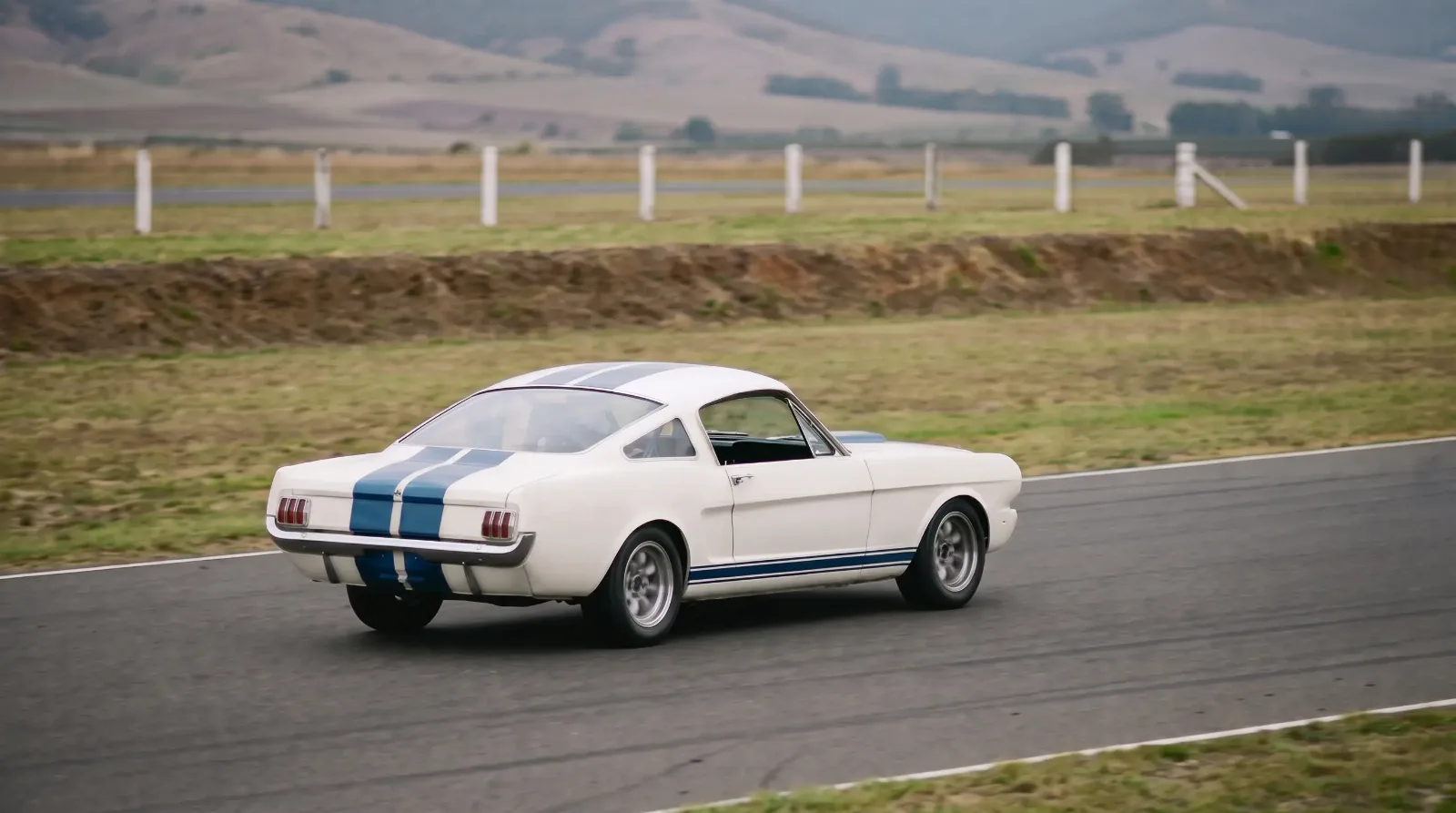
This is the story of the race car only. For the whole family, from these first white fastbacks to the last 1970 models, see the Shelby Mustangs. Here we stay with the cars that were built to race from the day they left the shop.
Why Shelby built a factory race car
The GT350 existed because Ford wanted a Mustang that could race. Lee Iacocca asked Carroll Shelby to make the car an SCCA B-Production contender, and Ford gave the go-ahead in August 1964. The SCCA required at least 100 street GT350s for 1965 before the car could run in that class. So the street car came first on paper, but the race car was the reason for the whole exercise.
The R-model was that reason, finished and sold ready to race. A street GT350 listed at $4,547. The R-model cost $5,995. For the extra money, a privateer got a car prepared for the track by the same outfit that built the team cars, instead of a street car, a parts catalog and a winter of evenings in the garage.
The first examples never went to customers. Serials 5R001 and 5R002 were the competition prototypes, and 5R002 is the car Ken Miles drove to victory at Green Valley Raceway on February 14, 1965, in the first sanctioned race a Shelby Mustang entered. How Miles developed the car is a separate story. For the R-model, it is enough to say it won the first time it tried.
Shelby GT350R 1965 hardware, piece by piece
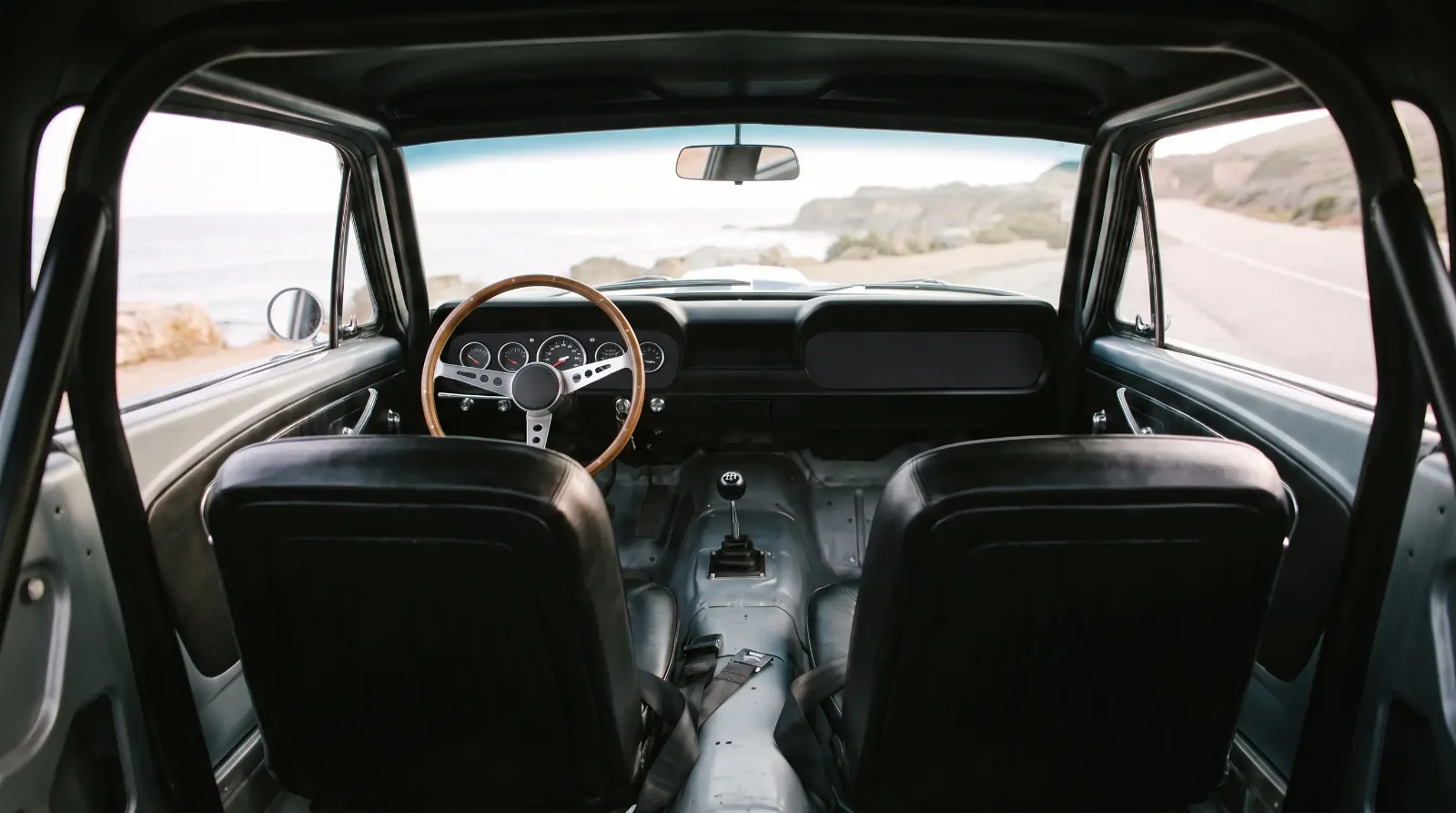
Start under the hood. The street GT350's 289 was rated at 306 hp. The R-model's engine was race-blueprinted, and the figures quoted for it run from 325 to 360 hp. That spread is not sloppiness. Race engines were built and rebuilt through a season, and the output moved with each build. Anybody who tells you there was one exact number is selling something.
Behind the engine sat an aluminum-case Borg-Warner T-10M four-speed, not the Toploader many people expect. Cooling got serious attention: an oil cooler, a larger radiator and ducts feeding air to the brakes at both ends of the car. The front wore a fiberglass apron. The windows were Plexiglas, the rear seat was deleted, and the fuel tank held 32 gallons. Magnesium wheels finished the package, and the whole car came in at about 2,750 lb.
Paint stayed the same as the street car's: Wimbledon White with blue stripes. A white R-model and a white street GT350 can look alike from across a show field, which is exactly why the serial number question comes up so often.
| Item | 1965 GT350 (street) | 1965 GT350R |
|---|---|---|
| List price | $4,547 | $5,995 |
| Engine output | 306 hp @ 6,000 rpm (gross) | 325 to 360 hp, race-blueprinted 289 |
| Transmission | Borg-Warner T-10 four-speed | Aluminum-case Borg-Warner T-10M |
| Wheels | Steel or 15-in cast-magnesium Cragar | Magnesium |
| Paint | Wimbledon White, Guardsman Blue rocker stripes | Wimbledon White, blue stripes |
| 1965 count | 504 street cars plus 1 street prototype | 34 customer cars plus 2 competition prototypes |
How many were built, and why the count drifts
The majority figure is 34 customer R-models, and three independent sources agree on it. That does not stop the argument. The Newport Car Museum reaches 34 by counting 33 cars plus a prototype. Sports Car Market says 36. Most of the drift comes from how each source treats the team cars and prototypes, not from anybody finding extra race cars in a barn.
The full 1965 picture helps. Shelby built 562 GT350s for the model year: 1 street prototype, 504 street cars, 2 competition prototypes, 34 R-models, 4 drag cars and 17 other prototypes. Once you see the categories laid out, the different totals stop looking like contradictions and start looking like bookkeeping.
When counts disagree, Shelby people go to the registry. The Shelby American Automobile Club was founded in 1975 by a handful of owners, and its registry work is the reason most R-model debates end in a polite nod rather than a shouting match. Plenty of confident claims on a show lawn go quiet the moment somebody opens the book.
What the R-model won
The scoreboard is the R-model's real credential. Jerry Titus won the 1965 SCCA National B-Production championship in a GT350, taking the title at the Daytona runoffs. Walt Hane won it in 1966. Fred van Beuren won it in 1967. That is three straight national titles in the class Ford had asked Shelby to go after, for a car that started life as a Mustang fastback on a San Jose assembly line.
Those championships are also why an R-model's individual history matters so much to the people who own them. A car's race entries, its drivers and its results are part of its identity, the same way a serial number is. Two R-models can be built to the same specification and carry very different stories.
"Everybody has a theory about an R-model until somebody reads the serial off the car. After that it is just a question of whether the registry agrees, and in my experience the registry usually wins."
Wayne Coburn
The R-model in the record today
The best-known R-model is the first winner. 5R002 sold for $3.85 million at a Mecum auction in July 2020, then crossed the block again at Mecum Kissimmee in January 2022, where the hammer fell at $3.7 million. Those figures describe one car with one very particular history. They are a record of what happened, not a yardstick for the other 35.
The R-model also marks the end of something. It was a 1965 story through and through, a race car sold to privateers under the Shelby name, built around a street car that existed mostly to make it legal. For 1966 the GT350 turned toward the street, with quieter exhaust, suspension closer to stock and an automatic on the option list, and the 1966 changes show how quickly the priorities shifted. The 1965 R-model is what the GT350 looked like when racing came first.
Sources and notes
- 1965 Ford Mustang Shelby GT350R, Newport Car Museum
- 1965 Shelby GT350 specifications and production, MustangSpecs
- The "Flying Mustang" 1965 Shelby GT350 prototype, Vanderbilt Cup Races
- 1965 Shelby GT350R profile, Sports Car Market
- Shelby Mustang, Wikipedia
- About SAAC, Shelby American Automobile Club
#Ford Mustang
#Shelby American
#saac registry
#1965 Shelby GT350
#SCCA B-Production
#Mustang racing history
#Shelby GT350R

About the author
Wayne Coburn
Longtime Corvette owner, judge and club figure who knows the cars, the records and the people behind them.
Related Listings - Ford Mustang




Comments
Be the first to comment on this article.