
On February 14, 1965, a white Mustang fastback with blue stripes started its first sanctioned race at Green Valley Raceway in Texas, and it won. The car was serial 5R002. The driver was a 46-year-old Englishman who had spent the winter teaching a showroom pony car to behave like a sports car. His name was Ken Miles, and the Ken Miles Mustang story is mostly the story of those few months: how a quick, affordable Ford fastback became the Shelby GT350, and who did the sorting.
Car Features
7 min read
Ken Miles and the Development of the GT350
How Ken Miles helped turn the 1965 Mustang fastback into the Shelby GT350, and won its first race at Green Valley in February 1965.
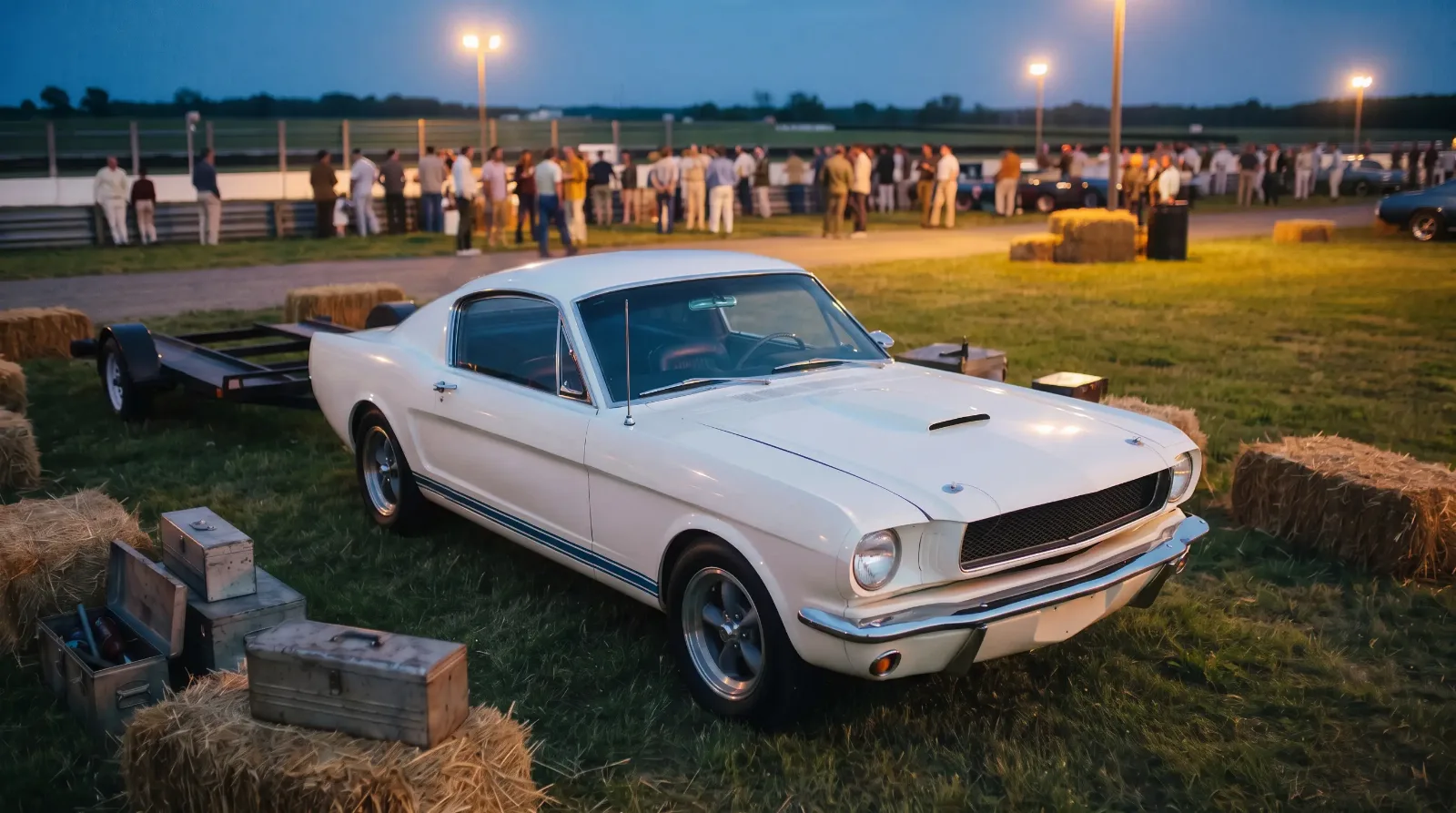
Carroll Shelby's name went on the fender, and he earned it. But a car like the GT350 is built by a crew, and the man doing the mechanical development on it was Miles. If you want the whole family tree, from these first white cars to the last of the line, our Shelby Mustang guide lays it out. This piece stays with one driver and one winter.
Who Ken Miles was when the Mustang arrived
Kenneth Henry Jarvis Miles was born on November 1, 1918, in Sutton Coldfield, England. He moved to the United States in 1952, and by 1963 he was chief test driver at Shelby American. At that shop, the job meant Cobras long before it meant Mustangs.
A chief test driver at a small race shop does more than set lap times. He has to come back into the pits and tell the engineers what the car is doing, in words they can turn into parts. Fast drivers are easier to find than drivers who can do both. When Ford came looking for a race version of its new Mustang, the person with that job was already on the payroll, already used to working with very little time and very few people.
The Ken Miles Mustang assignment: build a B-Production racer
The request came from the top. Lee Iacocca asked Shelby to turn the Mustang into a racer for the SCCA's B-Production class, and Ford gave the project its go-ahead in August 1964. The rules set the pace from there. To race in 1965, Shelby needed at least 100 street versions built, so the street GT350 and the race car had to be developed side by side. In the last week of 1964, Ford's San Jose plant shipped 110 Wimbledon White fastbacks to Shelby to start the run.
The team was small. Chuck Cantwell was the project engineer. Miles handled mechanical development. Peter Brock did the graphics, which is part of why the car still looks right with nothing more than white paint and a blue stripe. The credit lines are not perfectly tidy, either. At least one history credits Miles specifically with the suspension and gives Bob Bondurant credit for handling work. That kind of overlap is normal in a shop where the same handful of people did a bit of everything.
Look at the calendar and the pace becomes clear. Approval in August. Cars on the truck in late December. A race win in mid-February. That is roughly six months from a yes at Ford to a trophy in Texas, with a street car and a race car developed in the same window.
What the development work changed
The engine side started from Ford's own 289 High Performance V8, the K-code. Shelby's version added a 715-cfm Holley four-barrel, a Cobra high-rise intake and Tri-Y headers, and it was rated at 306 hp at 6,000 rpm and 329 lb-ft at 4,200 rpm. The gearbox was not the Toploader that people tend to assume, but a Borg-Warner T-10 four-speed. Wheels were steel or 15-inch cast-magnesium Cragars.
The chassis is where Miles's hands are most often placed, and where the record gets thinner on who did what. The 1965 car got front upper control arm mounting points dropped by about an inch, adjustable Koni shocks and over-ride traction bars at the rear. The control arm drop is usually credited to Ford engineer Klaus Arning, which is a fair reminder that Miles was testing and refining ideas from several people, not inventing every part himself. The goal behind all of it is easy to state and hard to achieve: keep a nose-heavy, live-axle street car flat and planted through a fast corner, lap after lap, without wearing out the driver or the parts.
The testing became a legend of its own. Shelby later said on film that Miles and Cantwell put 50,000 miles on the test-mule Mustang, and Cantwell suggested the real figure was far higher. Nobody kept a log that settles it. Which tracks they used, and on which dates, is poorly documented. I would rather tell you that plainly than fill the gap with a guess.
| Item | 1965 Shelby GT350 |
|---|---|
| Base car | 1965 Mustang fastback; 110 Wimbledon White cars shipped from San Jose in the last week of 1964 |
| Engine | 289 K-code High Performance V8, Shelby-modified |
| Induction and exhaust | 715-cfm Holley four-barrel, Cobra high-rise intake, Tri-Y headers |
| Rated output (gross) | 306 hp @ 6,000 rpm; 329 lb-ft @ 4,200 rpm |
| Transmission | Borg-Warner T-10 four-speed |
| Wheels | Steel or 15-in cast-magnesium Cragar |
| Paint | Wimbledon White with Guardsman Blue rocker stripes |
| List price | $4,547 |
| 1965 production | 562 in all, including 34 customer R-models |
The finished street car was quick by any 1965 yardstick. Period figures credited to a May 1965 Car and Driver test put it at 6.5 seconds from 0 to 60 mph and 14.9 seconds at 95 mph in the quarter mile. Those are numbers from a car you could drive home, which tells you how much of the race development made it into the showroom version.
Green Valley, February 1965
The first sanctioned race a Shelby Mustang ever entered took place at Green Valley Raceway on February 14, 1965. Miles drove 5R002, one of the two team cars built before the customer race cars, and he won. At least one published account puts Green Valley in California. It was in Texas, near Dallas and Fort Worth, and the stronger sources agree on that.
The car he drove that day was the competition version, the GT350R, and it has a story of its own. Shelby built 34 of them for customers, plus the team cars. What matters here is the direction of travel. The program Miles helped sort produced a race car, and the race car went out and won. Jerry Titus took the 1965 SCCA National B-Production championship in a GT350. The class title went to GT350 drivers again in 1966 with Walt Hane and in 1967 with Fred van Beuren.
"People still argue about who really made the GT350. Shelby had the name, Cantwell had the engineering, and Miles had the seat time. The scoreboard at Green Valley is the best evidence I know that the seat time mattered."
Patrick Walsh
Daytona, Sebring, Le Mans and Riverside
Miles did not stay with the Mustang for long. Ford's bigger racing program needed him, and 1966 turned into the best year of his career. He won the Daytona 24 Hours and the Sebring 12 Hours with Lloyd Ruby, then finished second at Le Mans after Ford staged a finish for its cars.
On August 17, 1966, he was killed at Riverside International Raceway while testing the Ford J-car. He was 47. By then the GT350 was in its second model year and reaching a wider public, and the R-model was still winning in SCCA racing without him.
Most people who know the name today know Miles from endurance racing. Mustang people have a second reason to remember him. The first Shelby Mustang was developed with him at the wheel, and the first race it entered ended with his name at the top of the results. That is a short chapter in a long career, and it is the one that put a pony car on a road course and made it stick. If the Shelby chapter has you wondering about the plain fastback those 110 cars started as, start at the beginning.
Sources and notes
Related Reading
#Ford Mustang
#Shelby GT350
#Shelby American
#Ken Miles
#1965 Shelby GT350
#SCCA B-Production
#Mustang racing history

About the author
Patrick Walsh
Automotive journalist covering classic car shows, events, and the enthusiast community across North America.
Related Listings - Ford Mustang




Comments
Be the first to comment on this article.