
The 1966 Chevelle isn't a facelift of the 1965 car. It's a different body from the ground up, and the production records back that up: new stampings for the roof, doors, quarter panels, and front clip, all released for a single model year changeover rather than staggered across a running redesign. That's a bigger commitment than most casual histories of this car give it credit for.
Car Features
6 min read
The 1966-67 Restyle: Sculpting a Sharper Chevelle
Why 1966 brought all-new Chevelle sheetmetal and a semi-fastback roofline, and how 1967's grille and trim changes differ from the year before.
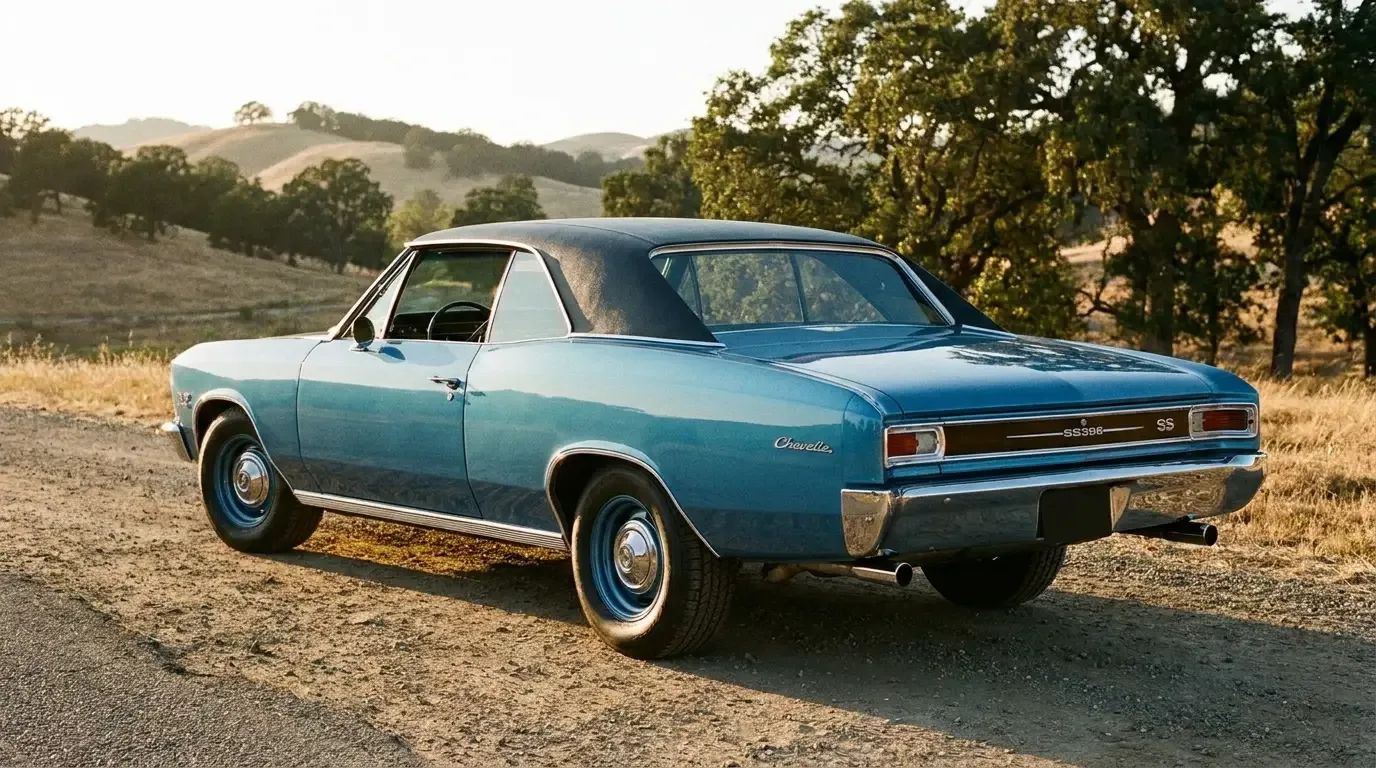
I work from build sheets and factory documentation more than memory, and what the paper trail shows for 1966 is a design team given real authority to move away from the first-generation body rather than just update it. The result is a car with noticeably more sculpting through the fenders and quarters, a lower beltline, and a roofline that reads faster even at a standstill.
What actually changed for 1966
The new body brought a more pronounced character line running from the front fender through the door, a wider stance visually created by flared wheel openings, and a fresh roof panel with a lower profile than the outgoing car. The Super Sport coupe picked up a semi-fastback roofline, less dramatic than what would follow in 1968 but a clear step in that direction. Twin simulated hood louvers and, on SS models, non-functional hood indents became part of the standard visual vocabulary, giving the front end a more aggressive read even before you get to engine specifics.
The taillight treatment moved to a wider, simpler horizontal bar arrangement, and the rear quarter panel picked up a subtle kick-up just ahead of the taillight panel. None of these are radical individually. Taken together across the full body, they add up to a genuinely new car, and restoration and production references treat 1966 as its own body series rather than a running change to the prior tooling.
1967: refinement, not reinvention
Where 1966 was a clean-sheet body, 1967 was a disciplined revision of it. The most visible change is the grille, which moved to a single-unit horizontal bar design in place of the twin-opening treatment used the year before, and the taillamps grew into a wraparound design integrated into the redesigned rear end. Front disc brakes became available and a collapsible steering column was added as a safety feature. The Super Sport badge script and trim details were revised, and interior appointments got minor updates, but the fundamental body stampings from 1966 carried forward largely unchanged. Side marker lights are a later identifier, not a 1967 one: those came industry-wide with the 1968 model year under a federal lighting standard that took effect January 1, 1968, so a genuine 1967 car will not have them from the factory.
That distinction matters more than it sounds like it should when you're trying to date a car or verify a parts match. A quarter panel or door skin from a 1966 Chevelle will generally interchange with a 1967, but grille assemblies, marker lights, and certain trim pieces will not. Anyone sourcing parts off a build sheet needs to know which of these two years they're actually working with, because the visual similarity between them at a glance is deceptive.
Interior trim followed a similar pattern of restrained, deliberate change. Instrument panel layout carried over from 1966 into 1967 with only minor detail revisions to trim plates and knob styling, and upholstery pattern options were refreshed rather than reengineered. It's the kind of year-over-year discipline that makes sense once you understand 1967 as a management-driven cost decision rather than a design team starting over: the new body had just absorbed a significant tooling investment, and 1967 was built to protect that investment while still meeting the year's federally mandated safety changes.
Reading the change in context
This restyle sits directly between the clean, restrained shape of the original A-body and the more sculpted, aggressive direction the Chevelle would take by decade's end, covered in next: 1968's Tunnelback Roof. The 1966-67 cars are the hinge point. They keep some of the earlier body's honesty in proportion while introducing the sculpted surfacing and semi-fastback roofline that would define the muscle car era's visual language going forward. Anyone tracing the full arc of the model's design across its production years should look at the full design story for how each generation connects to the next.
| Model year | Body status | Key visual identifier |
|---|---|---|
| 1966 | All-new body, semi-fastback SS roofline introduced | Twin-opening grille, hood louvers |
| 1967 | Trim and safety revision on 1966 body | Single-bar grille, side marker lights |
"The factory paperwork for '66 doesn't hedge on it. New body series, new stampings, released as a package. People see the family resemblance to '67 and assume it was one long running design, but the tooling investment says otherwise. It's worth going back to the documentation before you repeat the shorthand version of this story."
Tom Ramirez
Why the distinction holds up under inspection
Understanding 1966 as a genuine redesign, and 1967 as its careful refinement, changes how you evaluate a car in front of you. A 1966 with a mismatched grille insert, or a 1967 wearing the wrong-year wraparound taillamp treatment, is telling you something about its history before you even open the hood. A genuine 1967 car should also never carry factory side marker lights, since that federal requirement didn't arrive until the 1968 model year, so their presence on a car represented as a '67 is worth a closer look. The body may look like a single continuous shape from a distance, but the documentation, and the tooling records behind it, draw a clear line between the two years. That line is worth knowing whether you're buying, restoring, or just trying to correctly identify a car parked at a show.
It also matters when you're trying to verify a car against its own build sheet. A 1966 Chevelle showing a 1967-style single-bar grille, or a 1967 running the earlier twin-opening front end, is a red flag worth chasing down. Sometimes it's a simple case of an owner swapping parts for a preferred look. Sometimes it points to a car built late in one model year on carryover stock, or a repair history that pulled a front clip from the wrong donor car. Either way, the documentation gives you a starting point that a visual inspection alone can't, since these two years share enough of a family resemblance to fool a casual look.
Sources and notes
- Chevrolet Chevelle: Wikipedia
- Spotter's Guide: Identifying the 1964-1967 Chevelle: Champion Cooling
- 1966 Chevelle Restoration Information: Ground Up Motors / SS396.com
- 1966 Chevrolet Chevelle SS 396: A Profile of a Muscle Car: HowStuffWorks
- History of Side Marker Lights and Their Legal Requirements: LawShun
Related Reading
Have a
Chevrolet Chevelle
for Sale?
Reach thousands of serious classic car collectors across the US.
Sell It Here →
Are You a Classic Car Dealer?
List your full inventory and connect with targeted classic car buyers.
Join as a Dealer →

About the author
Tom Ramirez
Corvette researcher and historian based in Bowling Green, Kentucky. Two decades documenting Corvette production history from original factory records.
Related Listings - Chevrolet Chevelle




Comments (1)
B
Bill Cassidy
2 months ago
Had one of these about fifteen years ago. Sold it when life got complicated. Regret it most years come auction season.