
Zero to 60 mph in 5.8 seconds and a 14.2-second quarter mile at 100.3 mph. That is what Car and Driver got from the 1970 Camaro Z28 in its May 1970 issue, and it is the number to hold on to while everything else about this car gets argued over. Chevrolet still wrote the name Z/28 that year. The engine that made those numbers was the LT-1 350, and it was a different animal from the 302 that came before it. This is the story of that engine and the one model year it ran at full strength, a narrow slice of the 1970 to 1981 cars.
Car Features
6 min read
The 1970 Z/28 and the LT-1 350
The 1970 Z/28 ran 0 to 60 in 5.8 seconds on a 360 hp LT-1 350. What the engine had, why 1970 was its peak and what proves a real one.
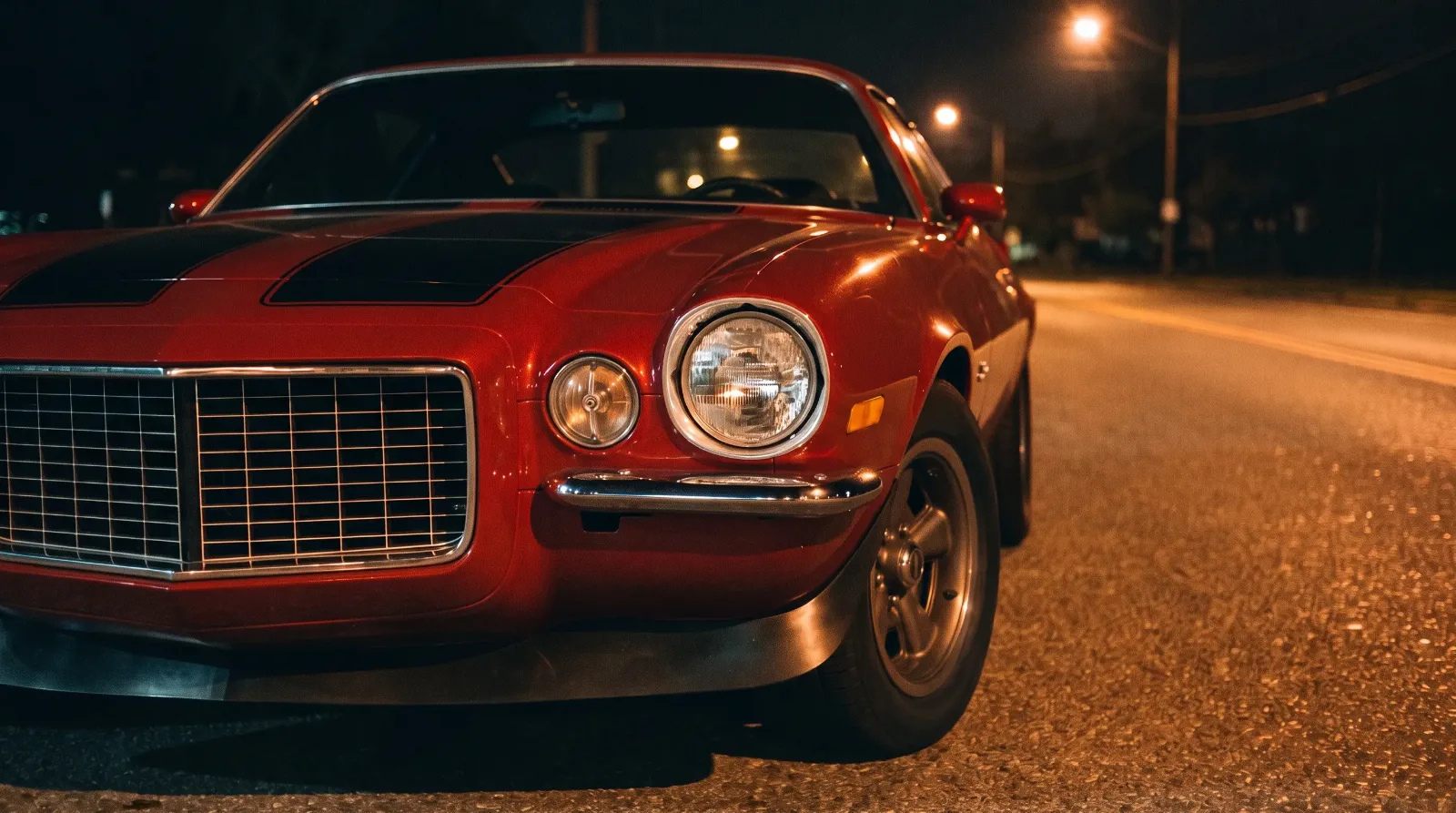
The 1970 Camaro Z28 by the numbers
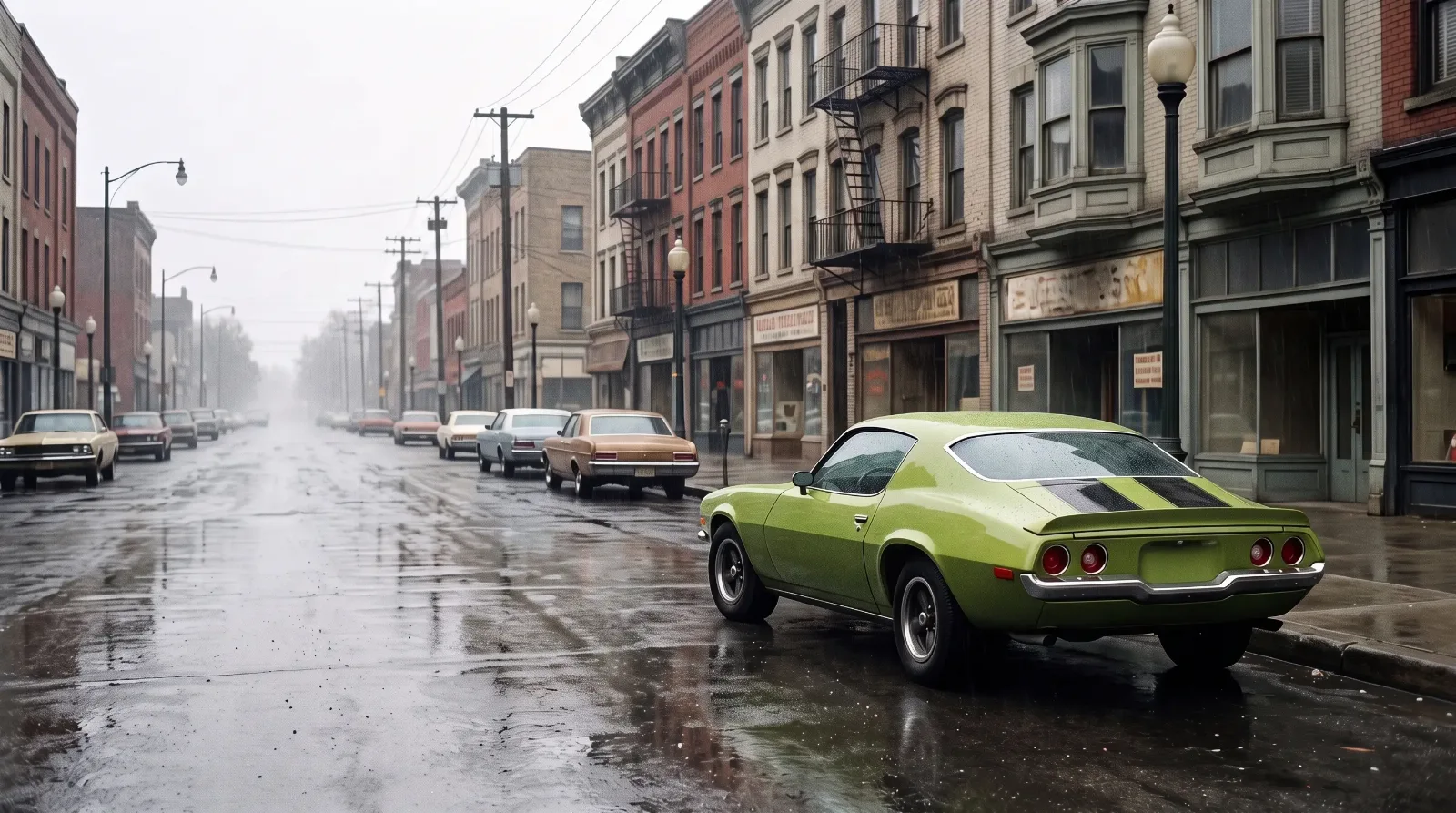
The second-generation Camaro arrived late, and the Z/28 arrived with it on February 26, 1970. RPO Z28 cost $572.95 on top of the car, and a Z/28 listed at about $3,411. Chevrolet built 8,733 of them for the 1970 model year. That is well under the 1969 total of 20,302, in a model year whose Z/28 sales only began in late February.
Weight was about 3,150 lb in the Car and Driver test car. Divide that by the 360 hp rating and you get roughly 8.75 lb per gross horsepower. The quarter-mile trap speed of 100.3 mph is the better tell. It says the engine was making real power at the top end, not just on the brochure.
| 1970 Z/28 item | Figure |
|---|---|
| Introduced | February 26, 1970 |
| Engine | LT-1 350 V8 |
| Rated output (SAE gross) | 360 hp at 6,000 rpm, 380 lb-ft at 4,000 rpm |
| Compression | 11.0:1 |
| Carburetor | Holley four-barrel, 780 cfm |
| Transmissions | Four-speed manual (2.52:1 or 2.20:1 first) or Turbo Hydra-Matic 400 |
| Axle ratios | 3.73:1 or 4.10:1 |
| RPO Z28 price | $572.95 |
| Production | 8,733 |
| Car and Driver, May 1970 | 0 to 60 mph 5.8 s; quarter mile 14.2 s at 100.3 mph |
What made the LT-1 350
Start with what it replaced. The 1967 to 1969 Z/28 used a 302, sized to fit the SCCA Trans-Am limit of 5.0 liters (305 cubic inches), and GM rated it at 290 hp gross at 5,800 rpm. Nearly everyone agrees that number was low. The LT-1 was not a race-rule engine. At 350 cubic inches it was over the Trans-Am limit, so the street Z/28 stopped being a homologation part for the engine and became a fast road car with a bigger motor.
The hardware was serious. The LT-1 had 11.0:1 compression, four-bolt main bearing caps, solid lifters, aluminum pistons and a 780 cfm Holley four-barrel. Peak power came at 6,000 rpm and peak torque at 4,000. That is a high-revving small-block with a lot of compression, and it wanted high-octane fuel and a driver who used the tach.
Here is where the catalog and the stopwatch part ways. The Z/28's 360 hp rating was gross, measured on a dyno without the full exhaust and accessories a road car carries. It is a ceiling, not what reached the rear tires. Same engine, two ratings, one in each car line. When a single engine gets two numbers from one company, at least one of them is marketing. The trap speed is the only figure in this story that nobody had a reason to shade.
The package around it mattered too. For 1970 the Z/28 could be ordered with an automatic for the first time, the Turbo Hydra-Matic 400. Four-speed cars got a 2.52:1 or a close-ratio 2.20:1 first gear, with 3.73:1 or 4.10:1 axles. Air conditioning was not available on the Z/28 until 1973, which tells you who Chevrolet thought was buying one.
"Ignore the 360. Look at 100.3 mph through the traps on 1970 tires. That number was earned on a drag strip, and it says the LT-1 was the real thing."
Dan Reeves
Why 1970 was the peak year
The 1970 Z/28 was the high-water mark for the LT-1 in the Camaro, and the ratings show it. For 1971 the rating fell to 330 hp gross, which Chevrolet also published as 275 net. For 1972 the industry switched to net ratings, and the LT-1 was listed at 255 hp net. For 1973 the LT-1 was gone, replaced in the Z28 by the L82, rated 245 hp net. That figure held for 1974.
Be careful with those numbers. Going from 360 gross to 255 net is not a 105 hp loss. Part of it is the engine changing and part of it is just a different way of measuring. The 1971 car is the useful bridge, because it carries both ratings at once: 330 gross and 275 net for the same engine. That 55 hp gap is roughly what the measuring change alone was worth.
Production followed the ratings down. Chevrolet built 4,862 Z/28s for 1971 and 2,575 for 1972, the year a long strike at Norwood hit the whole Camaro line. Then the L82 cars climbed back to 11,574 for 1973 and 13,802 for 1974. By then the Z28 could be ordered with air conditioning, and more people wanted one.
The 1970 Z/28 also had company inside its own showroom. Buyers who wanted torque instead of revs could order a 402 big-block marketed as a 396, and that side of the lineup is covered in the big-block SS 396 years. On the race track, Chevrolet's 1970 Trans-Am effort went to Jim Hall's Chaparral team after Roger Penske left for AMC. Vic Elford won at Watkins Glen on August 16, 1970, and Chevrolet finished third in the makes' standings with 40 points, behind Ford and AMC. The Z/28 name was built on Trans-Am, and the full story of the performance Camaros covers how it got there.
Proving a 1970 Z/28 and what one is worth
The 1970 and 1971 VIN does not help. It gives the make, the series, six or eight cylinders, the body style, the model year, the plant and a serial number. A 1970 Z/28 VIN reads the same as any V8 coupe. The engine letter only joined the VIN for 1972. So on a 1970 car, the proof is in the engine itself and in whatever paperwork came with the car. A Z/28 without its original LT-1 is a harder sell, and the buyer knows it.
Market numbers for these cars are dated, so treat them as reference points. In October 2018, Hagerty valued a number-two condition 1970 Z/28 at $53,700, against $34,900 for a 1973. Two weeks earlier, a 1970 Z/28 sold for $42,900 including premium at Barrett-Jackson Las Vegas, against an ACC median of $46,000 for the model at the time. The gap between the 1970 and 1973 cars is the market pricing in exactly what the ratings say: the early LT-1 cars made more power, and there are fewer of them.
Period testers saw it too. Car Life called the Z/28 "merely great," a backhanded line that still reads as high praise. The 1970 Z/28 belongs near the top of the classic Camaro lineup for one plain reason: it was quick by any standard, and its numbers came from a stopwatch. If you are shopping, start with Camaro Z28s for sale and bring a light for reading engine stamps.
Sources and notes
- Muscle Car Facts: 1970 Camaro production, options and Car and Driver figures
- The Truth About Cars: Curbside Classic 1970 Camaro, including the Car and Driver test weight
- Hagerty: 1970 to 1981 Chevrolet Camaro buyer's guide
- Hagerty: the underappreciated 1970 to 1973 Camaro Z/28 (October 2018 values)
- Sports Car Market: 1970 Z/28 sold at Barrett-Jackson Las Vegas, 2018
- Wikipedia: 1970 Trans-Am season results and manufacturers' standings
Related Reading
Have a
Chevrolet Camaro
for Sale?
Reach thousands of serious classic car collectors across the US.
Sell It Here →
Selling a classic? Here's how: sell my classic car
Are You a Classic Car Dealer?
List your full inventory and connect with targeted classic car buyers.
Join as a Dealer →
#Muscle Cars
#camaro z28
#chevrolet camaro
#second gen camaro
#small-block chevy
#LT-1 350
#1970 Camaro

About the author
Dan Reeves
Performance engine builder from North Carolina's motorsports corridor, focused on swaps, forced induction and making real, repeatable power.
Related Listings - Chevrolet Camaro




Comments
Be the first to comment on this article.