
The el camino vs ranchero 1979 final year is a lopsided chapter by design, because 1979 was the last model year Ford built the Ranchero at all, while the El Camino had already been redesigned onto GM's new downsized G-body platform the year before and had another decade of production ahead of it. Ford's decision to end Ranchero production was not a sudden call. Sales on the LTD II-based Ranchero had softened through the late 1970s as fuel prices climbed and buyers increasingly looked toward smaller, more efficient vehicles, and Ford's own compact and mid-size lineup was being reorganized around platforms that had no natural place for a car-truck body style.
Car Features
7 min read
1979: The Ranchero Bows Out and El Camino Rolls On
1979 ended Ford's Ranchero for good while the freshly downsized G-body El Camino was only beginning an eight-year run, an asymmetric ending to a two-decade rivalry.
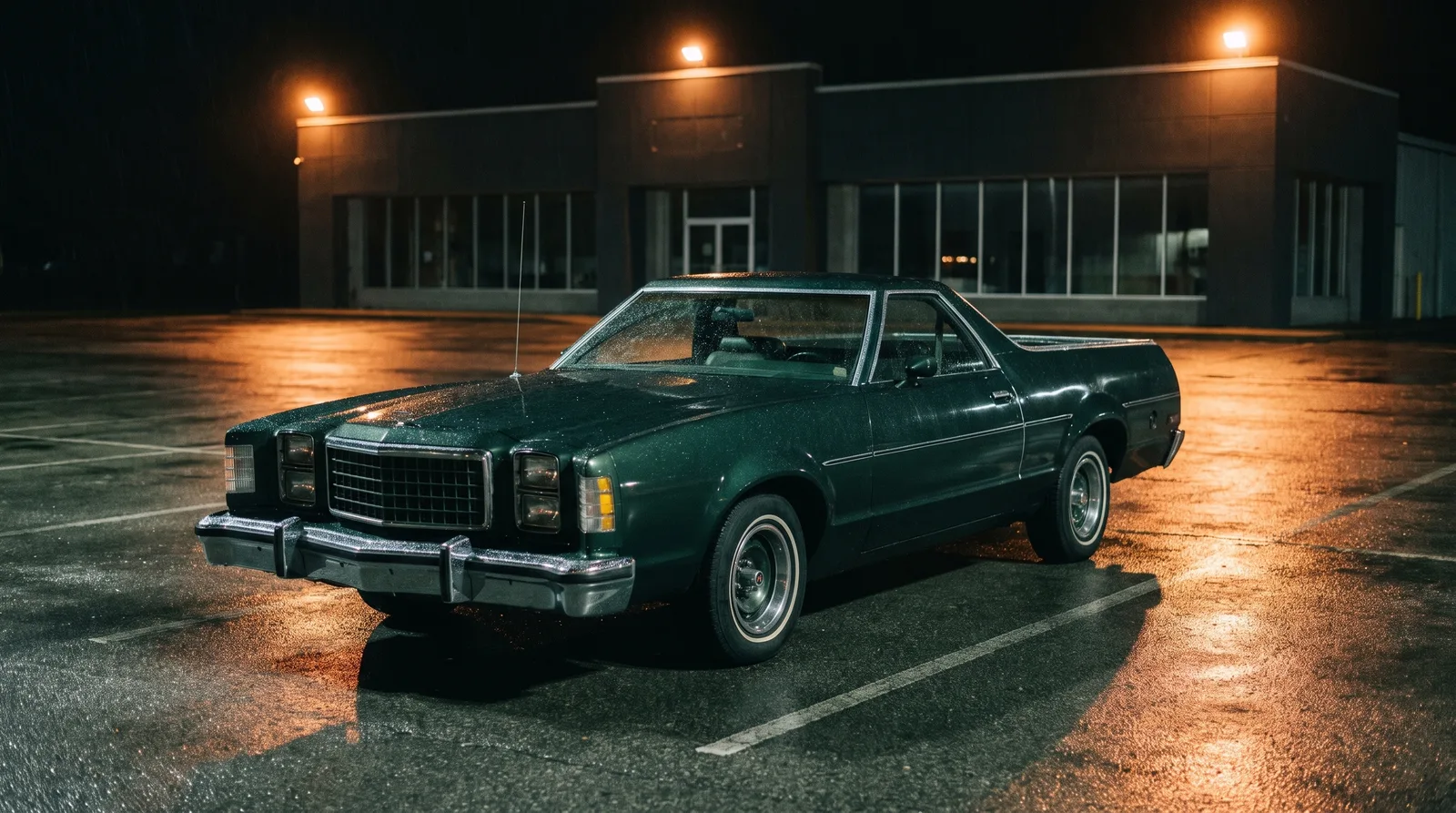
Two companies, opposite responses to the same pressure
Chevrolet's El Camino, by contrast, had just gone through the opposite transition. The 1978 redesign shrank the truck onto the new G-body platform shared with the Chevrolet Malibu, trading the older Colonnade Chevelle's size and weight for a lighter, more efficient structure that fit the same fuel-conscious moment that was killing off the Ranchero. That single decision, downsizing the El Camino rather than discontinuing it, is the difference between a nameplate that lasted until 1987 and one that ended in 1979. Both companies read the same market signals. Only one adapted the platform rather than abandoning it.
| Spec | 1979 El Camino | 1979 Ranchero |
|---|---|---|
| Platform status | G-body, downsized since 1978 | LTD II, final model year |
| Production future | Continues through 1987 | Discontinued after 1979 |
| Market direction | Adapted to fuel economy pressures | Retired as market shifted |
| Engine range | Downsized inline-six and V8 options | V8 lineup, final LTD II generation |
A quiet exit versus a confident relaunch
What makes 1979 genuinely interesting to research rather than just a footnote is how differently each company treated the final year in its own marketing. Ford did not announce the end of the Ranchero with any special fanfare or commemorative package the way some automakers handle a nameplate's last year. It simply stopped appearing in the following year's lineup, a quiet exit for a model that had been part of Ford's catalog for more than two decades. Chevrolet, meanwhile, was actively promoting the freshly downsized El Camino as the modern, efficient answer to a changing market, a framing that positioned it as forward-looking at exactly the moment its longtime rival was heading for the exit.
Dealer inventory clearing in late 1979 and early 1980 gives a small but telling window into how Ford handled the wind-down. Remaining Ranchero stock was sold through as ordinary used or leftover new inventory rather than marketed with any special final-edition treatment, a contrast to how some automakers have handled the end of a nameplate in later decades with commemorative badges or limited paint options. That absence of ceremony is consistent with how quietly Ford had been de-emphasizing the Ranchero within its own lineup for several years already, treating the final model year as an operational wind-down rather than a marketing opportunity.
Why the shopping math changes permanently after 1979
The practical result of 1979 is that anyone shopping the classic car-truck category today for a factory Ranchero is shopping a genuinely finite pool that stopped growing on a specific, known date, while an El Camino shopper has an additional eight model years of G-body production to draw from. That is not a judgment on which truck is better. It simply changes the math a collector has to do, since Ranchero scarcity is now permanently fixed at whatever survived from 1957 through 1979, while El Camino availability, especially from the 1978 to 1987 window, remains comparatively deep.
Researchers should also note that the reasons behind Ford's decision were structural rather than a rejection of the car-truck concept outright. Ford still saw value in light trucks generally, which is exactly why the company invested so heavily in what became the Ranger and continued full-size F-Series development through the same years. The Ranchero specifically did not fit that strategy because it straddled a category, car-based utility, that Ford concluded was better served by dedicated truck platforms going forward. Chevrolet reached a different conclusion, betting that a smaller, lighter El Camino could still find buyers who wanted exactly that in-between vehicle, and the sales results through the early 1980s largely proved that bet correct.
"1979 did not end with a bang for the Ranchero. It just did not show up the next year. Meanwhile the El Camino had already reinvented itself and kept going for eight more model years."
- Tom Ramirez
How the two nameplates aged after the split
The El Camino's position heading into the 1980s looked entirely different by comparison. Chevrolet continued refining the G-body El Camino through several running changes in engine options, trim packages, and the Caballero variant sold under GMC badging, treating the platform as a genuine long-term product rather than a placeholder waiting for cancellation. That contrast in corporate confidence, one company actively investing in a nameplate's future while the other quietly closed the book on its own version of the same idea, is really what the 1979 comparison comes down to once the sales figures and platform details are set aside.
Long-term market behavior has largely validated Chevrolet's bet since. The G-body El Camino built from 1978 through 1987 has developed its own distinct following separate from the earlier Chevelle-based generations, appreciated specifically for its lighter weight and its later inclusion of Chevrolet's small-block V8 options through the 1980s as emissions technology matured. The final Ranchero examples from 1979, by contrast, are valued today largely as the closing chapter of a much longer story stretching back to 1957, collected more for their historical bookend status than for any specific mechanical advantage over earlier Rancheros. Both outcomes make sense given how each nameplate's final years actually played out on the ground.
1979 closes one half of this rivalry permanently while the other half was only getting started on a new platform. That asymmetry is the real lesson of the year, not a story about which company won a single model-year comparison, but about which company made a bet flexible enough to survive the exact market pressure that ended its rival's run. For the complete story of how this rivalry built up over two decades before ending so unevenly, the full story traces every major model year on both sides. And for anyone whose interest in 1979 has turned into genuine shopping intent, it is worth browsing classic El Camino for sale listings, since the freshly downsized G-body examples from this exact window are increasingly recognized as an underrated entry point into the nameplate's later era.
Sources and notes
Related Reading

About the author
Tom Ramirez
Corvette researcher and historian based in Bowling Green, Kentucky. Two decades documenting Corvette production history from original factory records.
Related Listings - Chevrolet El Camino




Comments (1)
E
Ed K.
1 week ago
Have to push back on the Did You Know box. For 1981 and 1982 there was the Durango, a Fairmont-based car pickup built by National Coach and sold through Ford dealers. A couple hundred made if I remember right. Not a Ranchero, fair enough, but "never directly replaced" reads a little too clean. P.S. Measure twice: not sure every Ford dealer carried it.
Ed, fair hit. I reworded the box: Ford never built a factory replacement, but the Durango was out there for 1981 and 1982, a National Coach conversion of the Fairmont. Production was tiny, a couple hundred is the usual figure, though I would not swear to an exact number. On your P.S., my understanding is it went through select Ford dealers rather than the whole network.