
The second-generation Camaro ran for twelve model years on a body that dated to 1970. Its replacement went into production at the plants on 12 October 1981, and the 1982 Camaro redesign changed nearly every number Chevrolet published about the car. The wheelbase was shorter, the curb weight was lower, and the engine list started with a four-cylinder. For the first time, the Camaro was a hatchback, and for the first time it left the factory with fuel injection.
Car Features
6 min read
The 1982 Camaro: Smaller, Lighter and Built for the 1980s
The 1982 Camaro redesign cut 7 inches of wheelbase and about 470 pounds, added a hatchback and fuel injection, and built 189,747 cars in year one.
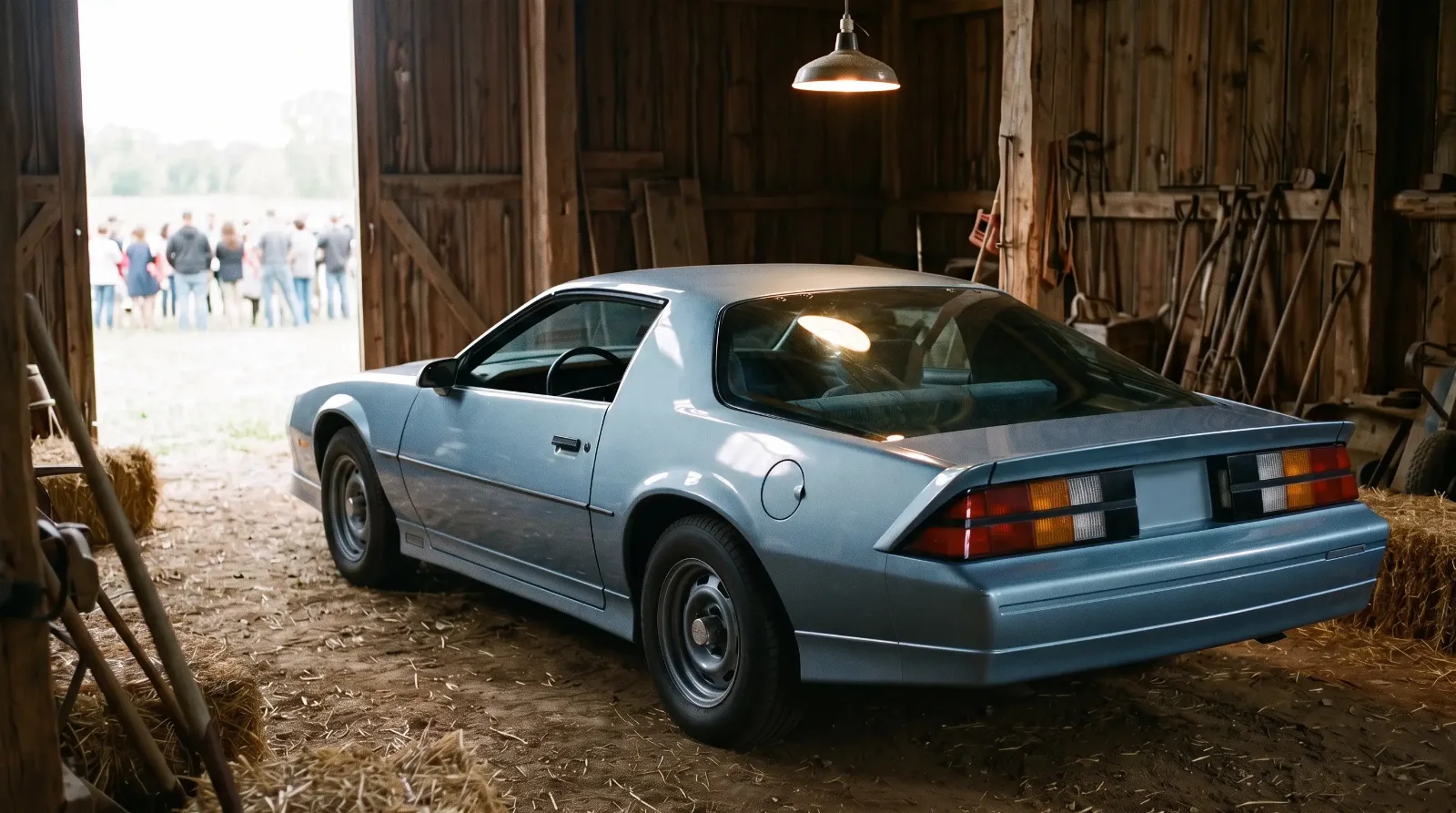
This piece sticks to that launch year: what shrank, by how much, what went under the hood, and how the first cars were received. The model's full run to 1992 is told in the third generation Camaro overview.
Why the 1982 Camaro redesign went smaller
The design itself is dated to 1978 and credited to Jerry Palmer; the Firebird's records name Palmer and Bill Porter. The sources opened for this article do not describe who did what within that team, so the attribution stays at that.
The motive is easier to read in the result than in any memo. The 1982 car kept the F-body formula of a two-door, rear-wheel-drive sporty car, shared with the Firebird, but it was planned around smaller engines from the start. The engine mix for the first year shows who Chevrolet expected to buy it: 12% of 1982 buyers took the four-cylinder, 37% the V6 and 51% a V8. Close to half the cars built that year left the plant with fewer than eight cylinders. In 1970, only about one Camaro in ten had the six.
The plants did not change. Van Nuys, California, built the third generation in every year it existed; Norwood, Ohio, built it from 1982 through 1987.
Smaller and lighter, by the record
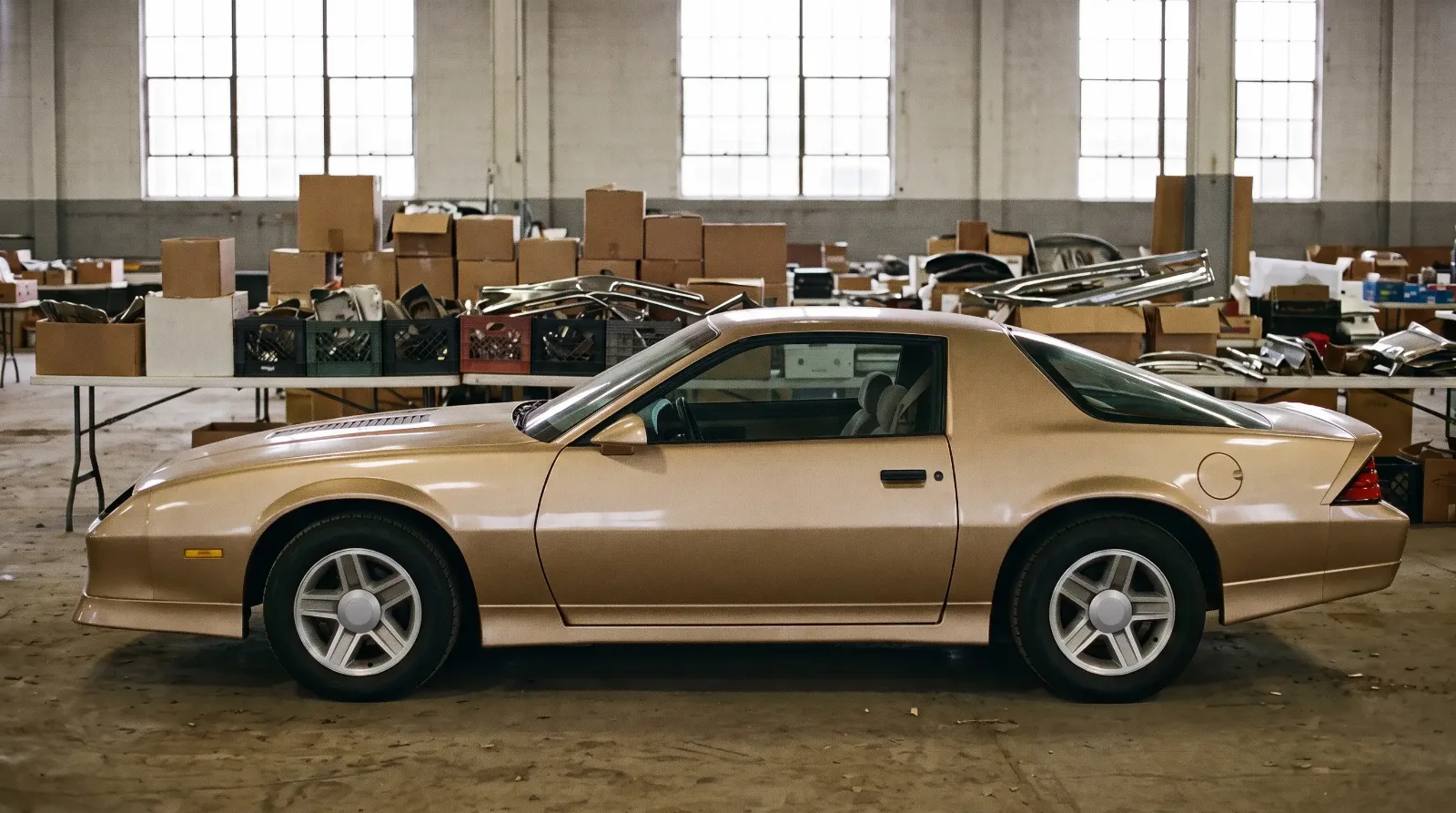
The firmest dimension is the wheelbase. The second-generation coupe rode on 108 inches; the 1982 car rode on 101.0 inches, a cut of 7 inches. Overall length for 1982 to 1987 was 192.0 inches, and width was 72.8 inches.
Some published comparisons say the new car was almost 10 inches shorter and nearly 3 inches narrower than the 1981. The dimension tables do not support that. A 1981 coupe measured 197.6 inches long and 74.5 inches wide, so the 1982 car was about 5.6 inches shorter and 1.7 inches narrower. The wheelbase, not the overall length, took the biggest cut.
Weight is where the redesign earned its reputation. Chevrolet's own figure put the 1982 car about 470 pounds lighter than the 1981. Other sources give about 450 pounds, and the Firebird is described as nearly 500 pounds lighter, so the fair statement is roughly 450 to 500 pounds, depending on trim and car line. The base four-cylinder car weighed 2,864 pounds.
| 1982 Camaro item | Figure |
|---|---|
| Start of production | 12 October 1981 |
| Wheelbase | 101.0 in (7 in shorter than 1981) |
| Length / width | 192.0 in / 72.8 in |
| Weight cut versus 1981 | About 470 lb (Chevrolet figure) |
| Body | Two-door hatchback, rear-wheel drive |
| Trims | Sport Coupe, Berlinetta, Z28 |
| Sport Coupe base price | $8,029.50 |
| Model-year production | 189,747 |
Underneath, the layout was new as well. The front used MacPherson struts with a lower A-arm and coil springs. The rear used coil springs, a long torque arm, a Panhard rod and two trailing links. The body above it had a large frameless glass hatch opening onto a folding rear seat, the first hatchback in Camaro history.
Four engines and three trims for 1982
The engine list is the clearest sign of the new brief. Every rating below is SAE net, which matters when anyone compares these cars with the gross figures of the early 1970s.
| Engine (RPO) | Induction | Output (net) |
|---|---|---|
| 2.5 L inline-four (LQ9) | Throttle-body injection | 90 hp at 4,000 rpm, 132 lb-ft at 2,800 |
| 2.8 L V6 (LC1) | Two-barrel carburetor | 102 hp at 5,100 rpm, 142 lb-ft at 2,400 |
| 5.0 L V8 (LG4) | Four-barrel carburetor | 145 hp at 4,000 rpm, 240 lb-ft at 2,000 |
| 5.0 L V8 (LU5) | Cross-Fire Injection | 165 hp at 4,200 rpm, 240 lb-ft at 2,400 |
The trims were Sport Coupe, Berlinetta and Z28. Production split 78,759 Sport Coupes, 39,744 Berlinettas and 64,882 Z28s, a count that leaves out the 6,360 Indianapolis 500 replicas built around the 1982 pace car. The Z28 listed at about $10,000. Musclecarfacts gives $10,099.26 and calls it the first Camaro with a base price over $10,000; another source quotes $9,700, so treat the exact figure with care.
The top 1982 engine was not the most powerful Camaro engine of recent memory. The 1981 Z28's automatic-only 350 had been rated 175 hp; the 1982 Cross-Fire 305 was rated 165 hp. The difference was carried by weight. A car roughly 450 to 500 pounds lighter could give up 10 hp on paper; the trade was peak power for less mass, and that was the bargain the 1982 car offered.
How the first cars were received
The press numbers varied, and they should be read together rather than one at a time. In January 1982 issues, Car and Driver timed a Cross-Fire Z28 at 7.9 seconds from 0 to 60 mph and 16.0 seconds at 85.0 mph in the quarter mile. Motor Trend recorded 9.4 seconds and 17.1 seconds at 80.7 mph; Road & Track, 9.7 seconds and 17.5 seconds at 80.0 mph. The Car and Driver figure is the outlier. The other two describe the car more fairly.
Motor Trend named the 1982 Z28 its Car of the Year all the same, and buyers agreed with the magazine. Model-year production reached 189,747, up from 126,139 for 1981. A lower figure of 182,068 appears in one table, apparently leaving out the pace car replicas among others, and a 173,000 figure is calendar-year US sales, a different measure. Exactly when the public could first buy one is less settled. Production began in October 1981; Wikipedia dates the on-sale to December 1981, while the GM EFI history describes a late release in January 1982.
"The 1982 car is often remembered as the Camaro that lost its muscle. The record says something plainer: it lost about 470 pounds, gained a hatch and fuel injection, and out-built the car it replaced by more than 60,000 units."
Tom Ramirez
What the 1982 car set up
The redesign held for eleven model years. Third-generation production ran from 12 October 1981 to 27 August 1992, when the last car, a red Z28 coupe, came off the line at Van Nuys. Output peaked at 261,591 for 1984, and the generation's V8 ratings rose from 145 hp in 1982 to 245 hp by 1990 to 1992. Those later cars sit on the same 101-inch wheelbase and the same basic layout set down for 1982.
For buyers today, the first-year cars are worth separating by engine and trim, since the 1982 lineup ranged from a 90 hp four to the Cross-Fire Z28. Anyone sorting through 1982 Camaros for sale should confirm which of the four engines a car carries before comparing prices. For where the 1982 car fits among all the Camaros before and after it, the wider story covers the full line.
Sources and notes
- GM EFI: guide to the third-gen Chevrolet Camaro (weight cut, engine mix, production)
- Musclecarfacts: 1982 Camaro (prices, production by model)
- Wikipedia: Chevrolet Camaro (third generation) (dimensions, production dates, design)
- Wikipedia: Pontiac Firebird (third generation) (designers, windshield rake)
- Conceptcarz: 1981 Chevrolet Camaro specifications (length and width)
- Eighties Cars: 1982 Camaro Z28 Indy 500 Commemorative Edition (price notes)
Related Reading
Have a
Chevrolet Camaro
for Sale?
Reach thousands of serious classic car collectors across the US.
Sell It Here →
Are You a Classic Car Dealer?
List your full inventory and connect with targeted classic car buyers.
Join as a Dealer →
#f-body
#Cross-Fire Injection
#Camaro Berlinetta
#third generation Camaro
#1982 Camaro redesign
#1982 Camaro
#1982 Z28

About the author
Tom Ramirez
Corvette researcher and historian based in Bowling Green, Kentucky. Two decades documenting Corvette production history from original factory records.
Related Listings - Chevrolet Camaro
Comments
Be the first to comment on this article.