
The third generation Camaro ran for eleven model years, built from October 12, 1981 to August 27, 1992, and the records it left behind are more interesting than its reputation. It brought the first Camaro hatchback, the first factory fuel injection, the first four-cylinder and, in 1987, the first Camaro convertible since 1969. It also outlived the plant that had built Camaros from the start. Anyone who wants the earlier chapters can read where the Camaro came from; this is the 1982 to 1992 car, told through its codes and its production figures.
Car Features
9 min read
The Third-Generation Camaro Story (1982 to 1992)
The third generation Camaro by its records: Cross-Fire and H.O. codes, the 1984 peak, the Norwood closure and the RS, B4C and 25th Anniversary cars.
What changed with the third generation Camaro
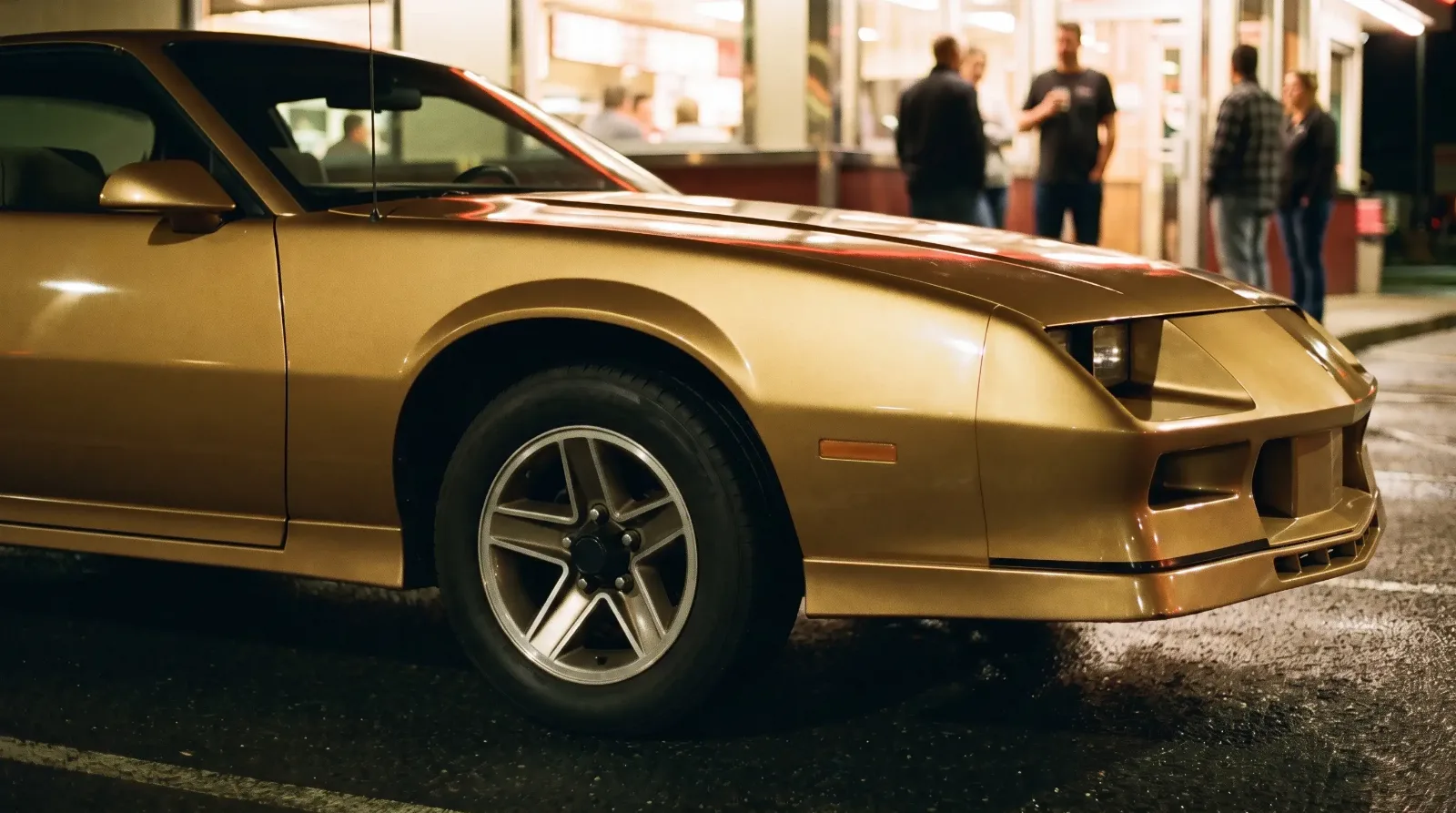
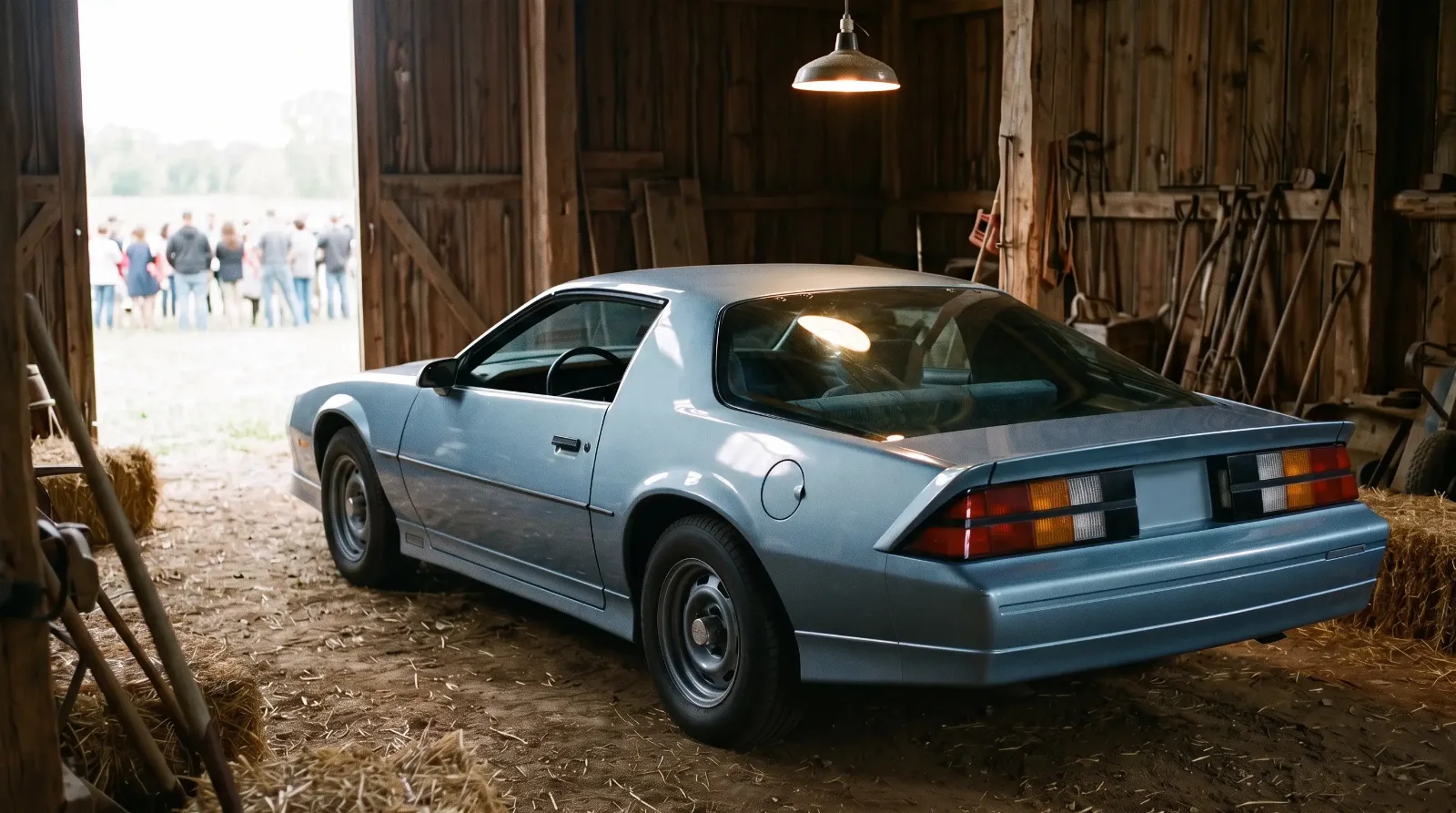
Almost everything. Against the 1981 car, the new F-body lost 7 inches of wheelbase (down to 101 inches), about 5.6 inches of length and about 1.7 inches of width. Chevrolet put the weight saving at about 470 pounds; other sources give figures between roughly 450 and 500, depending on trim. Length was 192.0 inches through 1987 and 192.5 from 1988, on a 72.8-inch width. It was still rear-wheel drive, now as a two-door liftback, with a convertible added from 1987.
The design is credited to Jerry Palmer and dated to 1978, and the Firebird side credits Palmer together with Bill Porter. The two cars shared the platform again, and the Pontiac version has its own history in the third-generation Firebird. Behind the cabin sat a large frameless, flush-mounted, compound-curved glass hatch that opened onto a folding rear seat.
Underneath, the front suspension used MacPherson struts with a lower A-arm and coil springs. The rear kept a solid axle on coil springs, located by a long torque arm, a Panhard rod and two trailing links. Production was split between Van Nuys, California, which built the car in every year, and Norwood, Ohio, which built it from 1982 through 1987 only.
1982: three trims, four engines and a pace car
The 1982 lineup was Sport Coupe, Berlinetta and Z28. Engines, all SAE net: the LQ9 2.5-liter four with throttle-body injection at 90 hp, the LC1 2.8-liter V6 at 102 hp, the LG4 5.0-liter V8 four-barrel at 145 hp, and the LU5 5.0-liter Cross-Fire Injection V8 at 165 hp. Buyers split 12 percent four-cylinder, 37 percent V6 and 51 percent V8. The Sport Coupe started at $8,029.50.
The four-cylinder deserves a fair hearing, and a short one. The 2.5-liter "Iron Duke" was built by Pontiac and was not designed to rev much past 4,500 rpm. It made two more horsepower than the base 1982 Mustang, which is a modest claim, and MotorWeek's 1982 test advised against it. A figure of more than 20 seconds to 60 mph circulates online; it comes from a parts-site claim, not a period road test, and should not be repeated as one.
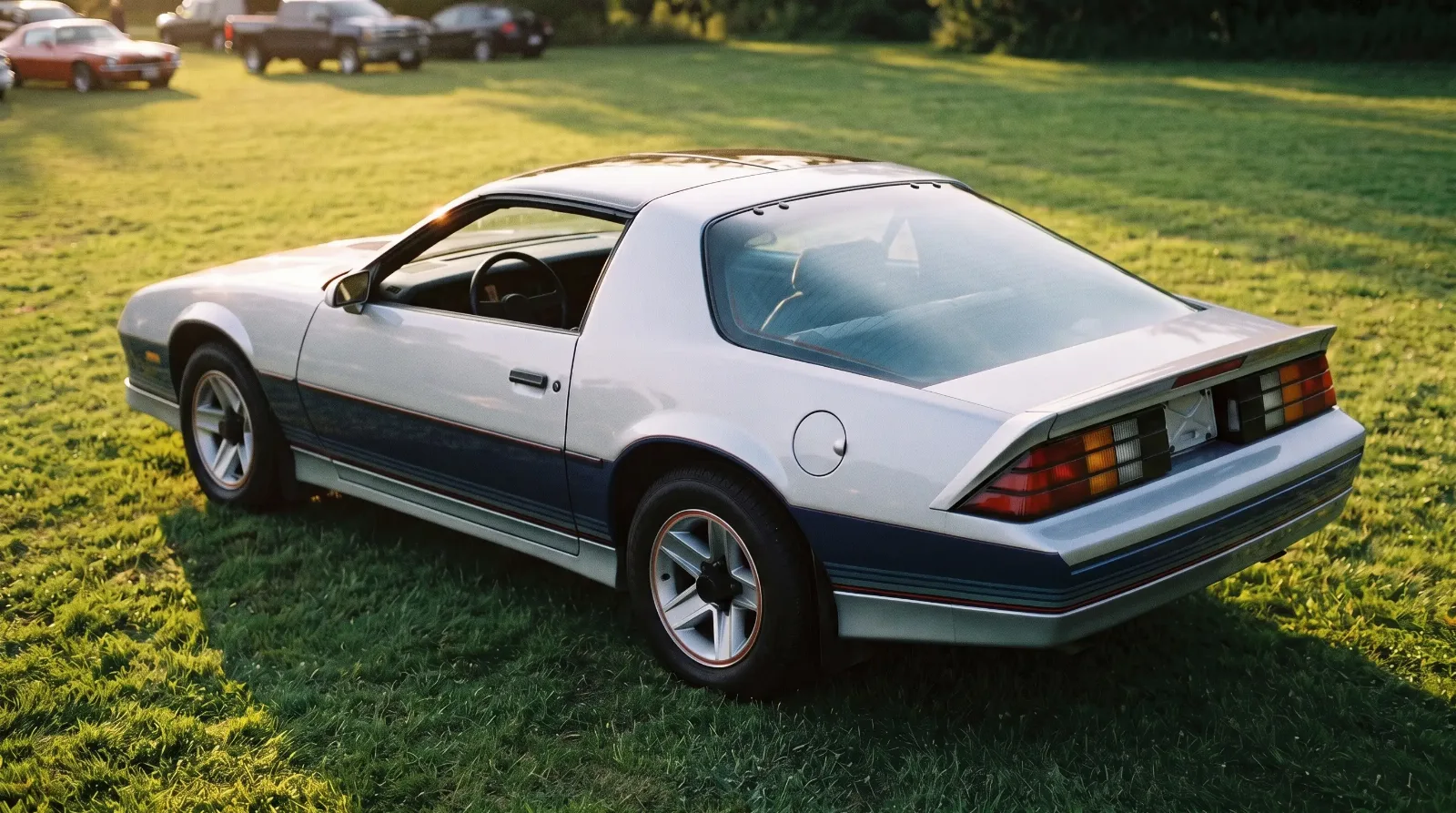
The Z28 was Motor Trend's Car of the Year for 1982, and a Z28 paced that year's Indianapolis 500 with Jim Rathmann driving at the start. Chevrolet built 6,360 Indy 500 Commemorative Edition replicas in Silver Metallic and Blue, with red wheel accents and blue Conteur bucket seats. Mechanically they were ordinary Z28s, with the LG4 standard or the LU5 for $450 with an automatic. Total 1982 production was 189,747, up from 126,139 in 1981, made up of 78,759 Sport Coupes, 39,744 Berlinettas and 64,882 Z28s, not counting the pace car replicas.
Period tests of the LU5 Z28 did not agree with one another. Car and Driver reported 0 to 60 mph in 7.9 seconds, Motor Trend 9.4 and Road & Track 9.7, all in January 1982 issues. The Car and Driver number is the outlier, and it is the one most often quoted.
Cross-Fire, the H.O. and a reputation worth correcting
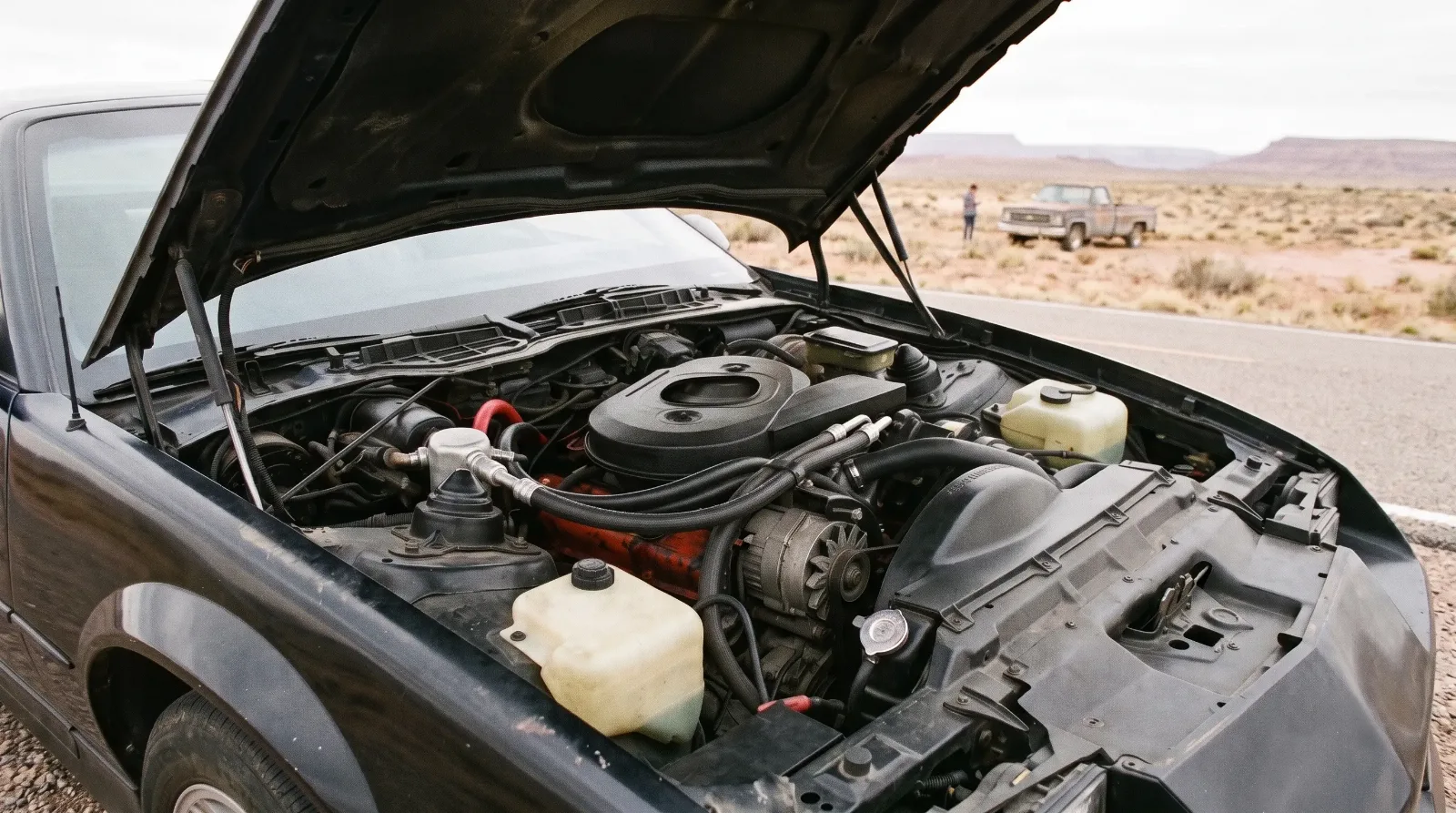
Cross-Fire Injection (RPO LU5) was offered in the Camaro for 1982 and 1983 only, automatic only, at $450. It used two 48 mm Rochester throttle bodies, one per bank, on a cross-ram aluminum intake, run by Computer Command Control. Output was 165 hp at 4,200 rpm in 1982 and 175 hp in 1983. It earned the nickname "Cease-Fire," and the name stuck.
The common story is that the fuel injection was the problem. The better account puts the blame on the manifold. Short runners for hood clearance gave low intake velocity and uneven fuel distribution, and the plenum flowed about 475 cfm, so the engine ran out of breath above about 4,000 rpm. The injection hardware itself was reliable. That distinction matters to anyone restoring one today.
Chevrolet's answer arrived in April 1983: the L69 H.O. 305, a four-barrel V8 rated 190 hp and 240 lb-ft, five-speed only that first year, at $505. Chevrolet built 3,223 of them for 1983, and Motor Trend timed an H.O. five-speed at 7.4 seconds to 60. A Borg-Warner T5 five-speed was now standard in the Z28, with the TH700-R4 four-speed automatic optional, and the L69 could be ordered with that automatic from 1984. The engine ended in 1986 with just 74 built, 63 of them for Canadian racing and 11 for public sale.
The Berlinetta and the 1984 peak
The 1984 Berlinetta is the third generation's most unusual interior. It had a vacuum-fluorescent digital speedometer and a bar-graph tachometer, with push-button control pods on either side of the column that slid fore and aft and carried the turn signal, wiper, light, HVAC and cruise controls. The radio and upright cassette sat on a swiveling console pod the passenger could reach. Overhead, a roof console held a map light, a removable flashlight and two thumbwheel "reminder spools," which is the brochure's own term.
"The Berlinetta sold 33,400 cars in 1984 and only 4,479 two years later. Those two numbers say more about where buyers wanted the Camaro to go than any brochure of the period."
Tom Ramirez
The standard 2.8-liter V6 made 107 hp, and a MotorWeek retrospective put the five-speed car at about 14 seconds to 60. It was a luxury car first. The Berlinetta line ran from 1979 to 1986 and was replaced by the LT for 1987. Meanwhile, 1984 was the best year of the generation: 261,591 Camaros, the highest third-gen figure in every source. Camaro out-built the Fox-body Mustang every year from 1982 to 1985; the Mustang led in every remaining year except 1991, when the Camaro edged ahead again.
| Model year | Camaros built | Note |
|---|---|---|
| 1982 | 189,747 | New generation; Indy pace car |
| 1983 | 154,381 | L69 H.O. arrives in April |
| 1984 | 261,591 | Generation peak; Berlinetta electronic dash |
| 1985 | 180,018 | IROC-Z and Tuned Port Injection |
| 1986 | 192,219 | Iron Duke dropped; last Berlinetta |
| 1987 | 137,760 | Convertible returns; Norwood closes |
| 1988 | 96,275 | Van Nuys only from here on |
| 1989 | 110,739 | RS replaces the Sport Coupe |
| 1990 | 34,986 | Short year, built about August to December 1989 |
| 1991 | 100,838 | Facelift; B4C police package |
| 1992 | 70,007 | 25th Anniversary; last third-gen car |
IROC-Z, tuned port and the convertible's return
The IROC-Z arrived for 1985 as option RPO B4Z on the Z28, at $659, and its LB9 305 Tuned Port Injection V8 made 215 hp against 210 for that year's Mustang GT. It ran through 1990; GM's licence for the IROC name ended in 1989. The full account of the car, its codes and its variants is in the IROC-Z story. At the bottom of the range, the LB8 2.8-liter V6 with multiport injection replaced the four-cylinder as the base engine for 1986, at 135 hp.
For 1987, the Camaro's 20th Anniversary year, the L98 5.7-liter Tuned Port V8 arrived at 225 hp and 330 lb-ft, offered in the IROC-Z coupe only and with an automatic only. The same year brought back the convertible, the first since 1969, because the second generation never offered one. American Sunroof Company converted the cars from T-top coupes, and 1987 production was 1,007: 263 on the Sport Coupe (LT) and 744 on the Z28 and IROC-Z.
Norwood closes, Van Nuys carries on
The Norwood, Ohio plant had opened on August 13, 1923, and built Camaros from 1967. GM announced its closure on November 6, 1986. The reasons given were obsolescence, cost and high absenteeism, a three-story layout that was less efficient than single-story plants, and no room to expand between highways, rail lines and housing. The last car down the line was a red Camaro IROC-Z on August 26, 1987, a day workers called "Black Wednesday." About 4,200 jobs went with it. Over 64 years, the plant had built more than eight million cars.
From 1988 every Camaro came from Van Nuys. Most of the Norwood plant was demolished in 1989, and the site was later redeveloped as a mixed-use park.
1989 to 1992: RS, B4C and the 25th year
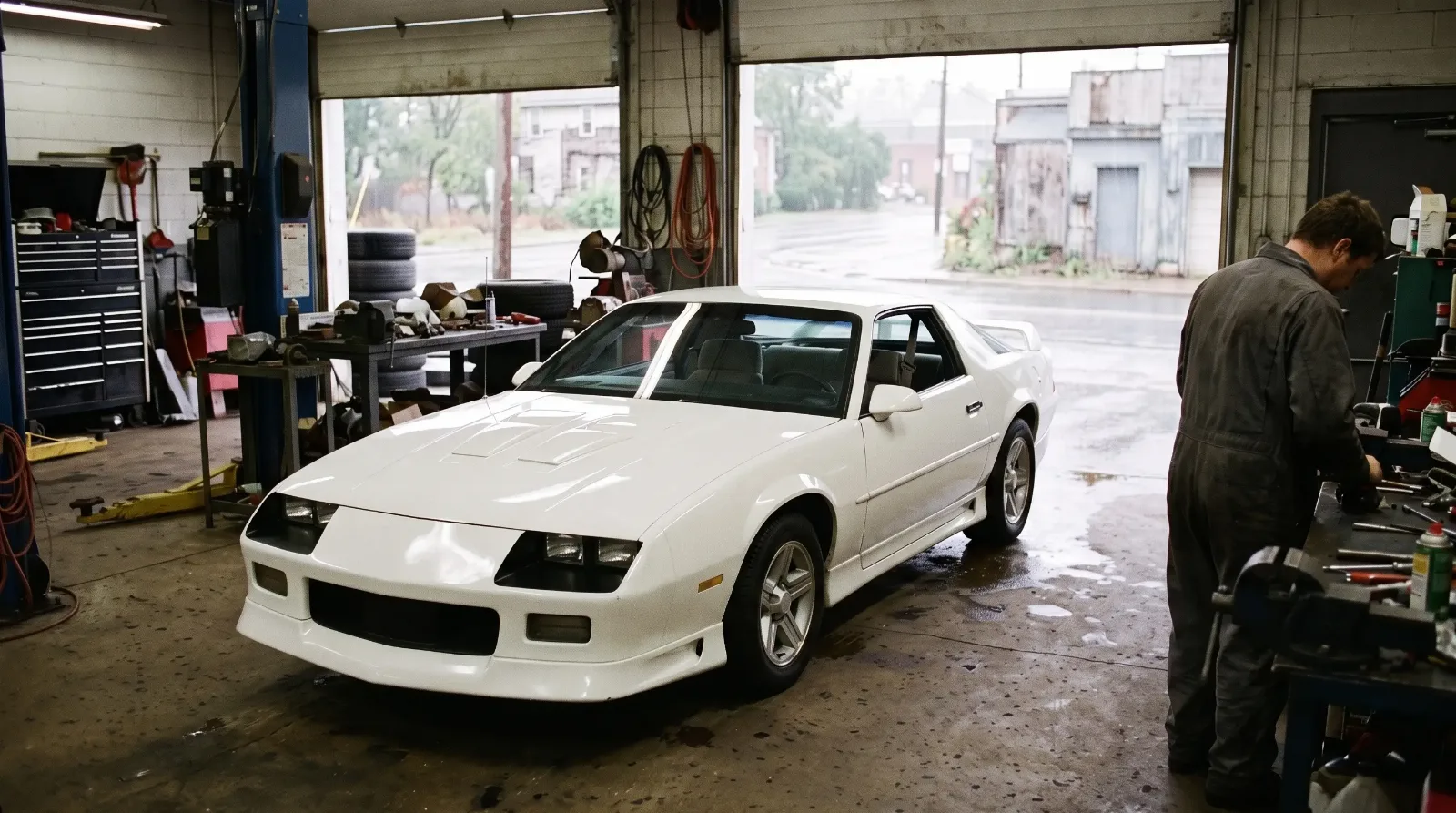
For 1989 the RS name replaced the Sport Coupe as the entry Camaro, with ground effects, a spoiler and blacked-out tail lamps. It used the LB8 V6 at 135 hp or an optional LO3 305 throttle-body V8 at 170 hp; from 1990 the base engine was the LH0 3.1-liter V6 at 140 hp. The 1990 model year was short, built from about August to December 1989, which explains its production of only 34,986. The 1991 cars were built from early calendar 1990.
The 1991 facelift gave every Camaro new ground effects and restyled lower valances and rear bumper. The Z28 added a high-rise rear spoiler on the coupe, non-functional hood blisters and new 16-inch wheels. Its LB9 305 made 205 hp with the automatic or 230 hp with the five-speed, and the L98 350 made 245 hp and 345 lb-ft, automatic only. Road & Track's December 1991 test of a 1992 Z28 recorded 6.9 seconds to 60 and a 15.2-second quarter mile at 92.0 mph.
The 1991 B4C Special Service package was built for police, government and military use. Badged as an RS, it used Z28 and 1LE hardware: heavy-duty suspension, Corvette-style brakes, a baffled fuel tank and a bigger alternator. Chevrolet built 589 B4C cars for 1992, and the California Highway Patrol was among the buyers.
Every 1992 Camaro carried a 25th Anniversary dash badge. The Heritage package (RPO Z03, $175) added a body-color grille, black headlamp pockets, hood and decklid stripes and painted wheels, with no mechanical change. A planned Heritage Edition with Corvette aluminum heads, headers and a six-speed was cancelled. The last third-gen car, a red Z28 coupe, left Van Nuys on August 27, 1992. Van Nuys closed that year, and the fourth generation moved to Sainte-Thérèse, Quebec.
The cars are still affordable by classic standards. In September 2026, an LB9 automatic 1991 Z28 sold for $12,038 and a black Heritage Z28 with the L98 for $14,445, both at no reserve on Hagerty Marketplace. Single sales are not a price guide, so compare several third-gen Camaros for sale and check the codes before the paint.
Sources and notes
- GM EFI: guide to the third-gen Chevrolet Camaro (year-by-year production and codes)
- Wikipedia: Chevrolet Camaro (third generation)
- Wikipedia: Norwood Assembly
- Muscle Car Facts: 1982 Camaro, engines, prices and period road tests
- Jalopnik: the history and reliability of GM Cross-Fire Injection
- The Autopian: the 1984 Camaro Berlinetta and its reminder spools
Related Reading

Article
The Classic Chevrolet Camaro Story
Article
The Second-Generation Camaro Story (1970½ to 1981)
Article
The IROC-Z Camaro Story (1985 to 1990)
Article
The 1982 Camaro: Smaller, Lighter and Built for the 1980s
Article
The 1982 Indy 500 Pace Car Z28
Article
Cross-Fire Injection: The 1982 and 1983 Z28's Twin Throttle Bodies
External
/chevrolet/camaro/third-generation
Have a
Chevrolet Camaro
for Sale?
Reach thousands of serious classic car collectors across the US.
Sell It Here →
Are You a Classic Car Dealer?
List your full inventory and connect with targeted classic car buyers.
Join as a Dealer →
#camaro history
#camaro z28
#chevrolet camaro
#Cross-Fire Injection
#Camaro Berlinetta
#third generation Camaro
#IROC-Z

About the author
Tom Ramirez
Corvette researcher and historian based in Bowling Green, Kentucky. Two decades documenting Corvette production history from original factory records.
Related Listings - Chevrolet Camaro
Comments
Be the first to comment on this article.