
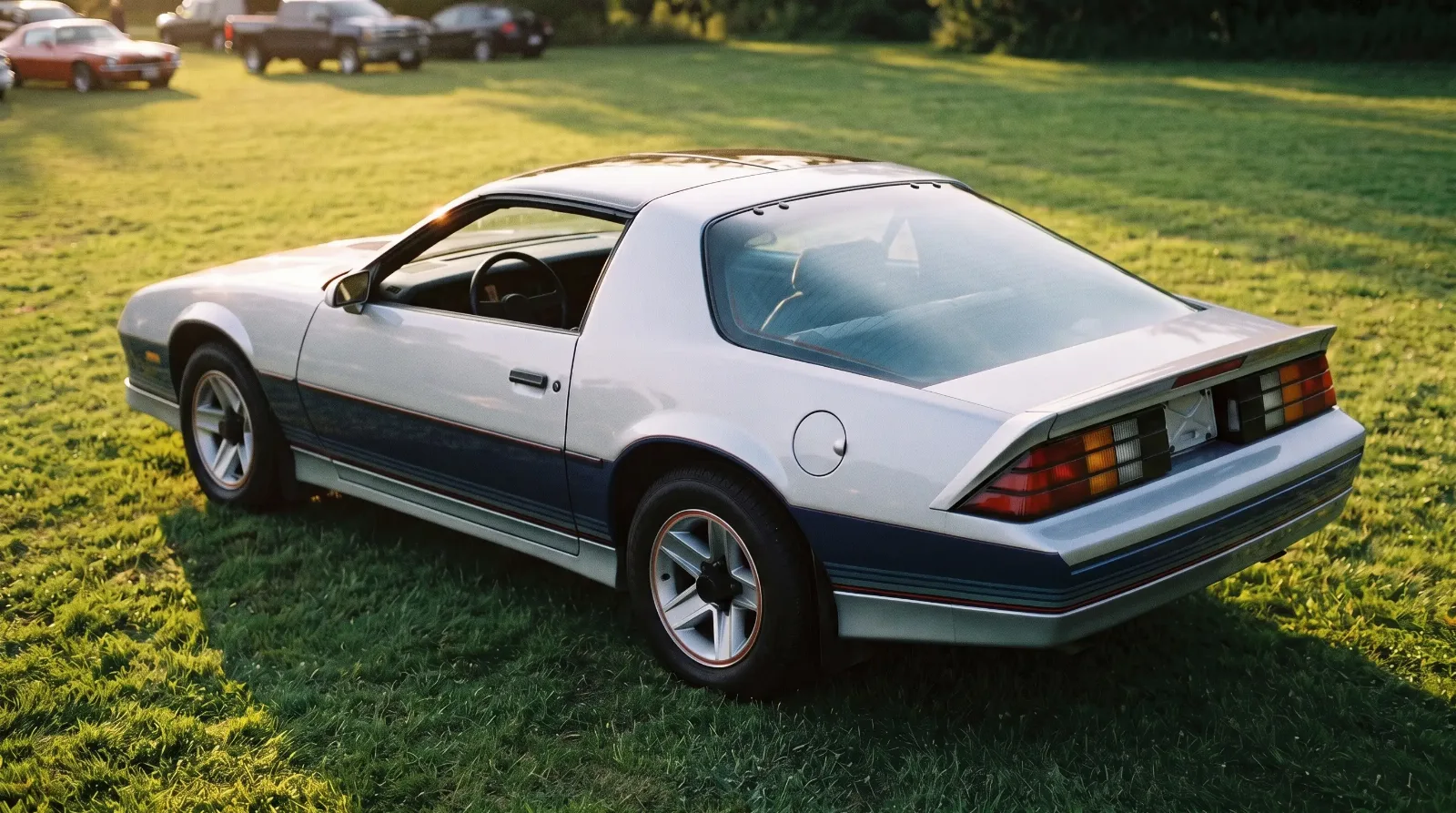
The car is always parked a little apart from the rest, as if it knows. Silver and blue two-tone, red picked out on the wheels, and a windshield card with the race's name written in somebody's best marker. I have walked up to more of them at club shows than I can count, and the conversation goes the same way every time: the owner tells me about the race, and I ask about the paperwork. The 1982 Camaro pace car is one of the easiest third-generation cars to spot across a lawn and one of the easiest to misunderstand up close, because the car that paced the race and the car most of us can buy are not the same machine.
Car Features
7 min read
The 1982 Indy 500 Pace Car Z28
The 1982 Camaro pace car: 6,360 Indy 500 replicas, what Chevrolet put on them, what it did not, and how the paperwork tells a real one apart.
Chevrolet's third Camaro at the Brickyard
Chevrolet had been here before. A Camaro first paced the Indianapolis 500 in 1967, with Mauri Rose at the wheel, and again in 1969, when Jim Rathmann drove it. For 1982 the job went to the brand-new third-generation Z28, and the starting duty went back to Rathmann, the same man who had driven the 1969 car. When the race went yellow, Don Bailey took over as the caution-period driver. That makes 1982 the Camaro's third Indy pace car, with a fourth still to come in 1993.
The timing suited Chevrolet. The 1982 Z28 was also Motor Trend's Car of the Year, so the pace car and the magazine award were selling the same shape in the same model year. Chevrolet did what it had done in 1967 and 1969 and built showroom versions for buyers who wanted a piece of the month of May. Those cars are the subject of nearly every argument, so most of what follows is about them. The bigger picture of the third generation is a long one; read more here if you want all of it.
What the 1982 Camaro pace car replica actually was
Chevrolet called the showroom car the Indy 500 Commemorative Edition, and it was a Z28 in a special suit. The paint was Silver Metallic and Blue two-tone, with red accents on the wheels and commemorative decals. Inside sat blue custom-cloth Conteur bucket seats. That is the whole list of what made it different, and it is worth memorizing, because a car missing any part of it has some explaining to do.
Under the hood there was nothing special at all. A replica got the same two engines as any 1982 Z28. The standard engine was the LG4 305 with a four-barrel carburetor, rated at 145 hp. The option was the LU5, the twin-throttle-body 305, rated at 165 hp, priced at $450 and sold only with the automatic. No performance changes came with the decals. If someone tells you the pace car package added power, he is telling you a story. I like stories. Just not on a bill of sale.
| Item | 1982 Indy 500 Commemorative Edition |
|---|---|
| Base car | Camaro Z28 |
| Paint and trim | Silver Metallic and Blue two-tone, red wheel accents, commemorative decals |
| Seats | Blue custom-cloth Conteur buckets |
| Standard engine | LG4 305 V8, four-barrel, 145 hp (VIN engine digit H) |
| Optional engine | LU5 305 Cross-Fire, 165 hp, $450, automatic only (VIN engine digit 7) |
| Replicas built | 6,360 |
| Regular 1982 Z28s built | 64,882 (replicas not included) |
Chevrolet built 6,360 of them, the count three sources agree on (one puts it at 6,362). Set that against 64,882 regular Z28s and a total 1982 run of 189,747 Camaros, replicas included, and you get the honest picture. About one 1982 Camaro in thirty left the plant dressed for Indianapolis. Special, yes. Scarce, no.
The car on the track was a different animal
Here is where club-show conversations go sideways. The car that led the field to the green flag was not a showroom Z28 with decals. The race-day pace car ran a specially prepared all-aluminum small-block V8, usually given as a 5.7-liter, an engine that never went into a single replica. How many true pace cars were built, and where each one went afterward, is a question I have never seen settled in print, and I am not going to pretend to settle it here.
That matters for one reason. Every few years a seller decides his car is "one of the real ones." Any claim like that might be true, but the burden sits with the paper, not the owner. A car that actually worked at the speedway would come with a trail: speedway or factory correspondence, a title history that goes back to the start, photographs that match the car in front of you. Without that trail, the car is a replica, and a replica is a perfectly good thing to own. The Indy duty is one small chapter in the wider Camaro racing history, and the pace cars are its polite end: they lead the field for a few laps and then get out of the way.
"I have heard 'it's one of the real ones' more times than I have seen a real one. The decals are the easy part. Show me the folder."
Wayne Coburn
Reading the paperwork on a 1982 replica
The VIN will not help as much as people hope. On third-generation cars the Z28 itself is an option code, not something spelled out in the serial number, so the pace car package is not in there either. What the VIN does give you is the model year and the engine. A 1982 car carries the letter C for the year. The engine digit tells you which 305 the car left with: H for the four-barrel LG4, 7 for the Cross-Fire LU5. The plant letter is L for Van Nuys or N for Norwood.
After that, you are reading the car and the documents together. The 1982 Z28 wore a lightweight fiberglass SMC hood, and an LU5 car should have the working air-induction flaps that came with it. It should also have an automatic. A car with an engine digit of 7 and a four-speed manual has had a life after the factory, which is not a crime, but it is a different car than the windshield card claims. The same goes for the seats. Blue Conteur cloth is part of the package, and original fabric in honest wear tells me more than a perfect seat with no story behind it.
What the 1982 Camaro pace car is worth to a buyer
The market has two data points I trust, and they sit far apart. A 2,630-mile Indy Commemorative Edition sold for $35,000 at Mecum's Indianapolis auction in 2021. A year earlier, RM Sotheby's sold an LU5 replica with an automatic and under 35,600 miles on the odometer for $11,275 at its Auburn Fall sale. The Mecum car was a single low-mileage example, five years ago, so read it as a ceiling for exceptional cars rather than a price for the one down the street with sun-faded decals and a tired interior.
With 6,360 built, supply is not the problem. Condition and documentation are. An LU5 car with its paperwork will draw a different crowd than a carbureted car with a story, and a car with neither is a silver Z28 that happens to wear nice graphics. If you are shopping, buy the paperwork first and the paint second. If the engine question interests you more than the decals, the Cross-Fire Injection story is where the 1982 Z28 gets complicated, and where a lot of owners learned more about throttle bodies than they ever wanted to know.
The race lasted one afternoon. The arguments about these cars have lasted forty-four years, and the winner is always the one holding the folder.
Sources and notes
- List of Indianapolis 500 pace cars (Wikipedia)
- Chevrolet Camaro, third generation (Wikipedia)
- 1982 Chevrolet Camaro Z28 Indy 500 Commemorative Edition (Eighties Cars)
- Chevy Camaro at the Indianapolis 500 (Guide Auto)
- 1982 Camaro Z28 Indianapolis Pace Car, Auburn Fall 2020 (RM Sotheby's)
- 1982 Camaro VIN codes (Camarotech)
Related Reading
Have a
Chevrolet Camaro
for Sale?
Reach thousands of serious classic car collectors across the US.
Sell It Here →
Are You a Classic Car Dealer?
List your full inventory and connect with targeted classic car buyers.
Join as a Dealer →
#camaro z28
#chevrolet camaro
#pace car replica
#Cross-Fire Injection
#Indy 500 pace car
#third generation Camaro
#1982 Camaro

About the author
Wayne Coburn
Longtime Corvette owner, judge and club figure who knows the cars, the records and the people behind them.
Related Listings - Chevrolet Camaro
Comments
Be the first to comment on this article.