
The comparison shows up in nearly every period road test and in most modern collector writing too. The 1955 bel air grille, with its simple twin-nostril opening flanked by clean chrome bars, drew immediate comparisons to European sports car fronts of the era, Ferrari most often among them, and Chevrolet's design team never went out of its way to discourage the association.
Car Features
7 min read
The Ferrari-Inspired Grille of 1955
The 1955 bel air grille traded heavy chrome teeth for a clean twin-nostril opening, a restraint that drew immediate comparisons to European sports car design.
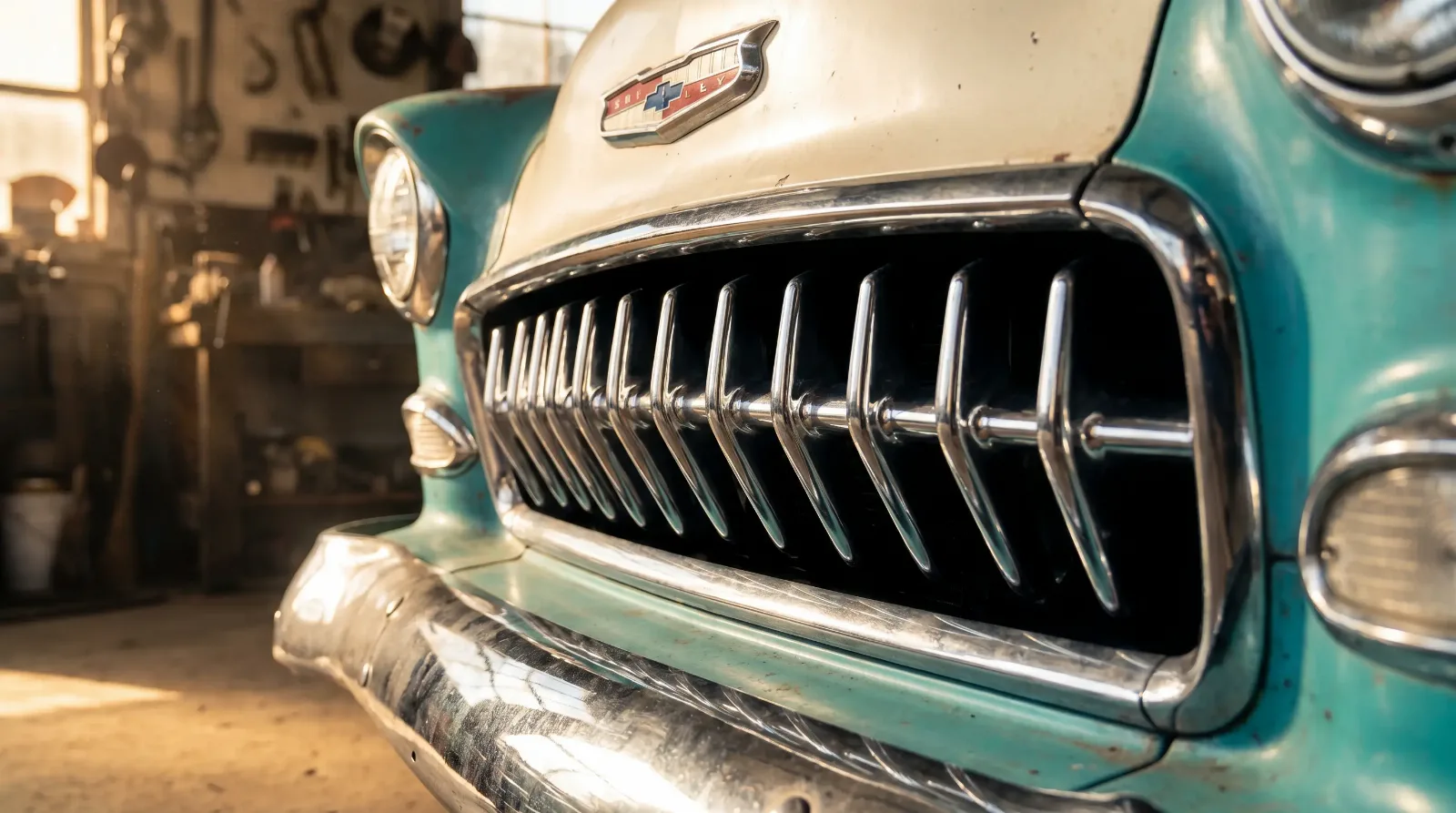
What the design actually borrowed and what it did not
Calling the 1955 grille a direct Ferrari copy overstates the connection. What the Chevrolet stylists actually did was strip away the heavy, tooth-filled chrome grilles that had dominated American car fronts through the early 1950s and replace them with a simpler, more restrained opening that emphasized horizontal lines over ornate vertical bars. That restraint, more than any specific borrowed shape, is what reminded contemporary observers of European sports car design, which tended toward function-first simplicity rather than the chrome excess common on American cars of the period.
Ed Cole's engineering team and the GM Styling division under Harley Earl were pursuing a genuinely lower, cleaner look across the whole 1955 Chevrolet lineup, and the grille redesign was one visible piece of that broader mission. The connection is not just a retrospective comparison, either. GM styling chief Harley Earl saw a Ferrari's egg-crate grille on a trip to European auto shows in the fall of 1953 and directed his team, including designer Clare MacKichan, to adapt that look for the new Chevrolet, a story confirmed by MacKichan's own recollections of the assignment. Even so, dealers and buyers were initially unsure about the result when the car debuted in the fall of 1954, and it took a full sales season for the grille to win over the skeptics.
Why the comparison stuck in popular memory
Automotive journalists of the mid-1950s were increasingly aware of European sports car design, partly through European race coverage and partly through a small but growing import market bringing Italian and British cars to American shores. When a mainstream, affordable American sedan showed up wearing a front end that echoed that European sensibility, it was a notable enough departure from Detroit convention that writers reached for the comparison immediately, and it has been repeated in enough subsequent decades of automotive writing that it became something close to received wisdom about the car.
Read read the background on the full 1955 redesign for the context around how the grille fit into the larger styling program that year, since the front-end treatment did not happen in isolation from the rest of the body's new lines.
"Whether Chevrolet's designers had a Ferrari photograph pinned to a studio wall or just arrived at the same conclusion independently, the result read as sophisticated next to what Detroit had been building. That perception mattered more to buyers than the actual design lineage did."
- Tom Ramirez
How the grille differed across trim levels
The basic grille opening shape carried across the 150, 210, and Bel Air trims for 1955, but Chevrolet used chrome detailing and surrounding trim to differentiate the top-tier Bel Air visually from the cheaper series wearing essentially the same front-end architecture. Bel Air models received additional chrome accents around the grille surround and headlight bezels that the base 150 did not carry, a small but deliberate reminder to showroom visitors of which trim level they were looking at, consistent with the flagship positioning Chevrolet had been building around the Bel Air name since the early 1950s.
This detail matters to restorers and judges today. A Bel Air missing its correct trim-specific chrome pieces around the grille, or wearing pieces correct for a 150 or 210, is an easy tell for anyone doing a careful concours-level inspection, and it is one of the first things I check when authenticating a car's trim level against its data plate.
The parking light and bumper details people overlook
Most discussion of the 1955 grille focuses on the central opening, but the surrounding hardware carries just as much originality risk for restorers. The parking lights sit integrated into the outer grille bar ends rather than mounted separately, a detail that changed in the 1956 facelift and makes the 1955 treatment specifically identifiable at a glance to anyone familiar with the model year progression. The front bumper, meanwhile, wraps around to meet the grille surround in a way that requires careful alignment during any bumper or grille replacement, and a poorly fitted reproduction bumper will throw off the whole front-end appearance even if the grille itself is correct.
I have seen restorations where every individual piece, tested separately, looked correct, but the overall fit and alignment across the grille, bumper, and parking lights was off by enough to bother anyone who has studied original photographs closely. Getting the grille right is necessary but not sufficient. The surrounding hardware has to come together as a system, the way it did when the car left the assembly line.
Reproduction parts and what to watch for
The 1955 Bel Air's popularity means reproduction grilles have been available from aftermarket suppliers for decades, and quality varies considerably between manufacturers. Chrome thickness, bar spacing, and the precise curvature of the outer frame differ enough between some reproduction pieces and the original stampings that a careful eye, or a side-by-side comparison with documented original photographs, can spot the difference. This matters most for cars being restored to concours standards, where judges specifically evaluate trim accuracy, but it is worth knowing even for a driver-quality restoration, since fit and finish on a mismatched reproduction grille can create gaps or alignment issues that a correct original piece would not.
Sourcing a genuine used original grille in good condition has become harder and more expensive over the years as the supply of donor cars shrinks, which is part of why reproduction quality has improved over time as demand for accurate parts increased. Still, buyers restoring toward a serious documentation standard should budget time to compare reproduction options carefully before committing to one.
Why this detail still matters to buyers and judges today
Grille condition and originality carry real weight in how a 1955 Bel Air presents and appraises, since it is the single most photographed and most immediately recognizable feature of the car's front-end design. A damaged, incorrect, or poorly re-chromed grille noticeably hurts a car's presentation even when everything else about the restoration is well executed, because it sits at the visual center of the design story that made this specific model year famous. If you are researching the 1955 Sport Coupe specifically, that body style is worth a look too, since the coupe's proportions put the grille and front-end design front and center.
If you want to compare the grille and overall front-end condition across real listings, you can shop classic Air listings from this model year and see how sellers are presenting this specific detail, which tells you a lot about how carefully a given car has actually been restored.
Sources and notes
Related Reading
Have a
Chevrolet Bel Air
for Sale?
Reach thousands of serious classic car collectors across the US.
Sell It Here →
Are You a Classic Car Dealer?
List your full inventory and connect with targeted classic car buyers.
Join as a Dealer →
#classic chevrolet
#Chevrolet Bel Air
#1955 bel air
#car grille design
#Chevrolet styling
#restoration originality

About the author
Tom Ramirez
Corvette researcher and historian based in Bowling Green, Kentucky. Two decades documenting Corvette production history from original factory records.
Related Listings - Chevrolet Bel Air




Comments
Be the first to comment on this article.