
Weight matters more than displacement in engine design, and the chevy 265 small block 1955 is the cleanest example of that principle in American automotive history. At 265 cubic inches, it was not the biggest V8 on the market that year. It was, by a comfortable margin, the lightest and most efficiently engineered, and that combination is why it outlived every direct competitor by decades rather than model years.
Car Features
7 min read
The 265 Small-Block V8 Debut: Chevrolet's Game-Changer
The chevy 265 small block 1955 won on weight, not just power, a manufacturing and engineering achievement that outlived every direct competitor by decades.
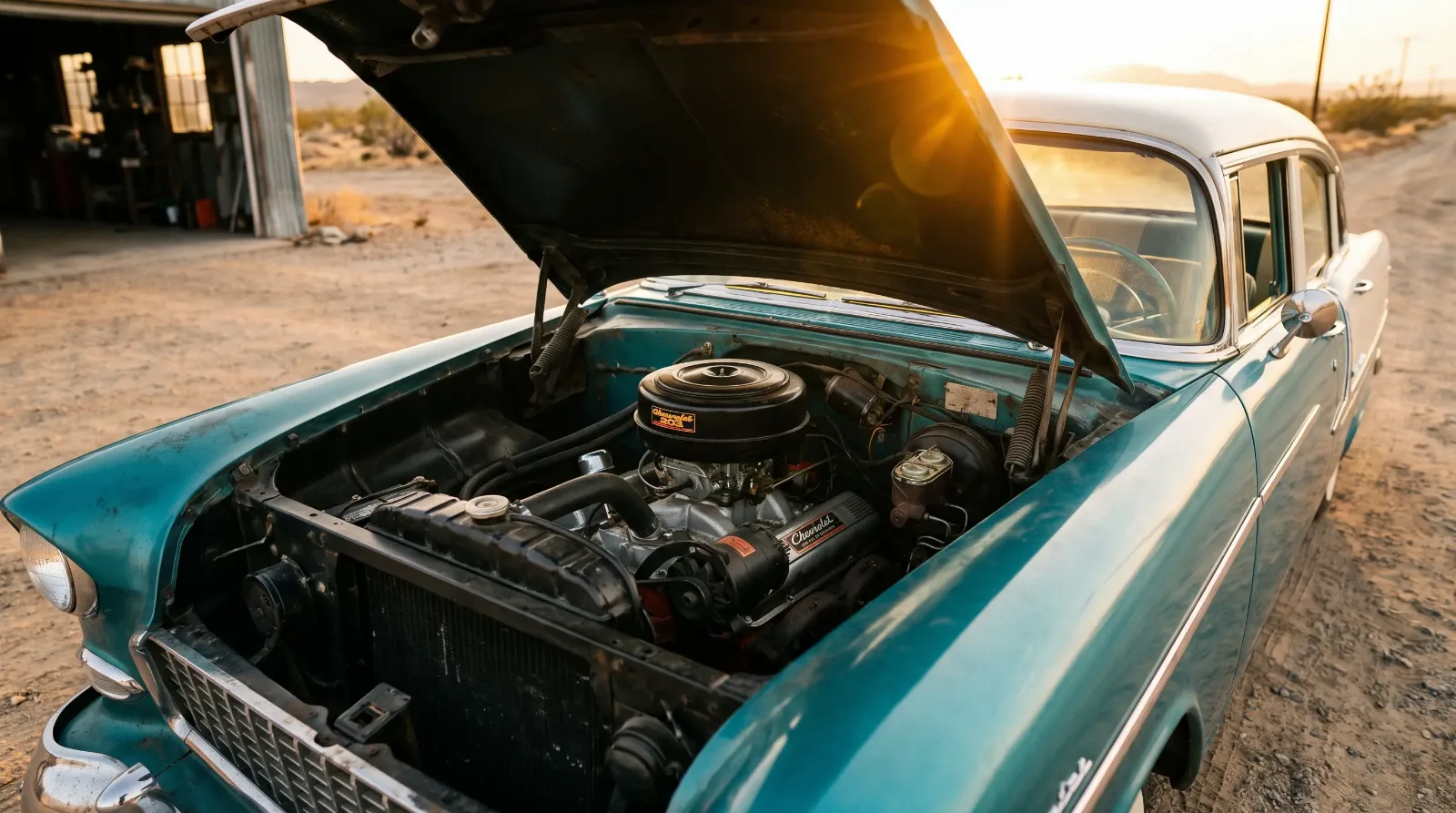
The engineering decisions that made it small
Chevrolet's engineering team, led by Ed Cole with major contributions from Harry Barr and Al Kolbe, made a set of deliberate choices that separated the 265 from the heavier, more complex V8s Detroit had been producing since the late 1940s. The block used thin-wall casting techniques that reduced material without sacrificing structural strength, a manufacturing approach that was not entirely new but had never been applied this aggressively to a mass-production engine block before. The valvetrain used stamped rocker arms rather than the more expensive forged or cast pieces common on contemporary engines, a cost decision that also happened to reduce reciprocating mass in the valvetrain.
The result weighed about 575 pounds complete, roughly 35 pounds less than Ford's contemporary Y-block V8 and well over 100 pounds less than Chrysler's Hemi and polyspheric V8s of the same era, a genuine engineering achievement rather than a marketing rounding error. Lighter reciprocating and rotating mass meant the engine could rev more freely, and the compact external dimensions meant it fit into the Bel Air's engine bay with room to spare for future displacement growth, something the engineering team clearly anticipated even if they could not have predicted exactly how far the small-block family would eventually be stretched.
"Most engines get heavier every time engineers try to make them stronger. The 265 got lighter while getting more capable, and that is the part people miss when they just look at the horsepower number on a spec sheet."
- Emily Chen
What the numbers actually looked like at introduction
The base 265 in 1955 produced 162 horsepower with a two-barrel carburetor, a respectable but unremarkable figure on paper. The optional Power Pack version, adding a four-barrel carburetor and dual exhaust, bumped output to 180 horsepower, and Chevrolet also offered a higher-compression, dual-carburetor variant, mainly through the Corvette, that reached 195 horsepower. What made these numbers meaningful was not their absolute magnitude compared to bigger displacement engines from Cadillac or Chrysler, it was the power-to-weight ratio in a car the size and price of the Bel Air. A buyer paying Chevrolet money got acceleration that had previously required paying for a much more expensive car.
Full details on how this engine fit into the broader 1955 redesign are covered in our complete history of that model year, which puts the 265 in context alongside the new body and chassis changes introduced alongside it.
Manufacturing scale as an engineering constraint, not an afterthought
It is worth remembering that the 265 was not designed in isolation as a performance exercise. Chevrolet needed an engine that could be produced at extremely high volume, on the same tooling and assembly lines building hundreds of thousands of cars a year, without the kind of hand-fitting or exotic materials that would be acceptable on a low-volume performance engine from a specialty manufacturer. Every design decision, from the thin-wall casting to the stamped rocker arms, had to survive contact with a production line running at Chevrolet's scale, and that constraint shaped the engine as much as any performance target did.
This is the part of the story that tends to get lost when people talk about the 265 purely in terms of horsepower and displacement growth. The engineering achievement was not just making a good engine, it was making a good engine that could be built by the hundreds of thousands without a corresponding jump in cost or complexity on the assembly line. That manufacturing discipline is arguably harder to pull off than the pure performance engineering, and it is why the 265's architecture proved so adaptable to mass production for decades after 1955.
Honest talk about failure modes and known weaknesses
No engine this influential is without documented weak points, and pretending otherwise does collectors a disservice. Early 265 blocks are known among restorers for babbitt-style rear main seal designs that leak more readily than the later neoprene seals introduced in subsequent small-block revisions, a common and expected maintenance item rather than a fundamental design flaw. Valve guide wear on high-mileage original engines is another well-documented issue, particularly on cars that spent decades running on leaded fuel formulations that have since changed. Neither issue is disqualifying on a well-maintained example, but both are worth budgeting for on any 1955 car with unknown maintenance history.
I would rather tell a buyer up front that a 70-year-old engine has 70-year-old wear patterns than let them discover it themselves after the sale. The 265's reputation for durability is earned, but earned reputation and zero maintenance needs are not the same thing.
How it compares to what came directly before it
The Blue Flame six it partially replaced under the Bel Air's hood was a perfectly competent engine for its purpose, but it was an evolutionary dead end by 1955 standards, a design that had been refined incrementally for years without a fundamental rethink. The 265 was not an evolution of anything Chevrolet had built before. It was a clean-sheet design, and the difference shows in details like the fact that the six's cylinder head and valvetrain layout traced its lineage back to engines from the 1930s, while the 265 was engineered from a blank drafting table with contemporary manufacturing tolerances and materials in mind from the start.
That distinction matters for anyone comparing a six-cylinder and V8 1955 Bel Air today. The six is a known, honest, unremarkable engine doing what it was designed to do competently. The V8 represents a genuine technological leap within the same model year and the same engine bay, which is part of why period buyers who could stretch their budget for the V8 rarely regretted the choice, and why V8-equipped cars carry a real premium in the collector market today.
Why engineers still study this specific engine
The chevy 265 small block 1955 gets cited in engineering discussions not because it was the most powerful engine of its era, it clearly was not, but because it demonstrated that mass-production manufacturing techniques could produce a genuinely lightweight, strong, and expandable engine architecture at a price point aimed at ordinary buyers. That combination of accessible cost and sound fundamental engineering is rare enough that it is worth studying on its own terms, independent of the nostalgia that usually surrounds discussion of 1950s Detroit engines.
If you want to evaluate one in person rather than just read the specifications, you can find a classic Air from this model year and inspect the drivetrain details directly, which is always more informative than any spec sheet, including this one.
Sources and notes
Related Reading

Have a
Chevrolet Bel Air
for Sale?
Reach thousands of serious classic car collectors across the US.
Sell It Here →
Are You a Classic Car Dealer?
List your full inventory and connect with targeted classic car buyers.
Join as a Dealer →

About the author
Emily Chen
Bay Area engineer with a deep focus on vintage Japanese and European performance cars. Approaches classic car research and restoration with an analytical eye.
Related Listings - Chevrolet Bel Air






Comments (1)
T
Tom Addison
1 month ago
Color combinations matter more than most buyers think. Original paint codes add real value; wrong-era repaints subtract from it.