
Numbers do not lie, but they do get repeated carelessly, and 1955 Bel Air production figures are a good example of how a rounded estimate turns into accepted fact after enough years of being copied from one article to the next. Chevrolet built more than 1.7 million cars across the full 1955 model year lineup, a record for the company at the time, and the Bel Air series accounted for a substantial share of that total. Getting the actual breakdown right, body style by body style, matters more than most casual histories bother to explain.
Car Features
7 min read
1955 Bel Air Production Numbers
1955 Bel Air production topped Chevrolet's records, but the real story is in the body-style breakdown, where sedans dwarfed convertibles and Nomads by a wide margin.
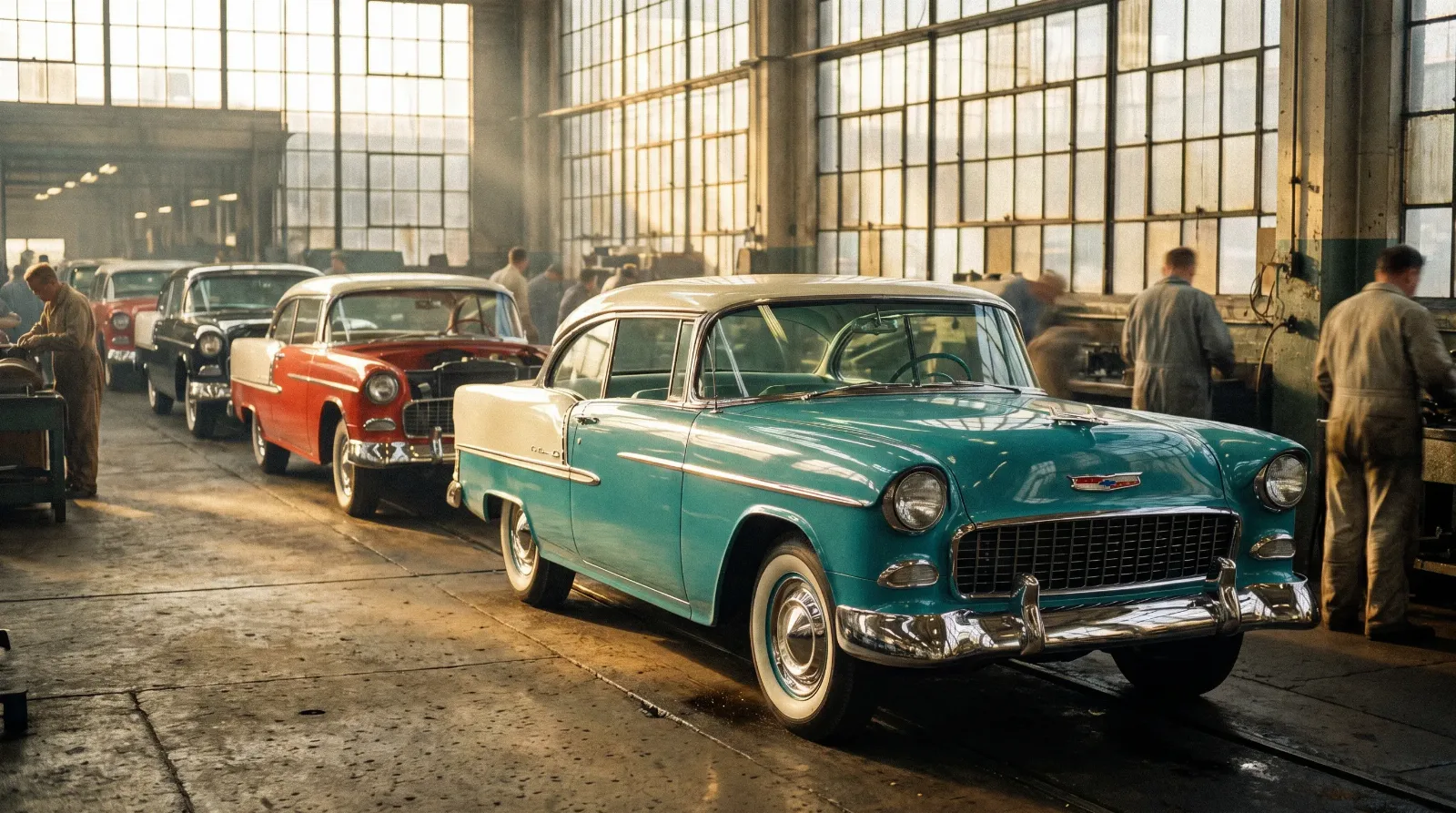
The scale of the 1955 model year
1955 was Chevrolet's best sales year to that point, driven by the combination of all-new styling, the new V8 option, and a postwar economy that had buyers ready to spend on something more than basic transportation. Total Chevrolet passenger car production for the model year came in at roughly 1.78 million units, split across the base 150, mid-range 210, and top-line Bel Air series, plus the Corvette running as a separate, low-volume line. Within that total, Bel Air series production numbered in the hundreds of thousands, making it comfortably the best-selling trim level of the three despite carrying the highest price of the mainstream sedans and wagons.
Production by body style
Within the Bel Air series, the four-door sedan sold in by far the highest volume, since it represented the most practical, most affordable way into the top trim level for a family buyer. The two-door hardtop, known as the Sport Coupe, sold in strong numbers as well and remains one of the most recognized body styles from the whole Tri-Five era. The convertible and the Nomad wagon, by contrast, were built in far smaller numbers, both because of their higher prices and because a convertible or a specialty wagon has always appealed to a narrower slice of the buying public than a standard sedan. That gap in original production volume is the single biggest reason convertible and Nomad values sit so far above sedan values in the collector market today. Scarcity was baked into the numbers from the factory floor, not created later by attrition alone.
| Body style | Relative 1955 Bel Air production |
|---|---|
| 4-door sedan | Highest volume |
| 2-door Sport Coupe (hardtop) | Strong volume, second highest |
| Convertible | Low volume |
| Nomad wagon | Lowest volume of the series |
Assembly plants behind the numbers
Chevrolet built its 1955 lineup across multiple assembly plants spread throughout the country, each turning out the full range of body styles for its regional territory rather than specializing in a single style. This distributed production model was standard practice for the industry at the time, meant to reduce shipping costs and get finished cars to dealers faster, but it also means that a car's build location has its own documentation trail, separate from the body-style and trim-level breakdowns most collectors focus on first. Serial number sequences and body tag codes tie back to specific plants, and matching those codes correctly is part of verifying a car's full production history alongside the more commonly discussed engine and color combination. For researchers working through original paperwork, plant of origin is often the detail that resolves an otherwise ambiguous case, since it narrows down which regional supply chain and which specific assembly line records might still exist for a given vehicle.
Where the confusion creeps in
A lot of the figures repeated online blend total Chevrolet production with Bel Air-specific production, or blend model year totals with calendar year totals, two different counting methods that produce different numbers for the same basic period. Factory records, where they survive intact, are the only reliable source for a body-style-specific figure, and even those can differ slightly depending on whether a source counts cars built versus cars actually sold at retail. Anyone citing a precise production number for a specific 1955 Bel Air body style should be able to point to where that figure came from, since rounded estimates get treated as gospel far too easily in this hobby.
"I have seen the same wrong number copied across a dozen websites because nobody went back to check the original source. Production figures deserve better than that."
- Tom Ramirez
Engine and trim mix within production
Body style is only one axis of 1955 Bel Air production. Within any given body style, the split between six-cylinder and V8 cars, and between base two-barrel and Power Pack four-barrel V8 configurations, adds another layer to how rare a specific original combination actually is. Early in the model year, the six-cylinder remained the more commonly ordered engine simply out of habit and price sensitivity, but V8 take rates climbed steadily as the model year went on and word of mouth about the new engine spread through dealer networks and enthusiast circles. By the back half of the 1955 production run, the V8 had become a much more common order than it had been at launch, a shift that shows up clearly when comparing early-build cars to late-build cars from the same model year. That production timeline detail is often overlooked, but it explains why some outwardly identical 1955 Bel Airs carry meaningfully different original engine takes depending on when in the model year they came down the line.
Two-tone paint follows a similar pattern. Single-color cars were more common early in the run, before the two-tone treatment had fully caught on with the buying public, and by mid-year two-tone combinations had become close to standard practice on Bel Air specifically, as covered elsewhere in Chevrolet's 1955 styling story. None of these production mix details change the basic body-style hierarchy of sedan, hardtop, convertible, and Nomad, but they matter to anyone trying to accurately place a specific surviving car within the full scope of 1955 Bel Air production rather than treating the model year as one undifferentiated block of manufacturing.
Why production numbers matter to buyers
Understanding where a specific car sits within 1955 Bel Air production, by body style and by original color and engine combination, gives a buyer real context for what they are looking at. A four-door sedan with the base six-cylinder engine was an extremely common car in 1955 and remains reasonably available today, while a documented small-block V8 convertible represents a genuinely rare configuration within that same production run.
Surviving population is a separate question from original production, and buyers should not confuse the two. A body style built in large numbers originally can still be genuinely scarce today if attrition hit it harder than a rarer body style that happened to attract more careful ownership over the decades. Sedans, despite dominating original 1955 Bel Air production, were often treated as disposable family transportation once they aged out of daily use, while convertibles and Nomads, precisely because they were expensive and comparatively rare from new, tended to attract owners who kept them under cover and away from daily wear. That divergence between original production volume and current surviving population is one of the more counterintuitive parts of valuing a 1955 Bel Air, and it is worth understanding before assuming rarity today maps cleanly onto rarity at the factory. Readers interested in the broader context behind these figures, including how the whole model year came together, can find the full story alongside this production breakdown. For buyers ready to compare specific body styles and configurations against what actually survives, browsing current classic Air for sale listings is the most direct way to see how original production scarcity plays out in today's market.
Sources and notes
Related Reading
Have a
Chevrolet Bel Air
for Sale?
Reach thousands of serious classic car collectors across the US.
Sell It Here →
Are You a Classic Car Dealer?
List your full inventory and connect with targeted classic car buyers.
Join as a Dealer →

About the author
Tom Ramirez
Corvette researcher and historian based in Bowling Green, Kentucky. Two decades documenting Corvette production history from original factory records.
Related Listings - Chevrolet Bel Air




Comments
Be the first to comment on this article.