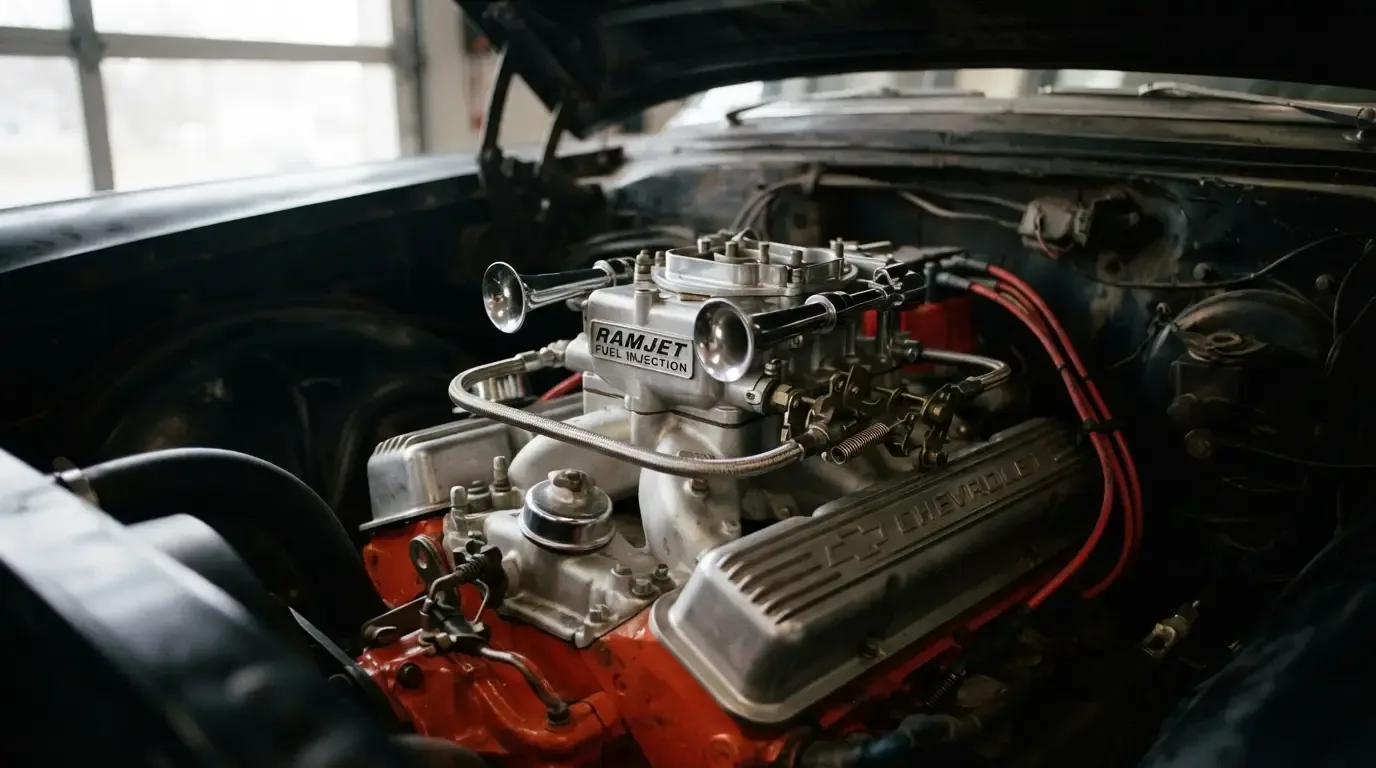
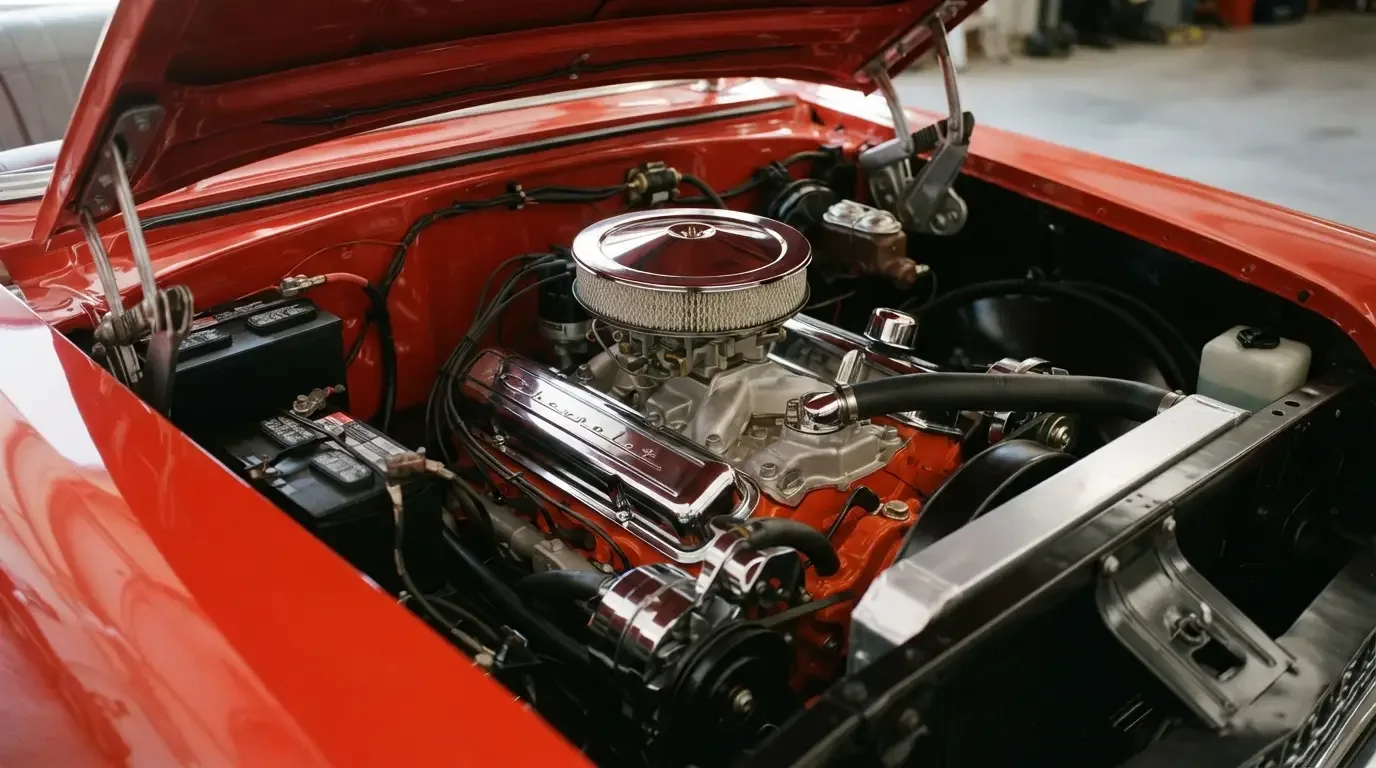
Every era of American performance cars has a number that gets repeated until it becomes shorthand for the whole decade. For the 1957 Chevy 283, that number is one horsepower per cubic inch, an achievement that sounds almost quaint in an age of engines that clear two or three times that ratio, but that was a genuine milestone when Chevrolet's engineers hit it with the fuel-injected 283 in the Bel Air lineup. Understanding why that ratio mattered requires looking past the marketing tagline and into what Chevrolet's small block actually had to do to get there.
What one horsepower per cubic inch actually meant in 1957
The math itself is simple. A 283 cubic inch V8 producing 283 horsepower hits a one-to-one ratio between displacement and output, a benchmark that had rarely been reached by a mass-production American engine before that point. Most V8s of the mid-1950s, even strong ones, were producing output well below their displacement number, since carbureted engines of the era struggled to deliver consistent fuel distribution and volumetric efficiency at higher output levels. Reaching parity between cubic inches and horsepower was treated as a symbolic threshold in the automotive press at the time, not because the ratio itself has deep engineering significance, but because it was an easy, legible way to communicate that Chevrolet's small block had crossed into serious performance territory.
The 283 engine family itself was a bored-and-stroked evolution of the 265 cubic inch small block that had debuted for 1955, the engine widely credited with establishing Chevrolet's small block V8 as one of the most important American engine designs of the century. By 1957, displacement had grown from 265 to 283 cubic inches, and Chevrolet offered the engine across a wide spread of states of tune, from a mild two-barrel carbureted version suitable for family transportation up through the fuel-injected variant that delivered the headline output figure.
How Chevrolet's engineers actually got there
Reaching that output level required more than displacement growth alone. Chevrolet's engineering team improved cylinder head flow, increased compression ratio in the higher-output variants, and refined the camshaft profile to support higher engine speeds without sacrificing durability. The top 283 horsepower fuel-injected engine ran a compression ratio in the 10.5:1 range with a solid-lifter, competition-style camshaft and high-speed valve gear, well up from the milder two-barrel version's compression and cam timing. The most significant technical leap, though, was the introduction of Rochester's Ramjet mechanical fuel injection system as an available option on the 283, which solved the fuel distribution inconsistency that limited carbureted engines from reaching their theoretical output ceiling. Fuel injection allowed more precise metering across the engine's operating range, which is what let Chevrolet's engineers extract the final increment of output needed to reach the one-to-one ratio reliably enough to advertise it.
It is worth being honest about the limits of the achievement, too. The one-horsepower-per-cubic-inch figure applied specifically to the top fuel-injected state of tune, not to every 283-equipped car that left a Chevrolet dealership in 1957. A buyer who ordered the base two-barrel 283 was driving a meaningfully less powerful car, and the marketing shorthand tends to flatten that distinction in retrospect. Readers curious about how the fuel-injected variant specifically fit into the model year's story can find more detail in the full story of the 1957 Bel Air.
| 283 V8 variant | Induction | Approximate output character |
|---|---|---|
| Base two-barrel | Single two-barrel carburetor | Family car tune, lowest output in the family |
| Four-barrel | Single four-barrel carburetor | Mid-range performance tune |
| Dual four-barrel | Two four-barrel carburetors | Upper performance tune |
| Ramjet fuel injection | Mechanical fuel injection | Top-tier tune, source of the 1:1 ratio claim |
Why the ratio still gets repeated today
Part of the reason the one-horsepower-per-cubic-inch figure has such staying power in enthusiast conversation is that it is a rare case of an engineering milestone that is genuinely easy to explain to someone with no technical background. You do not need to understand volumetric efficiency or brake specific fuel consumption to grasp what it means for an engine's horsepower number to equal its displacement number. That clarity made it a durable talking point in period advertising, and it has stayed a durable talking point in collector circles for the same reason, even though modern engines routinely exceed the ratio by a wide margin using technology that would have been unrecognizable to Chevrolet's 1957 engineering team.
There is also a historical weight to the achievement that has little to do with the raw number. The 283 fuel-injected engine represented Chevrolet putting real engineering resources behind performance at a moment when the American auto industry was still working out how seriously to take the emerging youth performance market. Reaching that ratio, and advertising it aggressively, signaled that Chevrolet intended to compete on outright performance credentials, not just style and price, and that signal shaped how the company positioned its cars for years afterward. Rival manufacturers took notice, and the horsepower race that defined much of American performance car marketing through the 1960s owes a real debt to the precedent Chevrolet set with this specific engine and this specific number.
Reading the number honestly today
Evaluating a 1957 Bel Air with a claimed 283 fuel-injected engine today means separating the marketing legend from the documentation. Fuel-injected cars are a small fraction of surviving 1957 Bel Airs, and matching-numbers verification matters more here than on almost any other configuration, since the performance and value premium attached to a genuine fuel-injected 283 creates real incentive for cars to be represented as something they are not. Engine block casting numbers, date codes, and any surviving factory paperwork are the tools that separate a documented fuel-injected car from one wearing later or incorrect induction hardware.
Buyers should also be careful about how the ratio itself gets used in sales listings, since the phrase "one horsepower per cubic inch" gets attached loosely to plenty of 283-powered cars that never carried the specific fuel-injected, high-compression state of tune the figure actually describes. A four-barrel 283 is a fine, honest engine, but calling it a one-horsepower-per-cubic-inch car misstates what Chevrolet's engineers actually achieved and misleads a buyer about both output and rarity. The safest approach is to treat the ratio as describing one specific factory configuration, not a general description of every 283 built that year, and to ask for documentation whenever a listing invokes the figure without specifying which state of tune the engine actually carries.
"The ratio itself is a marketing number, and I say that as a compliment. It is rare for an engineering team to produce a result clean enough that it doubles as its own advertisement. That is what happened here."
- Emily Chen
The one-horsepower-per-cubic-inch 283 remains one of the clearest examples of how a real engineering result and a marketing narrative can reinforce each other honestly, without one having to distort the other. Buyers who want to see how that engine shows up in real cars on the market today can browse classic Air listings and compare how sellers document engine configuration, since that documentation is where the real value of this specific milestone lives now.