
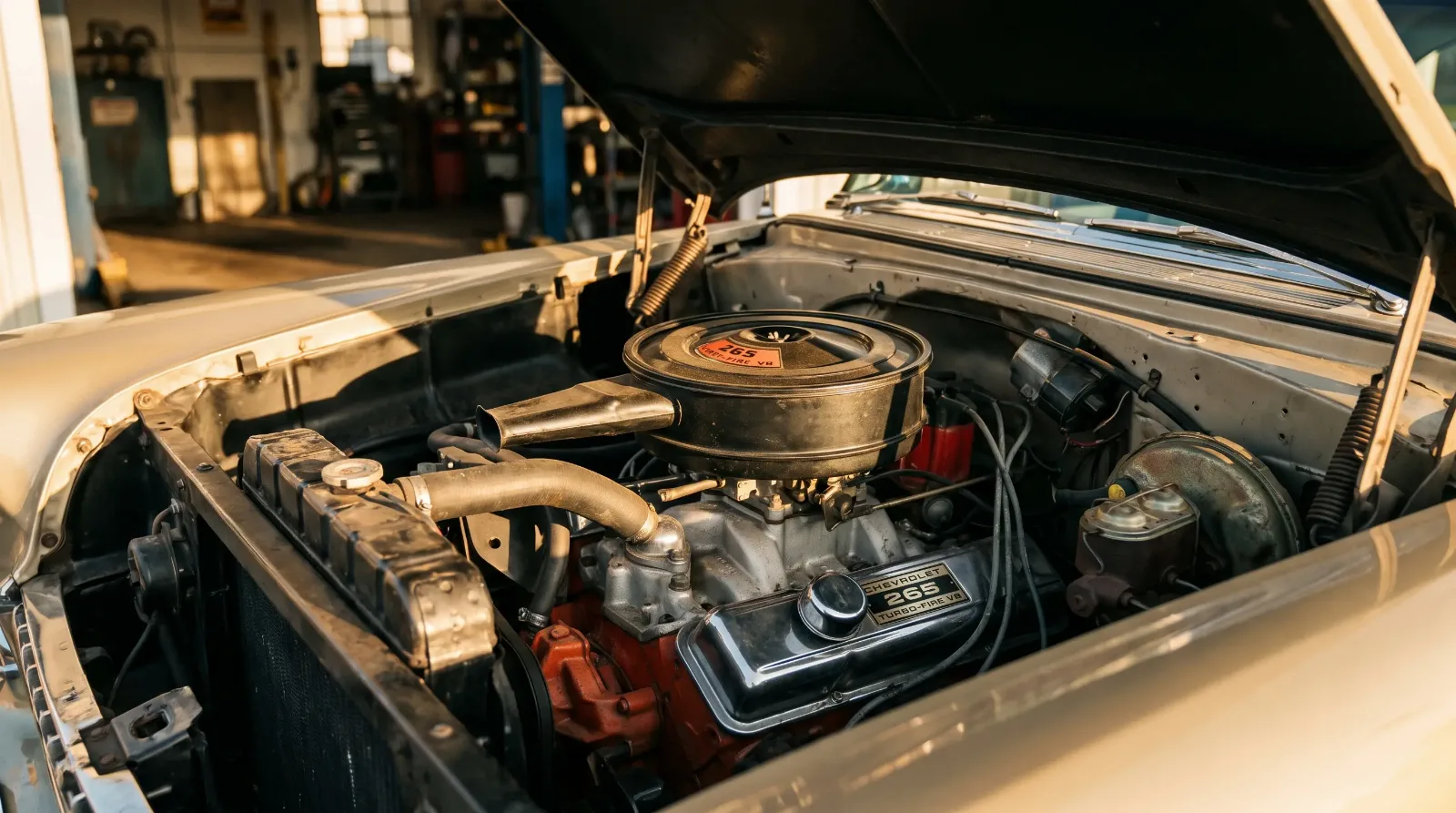
Here is the number that matters. Base 265, two-barrel carburetor: 162 horsepower at 4,400 rpm. Same block, four-barrel carburetor and dual exhaust bolted on at the factory: 180 horsepower at 4,600 rpm. That eighteen-horsepower jump had a name, chevy power pack 265, and it turned a pleasant new engine into the reason people started taking Chevrolet seriously at a stoplight. No mystery, no marketing fog. A bigger carburetor and a freer exhaust did the work, and the difference showed up on a stopwatch.
Car Features
7 min read
The Power Pack 265
The Power Pack option added a four-barrel carburetor and dual exhaust to the 1955 Bel Air's new 265 V8, and that simple change is what turned Chevrolet into a car people took seriously off the line.
What the option actually bought you
Chevrolet did not reinvent anything to build the Power Pack. The 265 cubic inch V8 that debuted for 1955 was already a good design, light for its output and eager to rev, a clean break from the truck-derived engines other low-price cars were still running. The Power Pack option took that base engine and gave it more air and less restriction. A four-barrel carburetor replaced the standard two-barrel, and dual exhaust pipes replaced the single system. That is the whole recipe. No larger displacement, no different cylinder heads in the earliest form of the option, just better breathing on both ends.
The result was an engine that pulled harder through the middle of the rev range and kept pulling where the base engine started to run out of ideas. Buyers who ordered the option were not chasing bragging rights on a spec sheet. They wanted the car to feel different from the driver's seat, and the Power Pack delivered that without asking Chevrolet's engineers to do anything exotic.
Why it mattered more than the horsepower number suggests
Eighteen extra horsepower does not sound like much against a modern engine, so it is easy to undersell what it meant in 1955. The Bel Air was a light car for its era, and the base 265 already moved it with more urgency than the six-cylinder ever had. Adding the Power Pack on top of that light chassis produced a car that could genuinely surprise drivers of more expensive machinery. Word of that spread through showrooms and drag strips fast, and it did more for Chevrolet's reputation than any brochure copy could have.
The option also mattered because of what it signaled about the direction Chevrolet was heading. A low-price car offering a factory performance upgrade, cheap enough for a working buyer to check the box, was not how the industry had operated. Ford and Plymouth had performance options too, but the Power Pack became the one people remembered, partly because the small-block underneath it turned out to be one of the most significant engines in American automotive history. Anyone reading the full 1955 chevy bel air history will see how much of that year's reputation rests on this single option box.
How it compares to what came right after
The Power Pack did not stay static. Chevrolet kept pushing the 265 in 1956, and the same basic four-barrel and dual exhaust formula produced even higher rated output as compression and tuning improved. The pattern set in 1955 became the template Chevrolet reused for the rest of the decade: sell a reasonable base engine, then offer a clearly defined step up that does not require a completely different car. That approach is part of why the small-block V8 built such a devoted following so quickly. It gave people a path to more power without pricing them out or forcing them into an unfamiliar platform.
Put the base 265 and the Power Pack 265 side by side today and the difference feels smaller than the horsepower gap implies, because both versions share the same fundamental character. That is not a knock on the option. It means Chevrolet built a genuinely good base engine and then improved on a strength rather than papering over a weakness. Buyers cross-shopping the two configurations now are really choosing between a good car and a slightly better one, not between two different personalities.
"People want the Power Pack to be some hidden race engine Chevrolet snuck into a family sedan. It was a four-barrel carburetor and dual exhaust. That is it. The number went up because the engineering was honest, not because there was a secret."
- Dan Reeves
What it means for a buyer today
If you are shopping a 1955 Bel Air and the seller claims Power Pack, verify it against the car's original build documentation rather than taking a four-barrel carburetor on the engine at face value. Carburetors get swapped, dual exhaust gets added later by owners chasing a sound rather than the factory spec, and a car can end up looking like a Power Pack car without the paperwork to prove it ever was one. The number stamped on a build sheet or trace record matters more than what is currently bolted to the intake.
For a car that is genuinely documented, the Power Pack adds a real, if modest, premium in most transactions, and it adds a driving character that a base two-barrel car simply does not have. It is not the engine that will win a concours judging on its own. It is the engine that makes the ownership experience better every time you put your foot down. That practical difference is worth something to buyers who plan to actually drive the car, which is most of the people who own one.
Parts availability is another practical point worth raising, since it rarely gets mentioned next to the horsepower talk. Because the 265 shares its basic architecture with the small-block family that Chevrolet kept building for decades, a Power Pack car is not stranded when it needs service. The specific carburetor and exhaust manifold combination takes some hunting to get period-correct, but the short block underneath is one of the best supported engines in the collector world. That is a quiet advantage over rivals whose performance options relied on harder-to-source hardware, and it is one reason these cars have stayed drivable rather than becoming museum pieces nobody dares start.
It also pays to be honest about what the Power Pack was not. It was not a race engine, and Chevrolet never pretended otherwise in its own literature. It was a modest, well-engineered step up aimed at a buyer who wanted more response without more complication, and it worked because the underlying engine had room to give without straining. That restraint is part of what separates a genuinely good factory option from a marketing gimmick, and the Power Pack sits firmly on the good side of that line.
The broader picture of what a documented, correctly optioned 1955 is worth against a plainer example is its own subject, and it is covered in a related story that walks through the numbers in more detail. For now, the short version holds. Base 265, fine engine. Power Pack 265, better one, and cheap enough in period that plenty of buyers said yes. Anyone shopping the real thing today can see current Airs for sale now and start asking sellers the right questions about what is actually under the hood.
Sources and notes
- Chevrolet small-block engine (first- and second-generation) - Wikipedia
- 1955-1965 Chevrolet Small Block V-8 - Over-Drive Magazine
- Collector Car Corner: 1955 Chevy 265 V8 and the Beginning of Chevy High Performance - The Spokesman-Review
- Chevy Small-Block: The Little Engine That Did - Hagerty
- Vintage Road Test: 1955 Chevrolet 210 V8, The Legend Is Born - Curbside Classic
Related Reading
Have a
Chevrolet Bel Air
for Sale?
Reach thousands of serious classic car collectors across the US.
Sell It Here →
Are You a Classic Car Dealer?
List your full inventory and connect with targeted classic car buyers.
Join as a Dealer →

About the author
Dan Reeves
Performance engine builder from North Carolina's motorsports corridor, focused on swaps, forced induction and making real, repeatable power.
Related Listings - Chevrolet Bel Air




Comments
Be the first to comment on this article.