
Every big-block Chevelle owner has heard the warnings before they even bought the car. It'll run hot in traffic. Don't ever shut it off after a hard run without letting it idle down. The factory radiator was never enough for that much engine. Some of that is grounded in something real. A lot of it is fifty years of bench-racing talk that got repeated so often it turned into received wisdom. Let's separate the two with actual numbers instead of vibes.
Car Features
6 min read
Big-Block Cooling and Reliability Lore, Fact-Checked
Does the LS6 Chevelle really run hot? A data-first look at the cooling system and reliability lore that follows these big-blocks around.
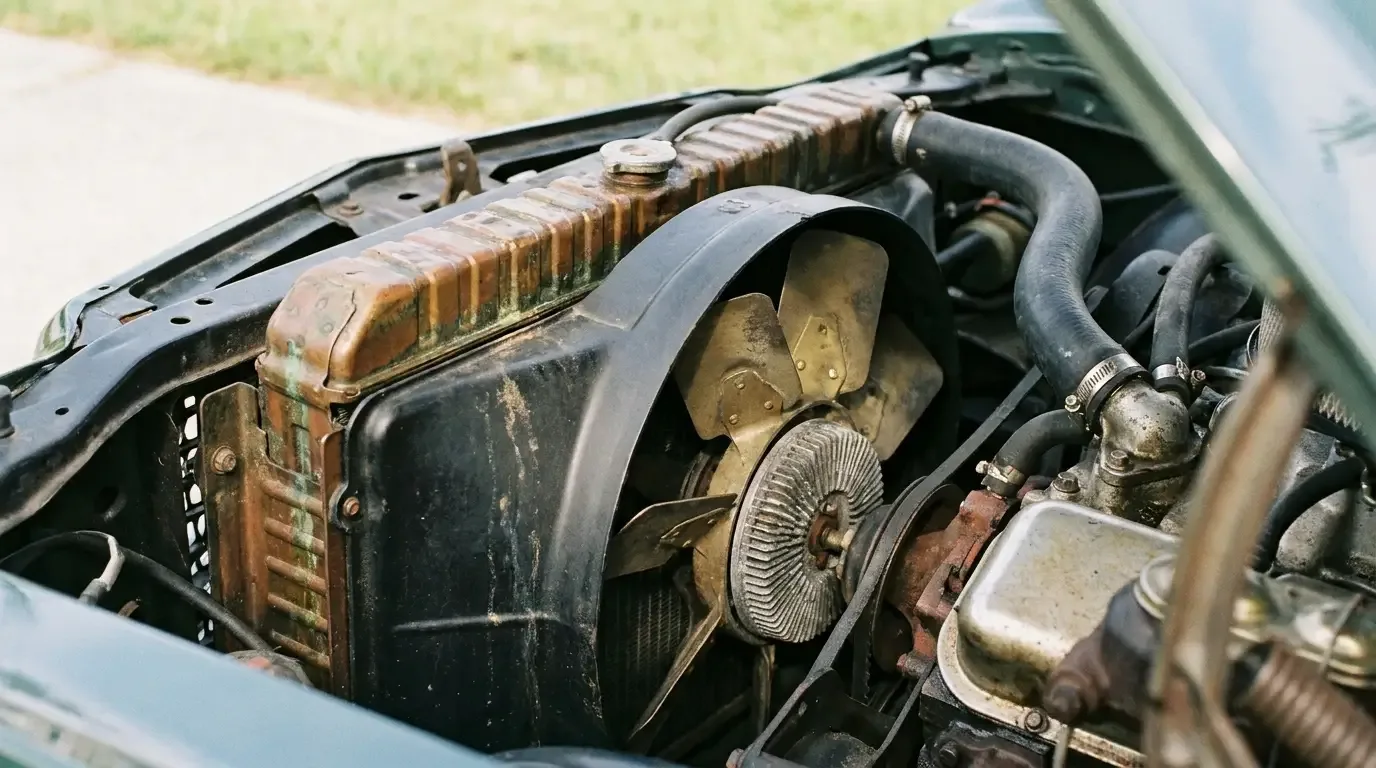
This kind of scrutiny matters for the same reason it matters everywhere else in the big-block Chevelle story: reputation and documented fact don't always line up, and the gap between them costs buyers real money.
What the factory cooling package actually was
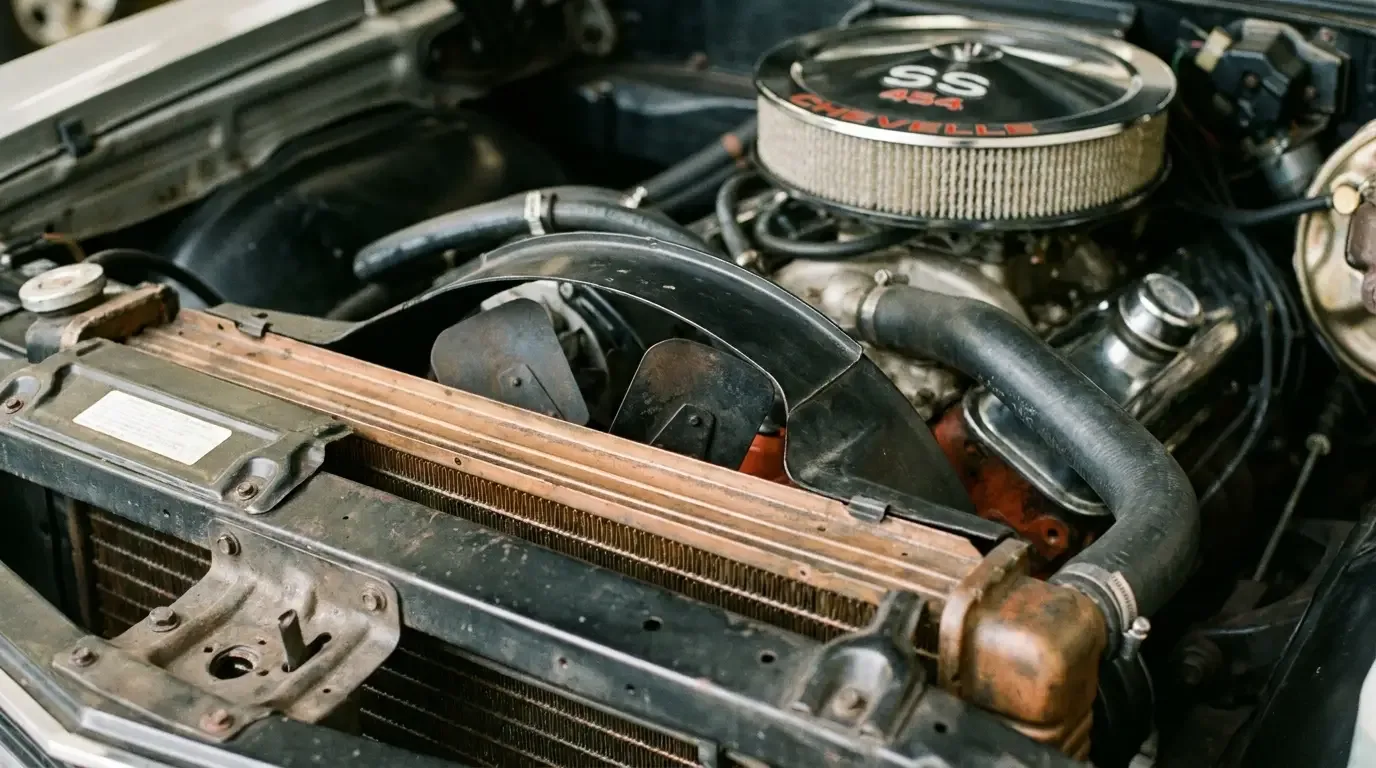
The baseline SS454 cooling setup was a three-row copper-brass radiator, not the four-row core people often assume was standard across the board. The four-row core came in specifically through RPO V01 heavy-duty cooling, through factory air conditioning, or on cars ordered with certain rear axle ratios, all of which used a different upper radiator core support to clear the larger unit. For the LS6 specifically, that distinction mostly disappears: heavy-duty cooling was a mandatory part of the LS6 option package, right alongside the Rock Crusher M22 four-speed or M40 automatic and the heavy-duty battery, so an LS6 car left the factory with the four-row radiator and a thermostatically controlled clutch fan rather than a fixed fan by default. An LS5 car without the V01 option, air conditioning, or the right axle ratio could leave the factory with the smaller three-row core, which is exactly the kind of detail that trips people up when they assume every big-block Chevelle got the same radiator. None of it was exotic engineering. It was the same basic approach every domestic manufacturer used to keep a large-displacement V8 from cooking itself in stop-and-go traffic, scaled up because the LS6 and LS5 both made more heat than a small-block ever would under hard use.
The factory setup, properly maintained, kept these engines within a normal operating range under most driving conditions. Where the reputation for running hot actually comes from is less about the original engineering and more about what's happened to these cars over five decades.
Where the overheating reputation actually comes from
Fifty-plus years is a long time for a cooling system to degrade without anyone noticing gradually. Radiator cores clog with scale and debris. Fan clutches wear out and stop engaging properly at temperature. Water pumps get replaced with parts-store units that don't move the same volume as the original casting. Owners add air conditioning to cars that weren't optioned with the factory AC-specific radiator, or they run a modern high-flow water pump pulley that spins too fast at idle and actually cavitates rather than moving coolant efficiently. Every one of those changes, made independently over the decades, adds up to a car that runs noticeably hotter than it did when it left the assembly line, and the LS6's reputation for running hot is built substantially on cars in exactly that condition.
There's also a timing element people forget. These are aggressive-tune, solid-lifter engines with more ignition advance dialed in for performance than a comfortable idle in traffic really wants. An engine that's timed for maximum power on the strip and then sits in July gridlock is going to run warmer than a mild-mannered daily driver, and that's true of any high-compression big-block from the era, not something specific to a manufacturing flaw in the LS6.
🔧 Inspection Priorities
- Check for the correct radiator core, not just "a big radiator." A four-row factory-style core matched to the right shroud and fan clutch does the job it was designed for. An undersized aftermarket radiator or a mismatched shroud that lets air recirculate will run hot regardless of core size.
- Test the fan clutch cold and hot. A clutch fan should spin fairly freely by hand when the engine is cold and resist noticeably more once the engine reaches operating temperature. A clutch that spins the same in both states has likely failed and isn't doing its job.
- Verify ignition timing against factory spec before blaming the cooling system for a hot-running engine. Over-advanced timing, a lean carburetor tune, or a vacuum leak will all cause overheating symptoms that have nothing to do with radiator capacity, and chasing the cooling system first wastes money on the wrong fix.
The reliability side of the lore
Beyond cooling, there's a broader mythology that the LS6 was somehow a fragile, high-strung engine that couldn't survive daily use. That doesn't hold up against how these engines were actually built. The solid-lifter valvetrain requires more frequent adjustment than a hydraulic-cam engine, and it demands an owner who actually does that maintenance rather than ignoring it, but that's a maintenance requirement, not a design flaw. Forged pistons, a four-bolt main block, and generally conservative bearing clearances for the era gave the LS6 a bottom end that holds up fine under the kind of use it was built for, provided oil changes happened on schedule and the valvetrain got its periodic lash adjustment.
Where LS6 engines genuinely do fail is where any high-compression, solid-lifter big-block fails: neglected maintenance, decades-old gaskets nobody's replaced, and owners who chase a magazine's quarter-mile number without checking whether the car underneath them has been kept up to the standard that number assumed.
| Common claim | Reality check |
|---|---|
| "LS6 Chevelles always run hot" | Properly maintained factory cooling handles normal driving; most overheating traces to degraded parts or timing, not original design |
| "The factory radiator was never enough" | Heavy-duty cooling was available as an option and the standard SS setup was sized for the engine's heat output |
| "Solid lifters mean unreliable" | They mean scheduled valve lash adjustment; skipping it, not the mechanism itself, causes problems |
"Everybody wants to blame the radiator. Half the time it's a fan clutch that quit working three owners ago, or timing that's still set for a quarter-mile pass instead of a stoplight. Fix the actual failure point before you throw money at a bigger core."
Dan Reeves
How the LS6 relates mechanically to its closest factory relatives is its own worthwhile detour, particularly given how much shared engineering shows up across the GM big-block family. Read next: The LS6's Family Tree for how those connections actually work.
Sources and notes
- Team Chevelle forum - big-block A/C and heavy-duty cooling (RPO V01) applications, 1970-72
- Team Chevelle forum - 1970 454, three-row vs four-row radiator core discussion
- Chevy Hardcore - 1970 Chevelle SS454 LS6 mandatory options, including heavy-duty cooling
- Chevy Hardcore - bringing an LS6 454 back to factory cooling and tune specs
- California Speed Shop - 1970 Chevelle SS454 LS6 identification and specifications guide
Related Reading
Have a
Chevrolet Chevelle
for Sale?
Reach thousands of serious classic car collectors across the US.
Sell It Here →
Are You a Classic Car Dealer?
List your full inventory and connect with targeted classic car buyers.
Join as a Dealer →

About the author
Dan Reeves
Performance engine builder from North Carolina's motorsports corridor, focused on swaps, forced induction and making real, repeatable power.
Related Listings - Chevrolet Chevelle

Comments
Be the first to comment on this article.