
The 1962 Chevy II exists because of a memo, not a dream. Ford's Falcon and Plymouth's Valiant had already proven that American buyers wanted a smaller, cheaper car without giving up a domestic badge, and Chevrolet's Corvair, unconventional with its rear engine and air cooling, was not converting enough of those buyers. Chevrolet's answer had to be conventional, cheap to build, and fast to market. It became the Chevy II, and understanding why it looks the way it does starts with that timeline pressure.
Car Features
6 min read
1962 Chevy II: Chevrolet's Answer to the Falcon
Built in roughly eighteen months to answer the Ford Falcon, the 1962 chevy ii was conventional by design, and its top trim, Nova 400, was not yet a car of its own.
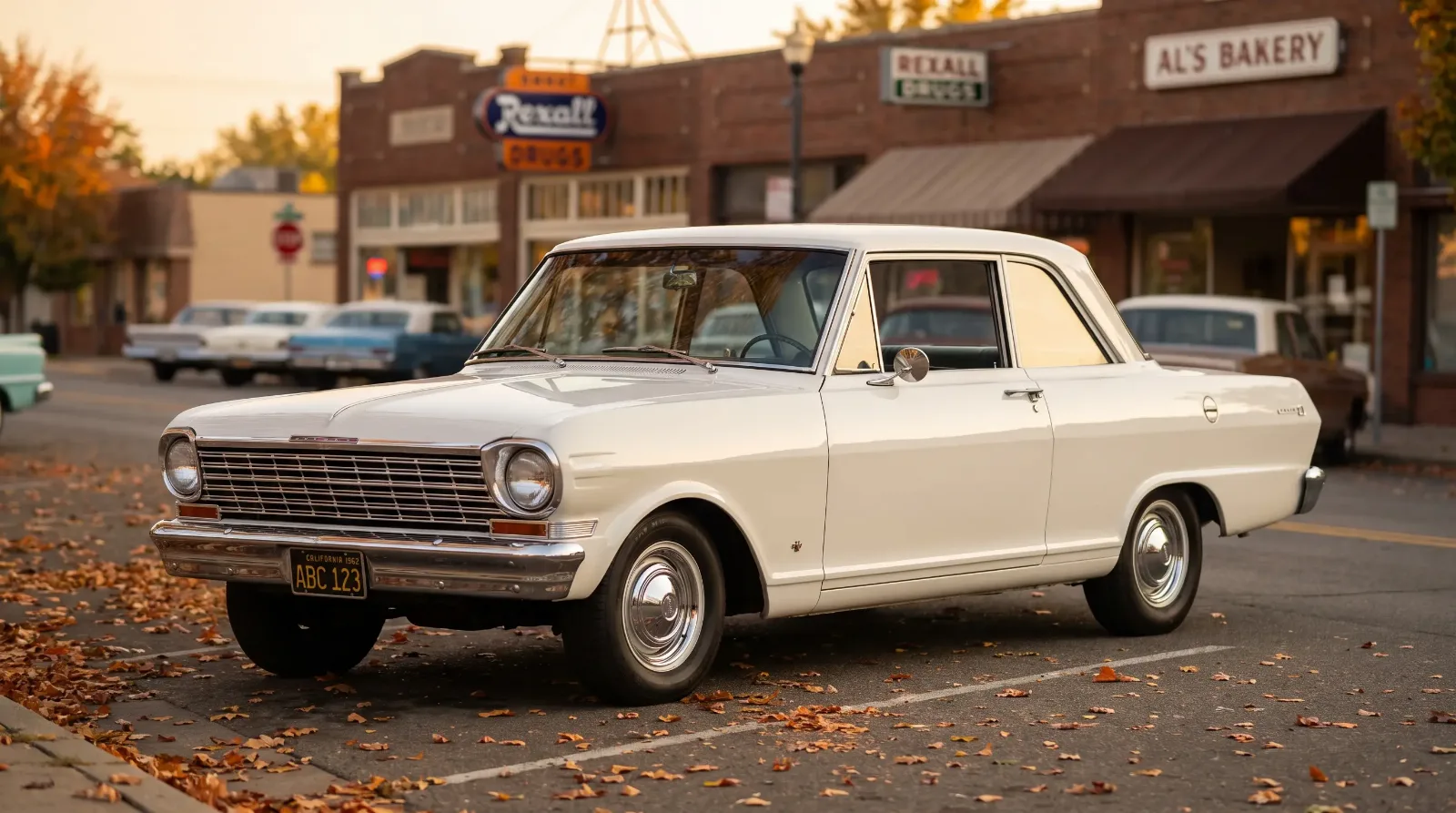
Why Chevrolet needed a compact, fast
By 1960, Chevrolet had a compact car on sale, the Corvair, and it was not stopping the bleeding to Falcon and Valiant. Buyers who wanted something small and affordable wanted it to behave like a small, affordable version of a normal car: front engine, conventional rear-wheel drive, a trunk that worked the way a trunk was supposed to work. The Corvair's engineering was clever. It was also a harder sell to a buyer who just wanted an economical second car for the family. Chevrolet management decided it needed a second compact, one built on entirely conventional lines, and it needed it fast.
That decision set an unusually tight clock running. Where a normal new model program ran several years from concept to production, the Chevy II was pushed through in roughly eighteen months, a compression that shaped nearly every engineering shortcut and cost decision made along the way.
Engineering it in a hurry
Speed meant borrowing wherever borrowing was possible and inventing only where it was unavoidable. The Chevy II used a simple unibody structure, a straightforward front suspension, and a rear axle setup that traded sophistication for durability and low cost. Nothing about the underlying engineering was exotic, and that was the point. A rushed program cannot afford to solve problems nobody has solved before. It succeeds by making conservative, well-understood choices correctly, and largely, Chevrolet's engineers did.
The results showed in ride and handling that critics of the era called unremarkable, and reliability that owners came to trust. It was not built to impress a road tester. It was built to start every morning and cost little to fix when it did not.
"People assume rushed always means cheapened. The Chevy II proves the opposite is possible. Give engineers a tight deadline and a conventional brief, and they'll build something plain that just works, year after year."
Tom Ramirez
Engines, trims, and body styles for 1962
The 1962 Chevy II launched with two engine choices: a 153 cubic inch inline four making 90 horsepower, and a 194 cubic inch inline six making 120 horsepower. Neither was designed to excite anyone. Both were designed to be cheap to manufacture and simple to service, in keeping with the car's entire mission.
Body styles at launch included a two-door sedan, a four-door sedan, a station wagon, and a convertible, with a two-door hardtop coupe joining shortly after. Trim levels ran from the base 100 series, through the mid-range 300 series, up to the Nova 400, which sat at the top of the lineup as the well-equipped, better-trimmed option rather than as a separate model in its own right.
| 1962 Chevy II | Detail |
|---|---|
| Engines | 153 ci inline-4, 194 ci inline-6 |
| Body styles | 2-door sedan, 4-door sedan, wagon, convertible, hardtop coupe |
| Trim levels | 100, 300, Nova 400 |
| Competes with | Ford Falcon, Plymouth Valiant |
Pricing was central to the whole exercise. A base Chevy II 100 two-door sedan started well under two thousand dollars, positioning it directly against the Falcon and Valiant on the sticker rather than trying to out-feature them. Chevrolet's dealers pushed the four-cylinder engine hard in early advertising precisely because it let salesmen quote the lowest possible monthly payment, even though the six-cylinder proved far more popular with actual buyers once they sat in the car and considered how they would actually use it, particularly for anyone planning highway driving or carrying a full load of passengers.
That gap between what the advertising emphasized and what buyers actually chose is a recurring theme in compact-car history from this period, and the Chevy II followed the pattern closely. The four-cylinder existed to win the sticker-price argument in showroom conversation. The six-cylinder existed to actually satisfy the buyer once the car left the lot.
Nova 400: the top trim, not yet a name
It is worth being precise here, because this is the point where a lot of casual histories get sloppy. In 1962, "Nova" was not the car. The car was the Chevy II. Nova 400 was simply the nicest trim package you could put on that car, the way a modern buyer might choose a top-of-the-line package on an otherwise ordinary model. Readers chasing the full arc of how that trim name eventually became the car's name on its own should look at the first-gen Chevy II for the broader picture, and I have written a companion piece that walks through exactly when and why the switch happened.
Reception and first-year numbers
The market answered quickly. Total 1962 Chevy II production landed at roughly 327,000 units across the full model range, a strong first year for a compressed program and proof that Chevrolet had read the compact-car buyer correctly. It was not a car that generated passionate press coverage, and it was not meant to. It plugged a real hole in the lineup, sold in real numbers, and set up everything that came after it, including the eventual Nova nameplate that would outlive the Chevy II name itself by a couple of decades.
Competitively, the numbers mattered more than the reviews. Ford and Plymouth were not going to concede the compact segment without a fight, and Chevrolet's dealers needed a car that could hold its own on the sales floor immediately, not after a generation of refinement. The 1962 Chevy II did that job. It gave Chevrolet a credible, conventional answer to sell against the Falcon and Valiant in the same conversation, on the same lot, without asking the salesman to explain an unconventional drivetrain layout the way a Corvair pitch required. That alone justified the rushed development schedule, whatever shortcuts it forced along the way.
Sources and notes
- Jalopnik: How Chevy Rushed the 1962 Chevy II Nova to Market in 18 Months
- Wikipedia: Chevrolet Chevy II / Nova
- Mac's Motor City Garage: Emergency-Room Engineering, The 1962 Chevy II
- Wikipedia: Chevrolet 153 4-cylinder engine
- Conceptcarz: 1962 Chevrolet Chevy II Series Specifications
- Drivin' It Home: Chevy II/Nova Production Numbers
Related Reading
Have a
Chevrolet Nova
for Sale?
Reach thousands of serious classic car collectors across the US.
Sell It Here →
Are You a Classic Car Dealer?
List your full inventory and connect with targeted classic car buyers.
Join as a Dealer →

About the author
Tom Ramirez
Corvette researcher and historian based in Bowling Green, Kentucky. Two decades documenting Corvette production history from original factory records.
Related Listings - Chevrolet Nova
Comments
Be the first to comment on this article.