
The kid in the driveway with a Cutlass Supreme up on jack stands is a scene that's played out in front yards across the country for fifty years, and it's still playing out now, just with the occasional YouTube tutorial pulled up on a phone propped against the fender. There's a reason so many people's first real muscle car project starts with an Oldsmobile Cutlass rather than a Chevelle or a Mustang, and it isn't nostalgia alone. It comes down to something more practical: this is a genuinely forgiving car to learn on.
Car Features
6 min read
Why the Cutlass Is a First Project Car
Why does a first muscle car project so often start with an Oldsmobile Cutlass? Parts availability, a forgiving layout, and a welcoming owner community.
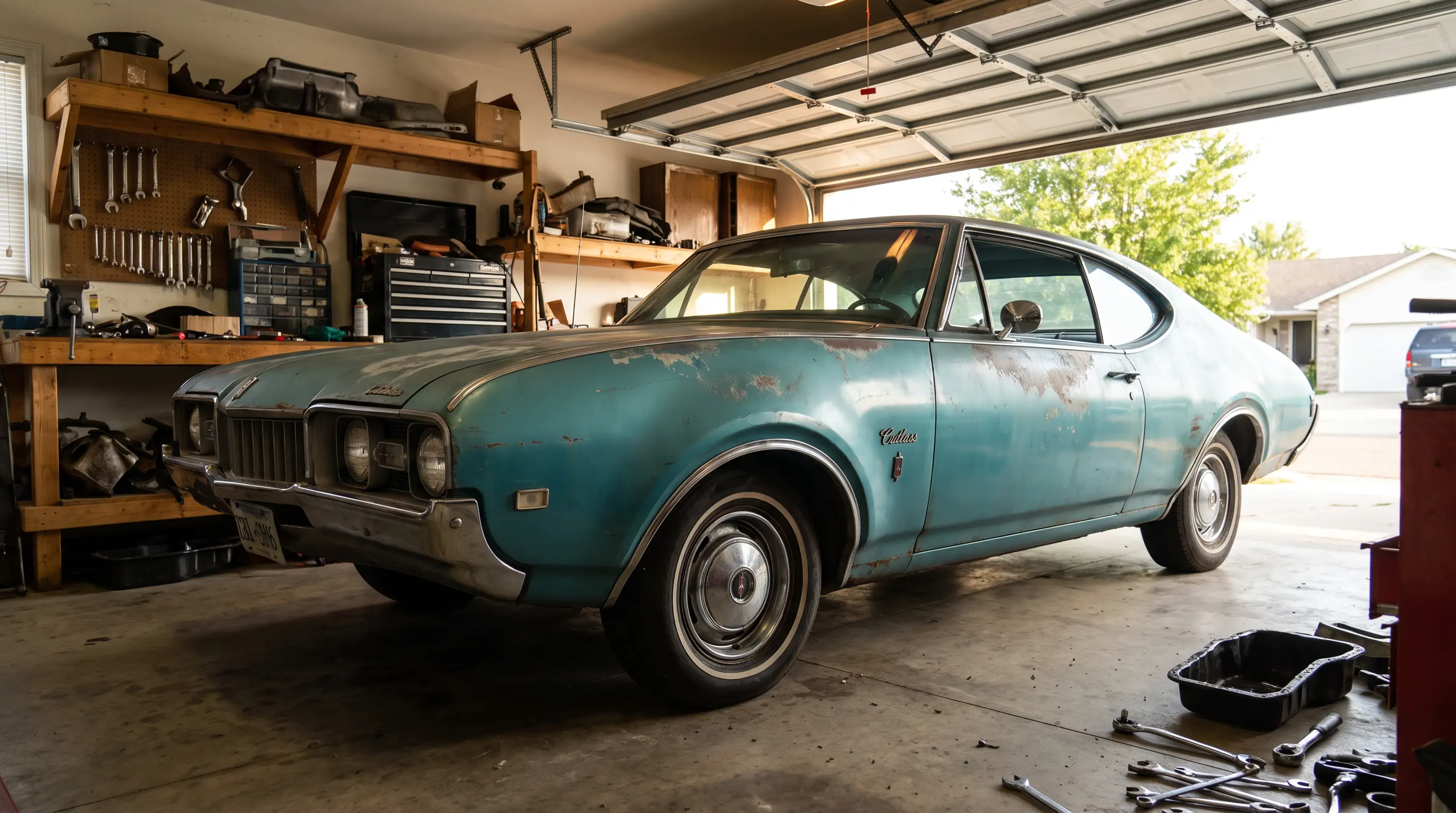
I've talked to enough first-time builders over the years to notice the pattern repeat itself. Someone's uncle had one, or their dad's first car was a hand-me-down Cutlass, and twenty years later they're standing in their own garage with one of their own, working through the same lessons their family did a generation earlier.
Why this car in particular
Start with the obvious reason: there are a lot of them. Oldsmobile built the Cutlass in enormous numbers through the 1970s, and that volume means parts availability today is far better than it is for rarer performance cars from the same period. A first-timer who strips a thread or cracks a bracket isn't looking at a months-long hunt for a replacement. Reproduction and used parts markets for the Cutlass are deep, and that changes the whole psychology of a first build. Mistakes become recoverable instead of catastrophic.
The mechanical layout helps too. These are body-on-frame cars with straightforward suspension geometry and engine bays that weren't designed around tight packaging the way later unibody cars were. There's room to work, room to see what you're doing, and room to make an honest mistake without needing a lift and three specialty tools to fix it. That matters enormously to somebody who's never pulled an engine before and is learning from a manual and a forum thread rather than a trade school.
What actually goes wrong on a first build
The most common first-project mistake isn't mechanical, it's sequencing. New builders want to tackle the engine first because it's the exciting part, and they end up doing expensive drivetrain work on a car whose floors and frame connectors turn out to be rotted through underneath. The right order is almost always structure first, then mechanicals, then cosmetics, and it's a hard lesson that usually only sticks after somebody's learned it the expensive way once.
The second common trap is buying a car that looks better in photos than it is in person, particularly around rust in the trunk floor, the rear frame rails, and the lower cowl. A Cutlass with cosmetic issues is a good learning project. A Cutlass with structural rust hidden under fresh undercoating is a money pit dressed up as a bargain, and telling those two apart is exactly the kind of skill a first-timer hasn't developed yet.
| Build stage | Typical first-timer focus | Better order |
|---|---|---|
| Structure and frame | Often skipped or assumed fine | Inspect and address first, before anything else |
| Engine and drivetrain | Tackled first out of enthusiasm | Second, once the structure is confirmed sound |
| Interior and trim | Rushed to make the car look finished | Third, after mechanicals are proven reliable |
| Paint and cosmetics | Prioritized for visible progress | Last, once everything underneath is right |
"Everybody remembers their first car project a little differently, but the ones who started on a Cutlass tend to actually finish. That's not an accident. This is a car built to be worked on by regular people in a regular driveway, and that hasn't stopped being true just because it's fifty years old now."
Patrick Walsh
Budgeting for a first build honestly
The number that sinks most first projects isn't the purchase price of the car, it's the gap between what a new builder budgets and what the job actually costs once the fenders come off and the real condition underneath shows itself. A Cutlass bought cheap because it "just needs a little work" almost always needs more than a little work, and the honest first step is assuming the worst about rust and structural issues until you've personally confirmed otherwise with a magnet and a flashlight.
A realistic first-timer's budget sets aside a meaningful cushion, often close to the purchase price itself, for the structural surprises that don't show up until the car is stripped down. That's not pessimism. It's just how these projects tend to go, and builders who plan for it finish their cars. Builders who don't plan for it are the ones who end up parting the project out halfway through, disillusioned by a bill nobody warned them about.
The payoff beyond the first build
What happens after that first project is often more interesting than the project itself. People who cut their teeth on a Cutlass tend to stay in this specific corner of the hobby rather than drifting off to something else, and a lot of that comes down to community. This is why the Cutlass endures we're talking about, and the network of owners, swap meets, and shared knowledge around it is one of the more welcoming corners of the classic car world for somebody who's still learning.
That community aspect is worth taking seriously before you even start turning wrenches. A lot of first builders find their footing faster once they connect with people who've already been through it, and there's a related deep-dive on exactly where to find that kind of support once your project is underway. The car gets you started. The people around it are usually what keeps you going.
Sources and notes
Related Reading
Have a
Oldsmobile Cutlass
for Sale?
Reach thousands of serious classic car collectors across the US.
Sell It Here →
Selling a classic? Here's how: the best sites to sell a classic car
Are You a Classic Car Dealer?
List your full inventory and connect with targeted classic car buyers.
Join as a Dealer →
#beginner restoration
#classic car build
#442
#muscle car restoration
#Oldsmobile Cutlass
#first project car

About the author
Patrick Walsh
Automotive journalist covering classic car shows, events, and the enthusiast community across North America.
Related Listings - Oldsmobile Cutlass




Comments
Be the first to comment on this article.