
By 1960, the car-truck rivalry between Chevrolet and Ford had already produced its first real strategic split. Ford moved the Ranchero onto the compact Falcon platform, cutting size and cost while keeping the concept's core appeal intact. Chevrolet, meanwhile, carried the El Camino into its second and, as it turned out, final year on the full-size Impala-based platform, unchanged in its basic formula from the debut season. Round two of this rivalry was not fought on equal footing, and the 1960 model year makes that imbalance easy to trace.
Car Features
7 min read
1960: Round Two in the Cartruck War
In 1960, Ford moved the Ranchero to the compact Falcon platform while Chevrolet kept the full-size El Camino unchanged, and lost. Here is how round two played out.
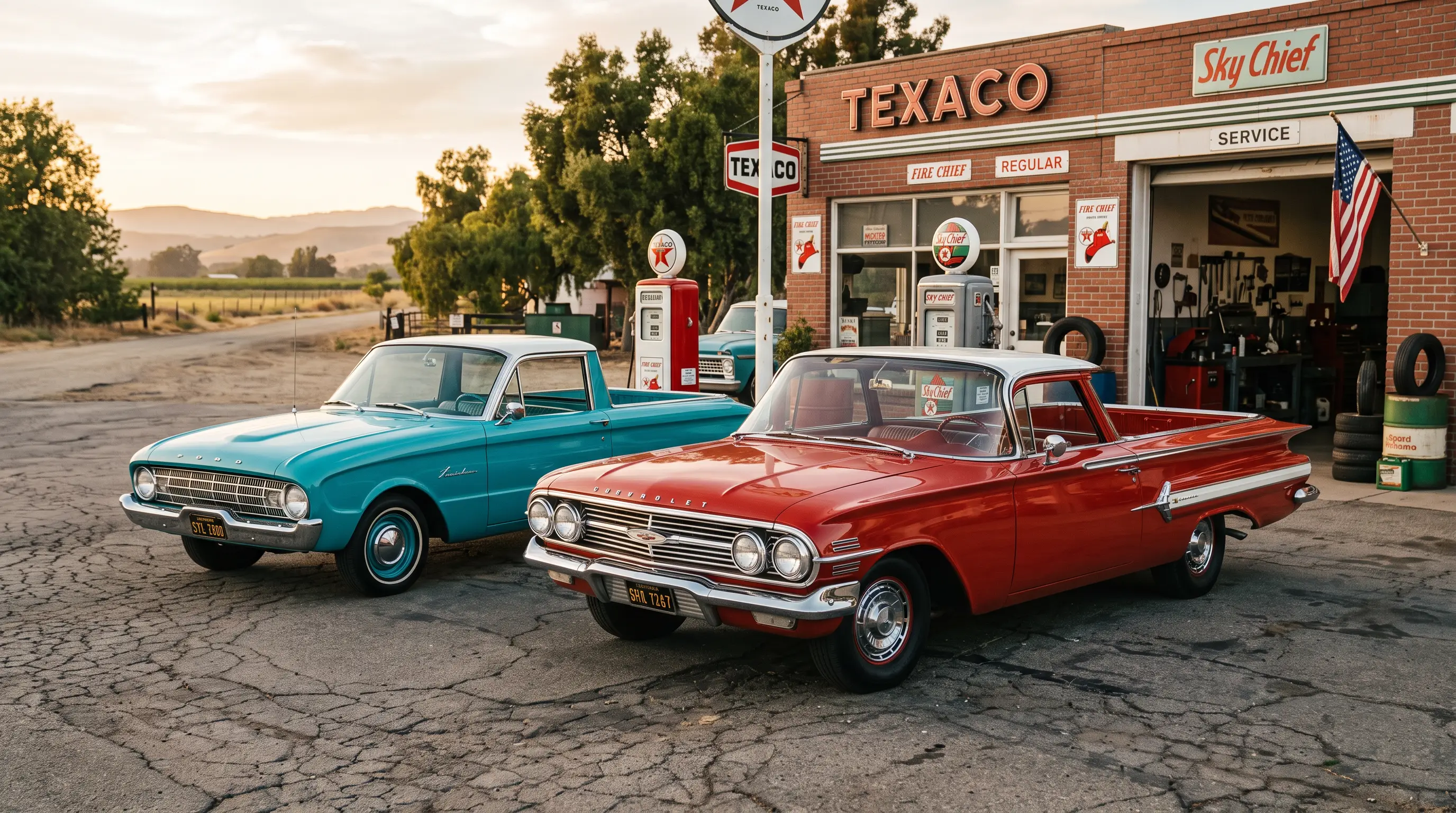
Ford's platform pivot changes the entire equation
Ford's decision to shift the Ranchero onto the Falcon chassis for 1960 was not a minor trim update. It was a wholesale rethinking of what the car-truck concept should weigh, cost, and drive like. The Falcon-based Ranchero was smaller, lighter, and more fuel efficient than its full-size predecessor, and it undercut the full-size El Camino on price by a meaningful margin. For a buyer weighing practicality over spectacle, that combination was difficult to argue against, and Ford's sales figures for the newly downsized Ranchero reflected the strength of that pitch.
This pivot also signaled something about where Ford believed the segment's future lay. Rather than doubling down on the full-size format that had defined the Ranchero's first three years, Ford bet that buyers wanted efficiency and value more than they wanted size and drama. That bet would prove correct not just for the Ranchero but for the broader compact car movement gathering momentum across the American market as the 1960s began.
Chevrolet's unchanged second year
Chevrolet, by contrast, brought the El Camino back for 1960 largely as-is, still riding the full-size Impala platform with only modest styling revisions to match the year's broader Chevrolet lineup changes. There was no compact pivot to match Ford's move, no meaningful reduction in size or cost, and no signal that Chevrolet had absorbed the lesson Ford's Falcon-based Ranchero was actively demonstrating in the marketplace. The 1960 El Camino essentially repeated its debut-year pitch to a market that was already shifting away from that pitch's core assumptions.
Sales reflected the mismatch. The 1960 El Camino sold in numbers that, by most accounts, trailed its already modest 1959 debut, giving Chevrolet's leadership little reason to commit to a third model year on the same platform. Whether internal planners fully understood Ford's Falcon strategy as the reason for the softening demand, or attributed it to more general market factors, the practical result was the same. Chevrolet discontinued the El Camino after the 1960 model year, ending round one of this rivalry with Ford holding a clear structural advantage.
What round two actually decided
It would be an overstatement to call 1960 a knockout blow in the traditional sense, since Chevrolet's exit from the segment was a business decision rather than a collapse forced by direct competitive pressure. But the timing is difficult to read as coincidence. Ford correctly identified that the car-truck concept worked better on a smaller, cheaper platform, executed that pivot decisively, and watched its rival exit the market in the very same year. Whatever internal reasoning drove Chevrolet's decision, the external appearance was of a company that had built the wrong version of the right idea and then walked away rather than correct course immediately.
That walk-away would not last. Chevrolet returned to the segment in 1964 with the Chevelle-based El Camino, a car built on exactly the kind of smaller, more efficient platform that Ford had already proven out with the Falcon-based Ranchero four years earlier. In hindsight, the lesson Chevrolet needed after 1960 was already sitting on Ford's lot the whole time.
"Chevrolet did not lose round two because Ford outsold them by some enormous margin. They lost it because Ford figured out what the segment actually wanted, and Chevrolet had not yet."
- Sarah Whitfield
Reading the styling changes correctly
The 1960 El Camino did receive Chevrolet's broader lineup restyling for the year, including revised grille work and reworked taillamp treatments that followed the full-size Impala and Bel Air's updated look. These were the same styling updates applied across Chevrolet's full-size passenger cars, not changes specific to the El Camino or its role in the market. A buyer comparing the 1959 and 1960 model years side by side would notice the trim differences immediately, but those differences reflect Chevrolet's annual styling cycle rather than any strategic rethink of the car-truck concept itself.
That distinction matters for anyone trying to understand why the 1960 model failed to reverse the segment's momentum toward Ford. A styling refresh, however well executed, does nothing to address a fundamental size and cost disadvantage against a rival that had just repositioned its entire platform. Chevrolet essentially brought a sharper-looking version of the same argument to a fight it was already losing on more basic terms.
Why this decisive year still shapes collector value today
For collectors today, the 1960 El Camino occupies a specific and somewhat overlooked niche. As the final year of the original full-size format before Chevrolet's multi-year absence from the segment, it represents the end of an experiment rather than the start of one, which gives it a slightly different historical weight than the more celebrated 1959 debut model. Surviving 1960 examples are scarce, a product of both low original sales and six and a half decades of ordinary attrition, and documentation on production specifics can be harder to pin down than for the more heavily discussed 1959 debut year.
Readers who want the full arc of this rivalry, from Ford's initial 1957 launch through Chevrolet's two false starts and eventual 1964 correction, will find that more on the el camino vs ranchero covers the complete sequence in one place. For the earlier history of how the segment began before this particular showdown, where this started traces the Chevrolet side of the story back to its own origins. And for anyone whose interest in this history has turned into an actual search for a car, classic El Caminos on the market span every era of this rivalry, from the rare full-size originals to the far more common Chevelle-based generation that eventually settled the argument for good.
A 1960 El Camino found today in genuinely original condition is, in a real sense, a snapshot of Chevrolet's last attempt at the full-size format before the company stepped back to rethink the entire concept from the platform up. That makes it a small but meaningful chapter in a rivalry that would ultimately run for decades longer than anyone shopping either lot in 1960 could have predicted, and it is precisely that overlooked status that keeps prices on genuine examples reasonable relative to their actual rarity.
It is worth noting how differently this moment reads depending on which company's archives you trust more. Ford's own retrospective materials tend to frame the Falcon-based pivot as a deliberate, confident strategic move planned well in advance, while independent historians describe a somewhat messier process of internal debate about whether the Ranchero should stay full-size at all. Chevrolet's side of the story is even thinner on record, since a discontinued model rarely gets the same internal documentation as one the company plans to keep building. What survives are dealer bulletins, contemporary road tests, and sales figures, and all three point in the same direction even without a tidy internal memo to confirm the obvious conclusion.
Sources and notes
Related Reading
Have a
Chevrolet El Camino
for Sale?
Reach thousands of serious classic car collectors across the US.
Sell It Here →
Selling a classic? Here's how: compare the places to sell classic cars
Are You a Classic Car Dealer?
List your full inventory and connect with targeted classic car buyers.
Join as a Dealer →

About the author
Sarah Whitfield
Third-generation classic car collector specializing in pre-war American and European coachbuilt automobiles. Researcher and concours enthusiast.
Related Listings - Chevrolet El Camino
More in Car Features
Comments
Be the first to comment on this article.