
I was at a Pontiac club meet a few summers back, standing next to a fellow with a six-cylinder Sprint model, when a guy walked up and asked him why he'd bothered restoring "the slow one." The Sprint owner didn't argue. He just popped the hood and pointed at the overhead cam six sitting where everybody expected a plain old inline six to be. That conversation is basically the whole story of the Firebird 1967 lineup in miniature: people assume they know what a base Pontiac pony car was, and the actual lineup keeps surprising them.
Car Features
6 min read
The Firebird in Pontiac's 1967 Lineup
Pontiac launched the Firebird as five distinct series built around five different engines, and the shape of that 1967 lineup explains a lot about what the car was trying to be.
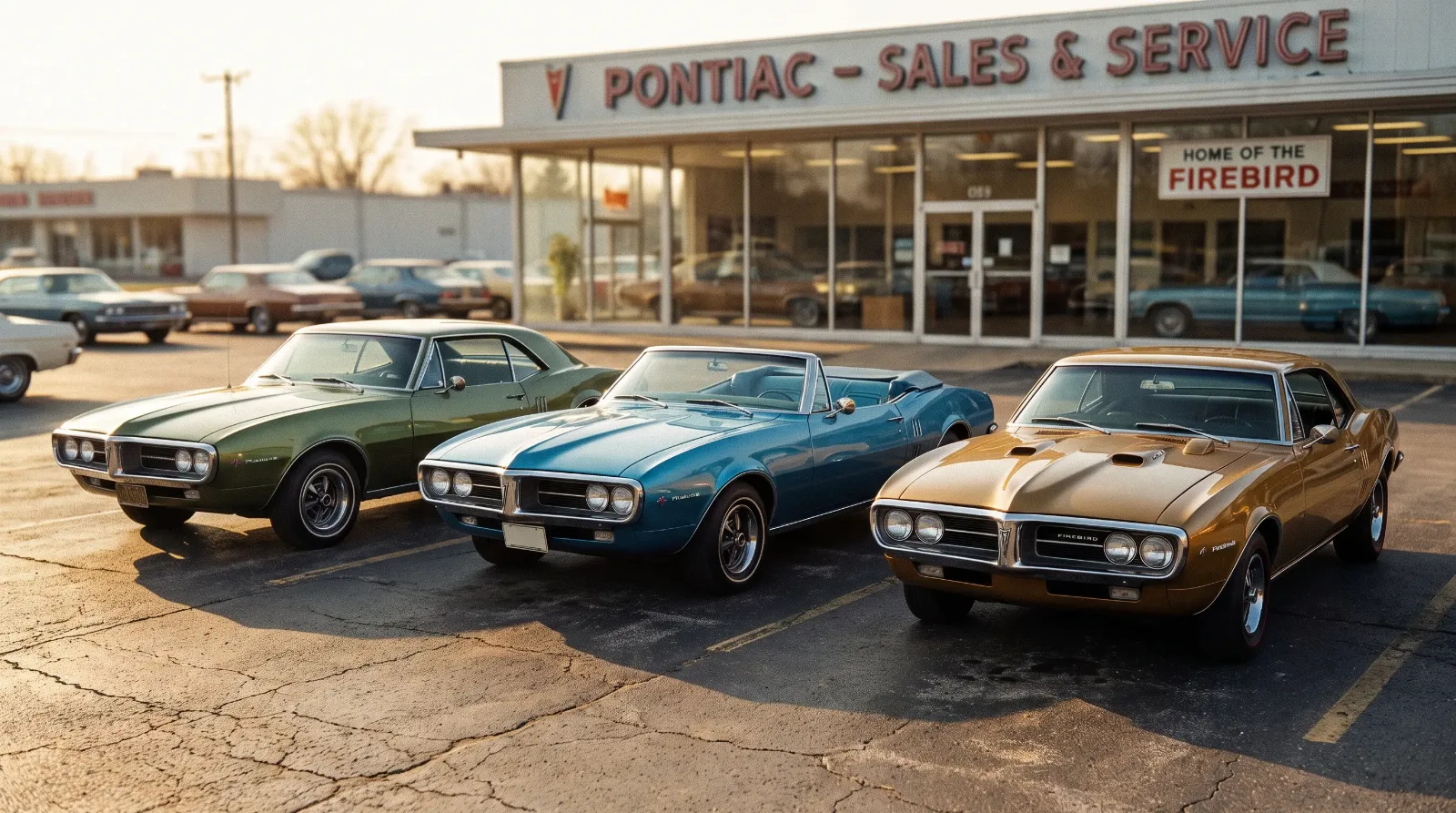
Five ways into one car
Pontiac didn't launch the Firebird as a single model with an options list bolted on. They launched it as five distinct series, each built around a specific engine, and a buyer walking into a Pontiac dealer in early 1967 picked a series before they picked much of anything else. There was the base Firebird with a standard six-cylinder, the Sprint with the overhead cam six, the Firebird 326 with a small-block V8, the 326 H.O. with a hotter version of that same engine, and the Firebird 400 sitting at the top with the big engine borrowed from the GTO parts bin. That's not a trim ladder in the modern sense. It's closer to five separate cars wearing one body.
The reasoning behind it makes sense once you think about who Pontiac was actually trying to reach. Chevrolet had the Camaro out first, and Pontiac needed a car that could compete for the same buyer at every price point Chevrolet was hitting, from a secretary's first car up through a genuine street performer. Building five distinct series let a single dealer floor cover all of that ground under one nameplate.
The Sprint nobody expects
The overhead cam six was the one that made engineers at other manufacturers pay attention, and it's the one modern buyers still underestimate. Pontiac didn't build it to be a curiosity. They built it because a well-sorted six with an overhead cam and a decent state of tune could out-handle and, in the right configuration, out-run a lazy V8, all while weighing less over the front wheels. The Sprint package added a Rochester Quadra-Jet four-barrel carburetor and higher compression over the base six, lifting output to 215 horsepower from the base engine's 165, and it turned the "economy" engine option into something a genuine enthusiast could take seriously.
I've heard the same story from three or four different longtime owners now, always with slight variations: somebody at a stoplight assumed the Sprint badge meant nothing, found out otherwise, and went home with a different opinion about six-cylinder Pontiacs. That's not a coincidence. That's the car doing exactly what it was built to do.
Where the 400 changed the conversation
The Firebird 400 sat at the top of the 1967 lineup and it's the series most people picture when they hear the name today, but it wasn't the volume seller. It was the halo. Pontiac built it around the same 400 cubic inch engine family that powered the GTO, and putting that engine in the smaller, lighter Firebird body created a genuinely quick car for the era, one that got Pontiac taken seriously in a segment Chevrolet had a head start on.
What settles the argument about how seriously Pontiac took the 400 series isn't a magazine road test from 1967. It's the parts record. Look at what Pontiac spec'd for cooling, for the rear axle, for the suspension pieces on a 400-equipped car versus a base six, and you can see a company that engineered the top of the lineup rather than just dropping a bigger engine into an unchanged chassis.
| 1967 series | Engine family | Market position |
|---|---|---|
| Firebird | Base inline six | Entry-level, value-focused buyer |
| Firebird Sprint | Overhead cam six, four-barrel | Enthusiast six, handling-focused |
| Firebird 326 | 326 cubic inch V8 | Mainstream V8 buyer |
| Firebird 326 H.O. | 326 V8, high output tune | Step-up performance |
| Firebird 400 | 400 cubic inch V8 | Halo performance model |
Why the five-way split didn't last
Pontiac simplified this structure in later years of the first generation, and it's worth understanding why a lineup this deliberately built got streamlined so quickly. Managing five distinct engine series across one body style is expensive, both in engineering and in dealer inventory terms, and as the market sorted itself out, certain series proved themselves and others didn't carry their weight in sales volume. The overall shape of the lineup, base six through top V8, survived. The exact five-way split from the debut year was a product of a specific moment, Pontiac trying to cover every possible buyer at launch, and that moment passed once the sales data came in.
"Everybody at the club had an opinion about which 1967 series was the 'real' Firebird until somebody laid out the build sheets side by side. Once you see what Pontiac actually spec'd for cooling and rear gears across those five series, the argument about which one mattered most kind of settles itself."
Wayne Coburn
Reading the lineup today
Understanding the full five-series structure changes how you look at a survivor today. A Sprint isn't a base car with a badge. A 326 H.O. isn't the same animal as a plain 326. Buyers who skip past the early Firebird chapter and jump straight to shopping tend to undervalue the mid-tier cars, when in fact the 326 H.O. and the Sprint tell you more about what Pontiac was capable of in 1967 than the range-topping 400 does on its own. For the fuller arc of how this all fits into Pontiac's Firebird history, and for anyone who wants to keep reading the series from the debut year forward, the five-series structure is the foundation everything else in this generation was built on.
If you're shopping this generation now, knowing which series you're actually looking at, not just the badge on the fender, is the difference between paying fairly and paying for a story somebody told you at a swap meet. Current listings of first-gen Firebirds for sale are a good place to see how that lineup structure still shapes prices nearly six decades later.
Sources and notes
- Old Cars Weekly: The Six-cylinder Firebird Sprint, Slouch or Sleeper?
- Curbside Classic: 1967 Pontiac Firebird, The Sexy Six
- Ate Up With Motor: Cammer, The Pontiac OHC Six
- Wikipedia: Pontiac Firebird (first generation)
- Hagerty Valuation Tools: Pontiac Firebird
- Barn Finds: OHC Survivor, 1967 Pontiac Firebird Sprint
Related Reading
Have a
Pontiac Firebird
for Sale?
Reach thousands of serious classic car collectors across the US.
Sell It Here →
Are You a Classic Car Dealer?
List your full inventory and connect with targeted classic car buyers.
Join as a Dealer →

About the author
Wayne Coburn
Longtime Corvette owner, judge and club figure who knows the cars, the records and the people behind them.
Related Listings - Pontiac Firebird




Comments (2)
N
Norm Delgado
2 months ago
Been in the hobby thirty years. The quality of information available now compared to the mid-90s is remarkable. This is a good example.
G
Gary Tompkins
1 month ago
Had one of these about fifteen years ago. Sold it when life got complicated. Regret it most years come auction season.