
Most first-generation Pontiac Firebird buyers in 1967 walked past the six-cylinder option without a second look, assuming it was the base engine for people who did not care about performance. That assumption cost them a chance at one of the more interesting engineering stories in the whole Firebird line. The Sprint package, built around Pontiac's own overhead cam six, was a genuinely unusual piece of engineering hiding under a badge that suggested nothing of the kind, and a related engineering effort, the Sprint Turismo prototype program, is rarer still and far less discussed because it never actually reached a showroom.
Car Features
6 min read
The Rare Pontiac Firebird Sprint and Sprint Turismo Prototype
Pontiac's Firebird Sprint hid a genuinely unusual overhead cam six under an unassuming badge, and the rarer Sprint Turismo racing prototype never even reached a showroom.
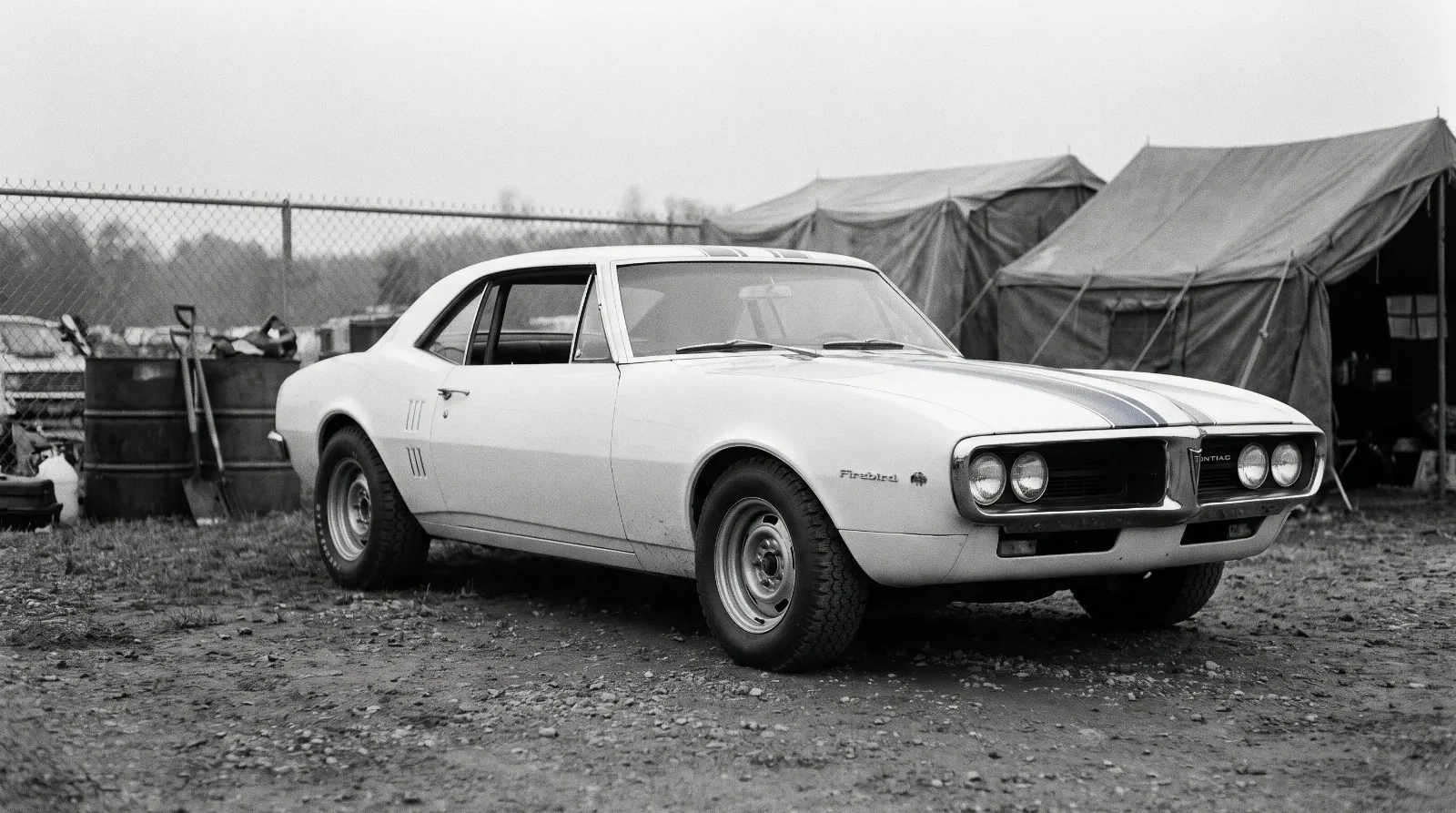
The Sprint option and Pontiac's overhead-cam six
When the Firebird launched for 1967, Pontiac offered an OHC six option called the Sprint, built around a 230 cubic inch overhead cam inline six developed under John DeLorean's direction. This was not a warmed-over version of the corporate six shared across GM divisions. Pontiac's engineers gave it a belt-driven overhead camshaft at a time when that layout was almost unheard of in American production engines, most of which still ran pushrod valvetrains across the board.
The Sprint package paired that engine with a four-barrel carburetor, a stronger exhaust setup, and a suspension tune aimed at drivers who wanted genuine handling rather than straight-line bragging rights. Factory ratings put the OHC six Sprint at 215 horsepower for 1967 and 1968, rising to 230 horsepower in 1969 for cars ordered with the four-speed manual, a genuinely competitive number against some V8 options of the period, delivered through an engine most competitors assumed was a fuel-economy afterthought.
What made the OHC six different
Overhead cam engines were common in Europe by the mid-1960s but nearly absent from Detroit's regular production lineups. Pontiac's decision to engineer one in-house, rather than license an existing design, reflected an unusual appetite for engineering risk on a car aimed at a mainstream buyer. The belt-driven cam design kept the engine relatively compact and allowed for a higher redline than a comparable pushrod six, which is exactly what let the Sprint package post numbers that surprised people cross-shopping small-block V8 Firebirds.
That same complexity worked against the engine's reputation over time. A belt-driven overhead cam six was more expensive to service than Pontiac's conventional engines, and dealers outside the Firebird's core markets were not always equipped to handle it. The engineering ambition that made the Sprint interesting is the same thing that made it a harder sell once the warranty period ended.
Sprint Turismo: the racing prototype that never reached a showroom
Where the production Sprint got real magazine coverage in period, the Sprint Turismo, internally known as PFST, sits much further into the documentation gap because it was never actually sold to the public. Pontiac engineers Herb Adams and Bill Collins built the PFST in 1967 as a hardened, SCCA-focused answer to the Camaro Z/28, running the project in parallel with a separate effort by former racer John Fitch, who received a 400 cubic inch Firebird and an OHC six Sprint car directly from John DeLorean to modify and test at Lime Rock.
What killed the PFST was regulatory, not mechanical. The prototype originally ran triple Weber carburetors, which ran straight into GM's corporate ban on multiple carburetion. Pontiac's engineers swapped in a single larger Rochester Quadrajet to get around that rule, but the modified engine then failed to meet drive-by noise regulations, and the project was shelved before it ever became a regular production option. Magazine testers did get seat time in the prototype, which is why period road tests exist for a car that was never actually for sale.
Fitch's own parallel-built cars are a separate, smaller population. He is not certain of the exact count from his own shop, but estimates put it around six to eight modified Firebirds, nearly all running the 400 cubic inch V8 with only one built around the OHC Sprint six.
Why so few survive
The production Sprint suffered from the slow attrition that claims unusual factory options generally. Owners who did not know what they had replaced the OHC six with a more familiar V8 when repairs got expensive, and dealers were not shy about recommending exactly that swap. The Sprint Turismo prototypes and Fitch's parallel-built cars face a different problem entirely: there were only ever a handful of them, built as engineering exercises rather than customer cars, so the surviving population was tiny from day one and has nothing to do with owners swapping parts later.
Survivors that remain correct today are concentrated among owners who understood the engineering story early and kept the original drivetrain components matched to the car's build sheet. That is a smaller population than most Firebird variants from the early Firebird chapter, and for the Fitch and PFST cars specifically, it shrinks to a small number of known survivors rather than an unknown-but-larger production run.
"The Sprint six proved Pontiac could out-engineer its own reputation when it wanted to. The Sprint Turismo proves how close the company came to building something even sharper, and how a carburetor ban and a noise regulation can erase a car from history almost as effectively as nobody writing down the numbers at the time."
Tom Ramirez
Buying one today
If you are chasing an original Sprint, treat documentation as the deciding factor over cosmetic condition. A rough but numbers-matching OHC six car with a verifiable build sheet is worth more attention than a beautifully restored Firebird wearing a drivetrain nobody can confirm. A genuine Sprint Turismo or Fitch-built car is a different proposition entirely, closer to a museum find than a market segment, so treat any such claim with real skepticism until the provenance is nailed down. For the fuller mechanical story behind the overhead cam engine itself, a related deep-dive covers its development in more depth. And if this history has you shopping in earnest, current classic Firebirds for sale is the place to see what is actually available right now, Sprint badge or not.
Sources and notes
- Ate Up With Motor: Cammer, The Pontiac OHC Six
- Hagerty: Pontiac's Sprint Six Could Have Triggered an Alternate Muscle-Car Multiverse
- Autoevolution: The 1967 Pontiac Fitch Firebird
- First Generation Firebirds: 1967 Fitch Firebird
- Curbside Classic: 1967 Firebird, Pontiac's Rare and Special OHC Six
- OnAllCylinders: Pontiac's Innovative OHC Sprint Inline Six
Related Reading
Have a
Pontiac Firebird
for Sale?
Reach thousands of serious classic car collectors across the US.
Sell It Here →
Are You a Classic Car Dealer?
List your full inventory and connect with targeted classic car buyers.
Join as a Dealer →

About the author
Tom Ramirez
Corvette researcher and historian based in Bowling Green, Kentucky. Two decades documenting Corvette production history from original factory records.
Related Listings - Pontiac Firebird
Comments
Be the first to comment on this article.