
Firebird t-tops are one of those options that split buyers into two camps and never really stopped. Pontiac did not invent the idea, GM had been fielding open-air alternatives to a full convertible for years, but the second-generation Firebird is where the T-top became a fixture on build sheets and, eventually, a line item that moves prices at auction. I look at these cars the way I look at any option package: does it hold value, and does the ownership cost match the premium buyers pay for it. On the Firebird, the answer is more complicated than the folklore suggests.
Car Features
7 min read
T-Tops and the Open-Air Firebird
Firebird t-tops brought open-air driving to a car without a convertible option, but the roof panels carry real ownership trade-offs that show up directly in today's asking prices.
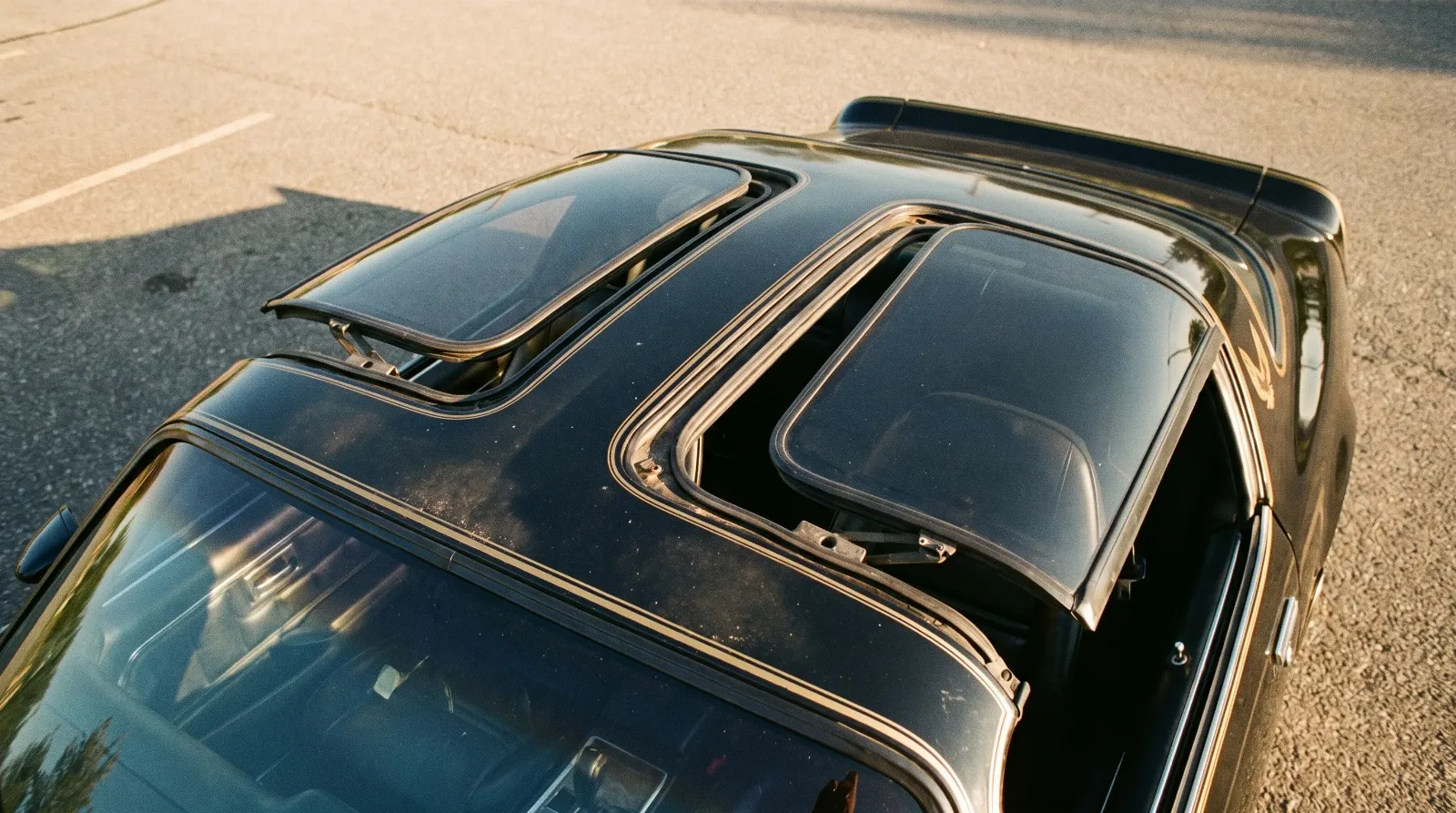
Why the T-top option existed at all
A full convertible Firebird disappeared after the 1969 model year, and it would not return until 1991. That left a decade-plus gap where anyone wanting open-air motoring in a Firebird had exactly one factory answer: the T-top roof, with its twin removable glass or acrylic panels and a fixed center bar for structural support. Pontiac phased the option in during the mid-1970s as convertible sales collapsed industry-wide, partly over rollover-standard rumors that never became law, and partly because Detroit had decided hardtops sold better anyway. The T-top let Pontiac offer open-sky driving without re-engineering the unibody for a soft top, which on a second-gen F-body would have been an expensive redesign this late in the car's life.
The panels themselves were sourced and assembled by an outside supplier rather than built in-house, a detail collectors still ask about because the fit and hardware differ subtly from later GM-produced T-tops. That distinction matters more to detail-obsessed restorers than to the market as a whole, but it is worth knowing before you argue about "correct" latches at a car show.
What buyers actually got, and gave up
Structurally, cutting two large holes in a unibody roof is not free. Pontiac reinforced the rocker panels and added bracing to compensate, but T-top cars still flex more than fixed-roof cars over rough pavement, a trait enthusiasts call cowl shake. It is not dangerous, but you feel it, especially on a warm day over broken asphalt. The bigger complaint, the one that shows up in nearly every long-term ownership account, is water intrusion. The seals were adequate when new and mediocre once they aged, and a T-top Firebird that has sat outside for a few decades without seal replacement usually has some history of water finding its way into the headliner or trunk.
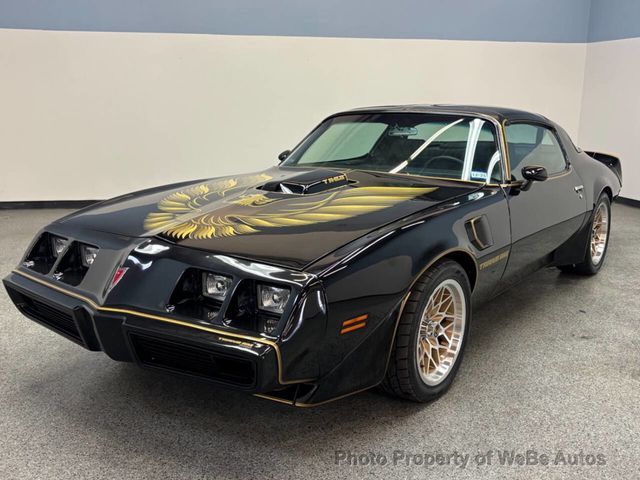
None of that stopped people from ordering the option. It sold well enough that unbroken T-top production runs became common on higher trims, and it is closely tied in buyers' minds to the Trans Am's late-1970s pop-culture moment, when open-roof cars photographed better and sold the fantasy harder than a fixed hardtop ever could. That association is doing real work in today's market, which brings me to the number that matters most to anyone shopping one now.
The reseal question every buyer eventually asks
Weatherstripping is a wear item, not a permanent part, and on a car this age the honest assumption should be that the seals have been replaced at least once if the current owner has been paying attention. A reseal job touches both panel gaskets, the center bar seal, and often the rear glass gasket at the same time, since water tends to find every weak point in one pass rather than picking a single spot to fail. Parts availability for these seals is better than it was a decade ago thanks to the reproduction market, so the job itself is not the obstacle. The obstacle is finding out whether it was ever done before you are the one smelling mildew in the trunk carpet.
I also tell buyers to check the headliner edges specifically, not just the trunk. A headliner that has been replaced once already, with slightly different stitching or fabric texture than the rest of the interior, is a quiet confession that water got in at some point and someone dealt with the damage rather than the cause. That is not automatically a dealbreaker. It just means you should ask directly whether the seals were addressed at the same time, because replacing the symptom without fixing the leak is a common shortcut on cars that changed hands quickly.
The pricing gap between T-top and fixed-roof cars
Auction data on comparable second-gen Firebirds consistently shows a premium for documented, leak-free T-top cars over otherwise equivalent fixed-roof examples. The spread is not enormous on lower trims, where the option was common enough that it barely moves the needle, but it widens on Trans Ams and Formulas from the peak years, where T-tops are part of the expected spec and a fixed-roof car actually reads as the unusual one.
| Condition / documentation | Typical market position |
|---|---|
| T-tops with fresh seals, no leak history, clear paperwork | Commands the strongest bids in a given trim |
| T-tops with old, hardened seals, unknown leak history | Priced at a discount to reflect likely reseal cost, which owners report can run well past $1,000 once labor and cleanup are included |
| Fixed-roof car, factory documented as never optioned | Steady demand from buyers who prioritize structural rigidity over open air |
| Fixed-roof car with evidence of a removed or swapped roof | Discounted until the history is sorted out |
What that table does not capture is condition risk. A T-top car with soft, cracked weatherstripping and rust starting at the roof rail is not a bargain just because the seller lists it below fixed-roof comps. You are buying a repair bill along with the panels, and that repair touches the headliner, the rear window seal, and sometimes the trunk floor if water has been finding its way back there for years.
My take on buying one
If you are cross-shopping the 1970s Firebird story against a specific car for sale, the T-top question is really a documentation question. Ask for service records that mention seal replacement. Ask when the panels were last removed and reinstalled, since gaskets that have not been disturbed in twenty years are rarely still doing their job. A car with recent reseal work, verified with photos or receipts, is worth paying up for. A car where the seller cannot answer basic questions about water intrusion is a renegotiation waiting to happen, regardless of how good the panels look sitting on the garage floor in the listing photos.
Storage history matters here almost as much as the seals themselves. A T-top car that spent decades in a dry garage is a fundamentally different proposition than one that sat outdoors under a cover, even with the same seal condition on paper. Ask about storage the same way you would ask about mileage. Sellers rarely volunteer that a car lived outside for fifteen years, but it usually shows up eventually in small details, faded weatherstripping, sun-baked dash plastic, or corrosion starting at the drip rails, once you know to look for it.
For a wider look at how the 400 and 455 powertrains that usually sit under these T-top cars held up through the decade, a related deep-dive covers that ground in detail. Between the roof and the engine bay, those two factors do more to set a fair price on a 1970s Firebird than trim level alone.
"Buyers pay a premium for the fantasy of open-air Trans Am driving, and that premium is legitimate as long as the seals are actually sorted. What I will not pay for is someone else's future headliner job."
David Mercer
Bottom line: T-tops add value when documented and properly maintained, and they add risk when they are not. Price the risk before you price the nostalgia.
Sources and notes
- Hitman's Pontiac Trans Am Site: T-Tops History
- Heacock Classic: The History of the T-Top
- Hagerty: 25 Firebird Facts Every Enthusiast Should Know
- Curbside Classic: 1991 Pontiac Firebird Convertible, Welcome Back
- Third Generation F-Body Forums: T-Tops and Firebird Convertibles
- Wikipedia: Pontiac Firebird
Related Reading
Have a
Pontiac Firebird
for Sale?
Reach thousands of serious classic car collectors across the US.
Sell It Here →
Are You a Classic Car Dealer?
List your full inventory and connect with targeted classic car buyers.
Join as a Dealer →
#trans-am
#pontiac firebird
#1970s muscle cars
#classic car values
#second-gen Firebird
#Firebird T-Tops

About the author
David Mercer
Classic car market analyst with two decades of experience tracking collector car valuations, auction results, and investment trends.
Related Listings - Pontiac Firebird
Comments
Be the first to comment on this article.