
Open the door of a 1969 Camaro coupe on a warm afternoon and the seats look back at you. Small broken checks, black on ivory or black on orange, woven tight enough that from the curb they read as a single color and up close they flicker. The camaro houndstooth interior is the detail people photograph before they photograph the engine. It feels like it belongs to the whole first generation. It does not. The pattern lived for two model years, inside one option, and most buyers never ordered it. For the wider history of these cars, the full story covers the 1967 to 1969 run. This piece stays inside the cabin.
Car Features
6 min read
Houndstooth and the First-Gen Camaro Interior
Houndstooth lived for two years inside the Z87 Custom Interior. The codes, the colors, the pace car exception and how to read the tag.
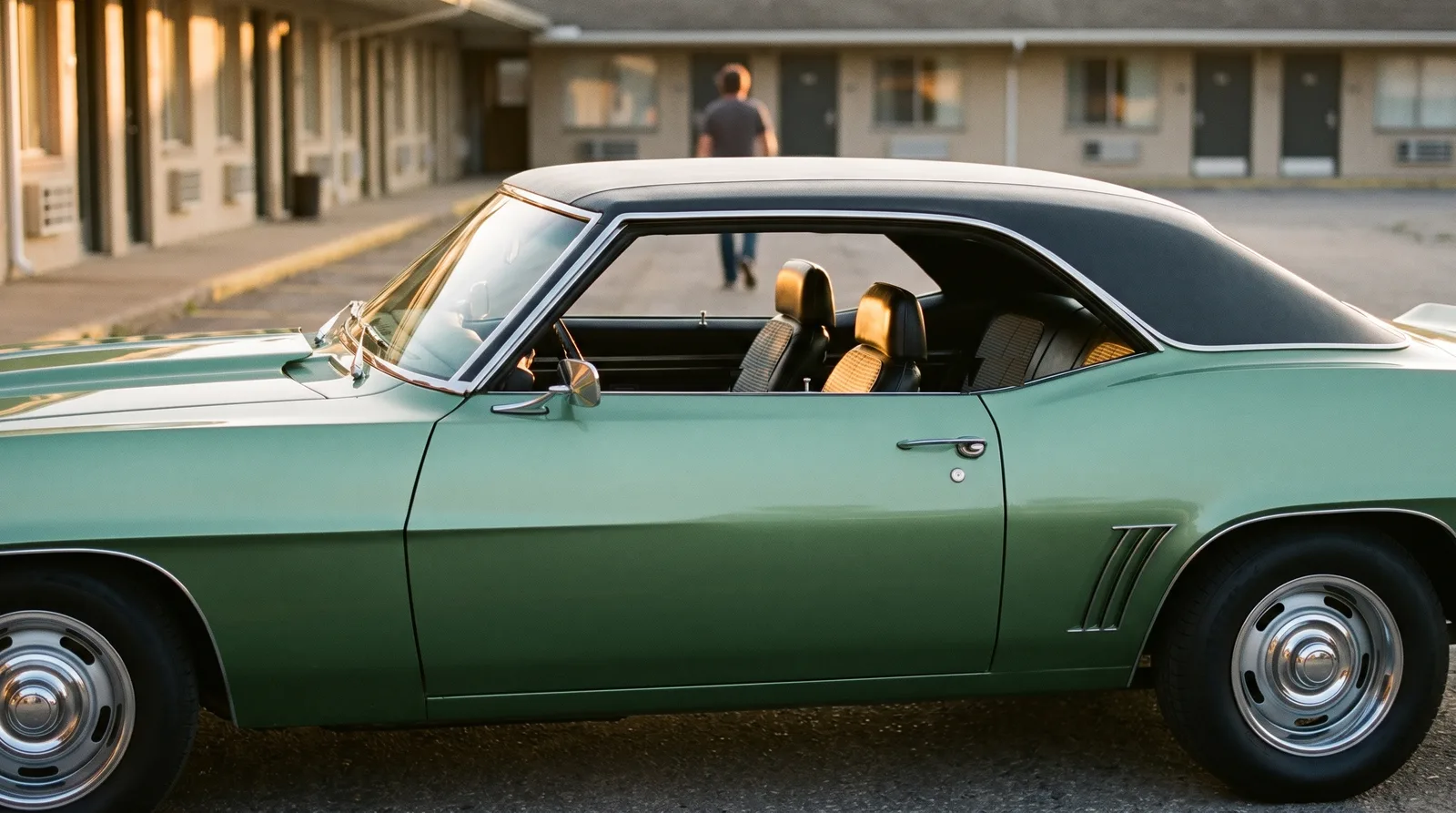
Where the Camaro houndstooth interior came from
The cloth came through a door Chevrolet opened on day one. From the start, a buyer could order RPO Z87, the Custom Interior. It did not change the shape of the seats so much as the feel of the room: special seat trim, molded door panels with built-in armrests, pull-type door handles, a glove box light, hood insulation and a trunk mat. Those parts were there every year from 1967 to 1969.
Houndstooth was not. It never appeared in the 1967 Camaro, and a 1967 car wearing it today is wearing a later idea. The fabric arrived with the 1968 model, as a seat trim choice under Z87, and stayed through 1969. Then the first generation ended, and so did the pattern.
For 1968 and 1969 the Custom Interior also picked up a dash assist handle and woodgrain dash molding, applied to both sides of the dash in 1969. A few small comforts were lost along the way. The 1967 Z87 had sail-panel courtesy lights and rear armrests with ashtrays in the coupe, and those did not carry over. The Special Interior group, RPO Z23, could be ordered alone in 1967; for 1968 and 1969 its features were folded into Z87.
| Model year | Z87 Custom Interior built | Z87 price | Share of production | Houndstooth offered |
|---|---|---|---|---|
| 1967 | 69,103 | $90.00 | 31% | No |
| 1968 | 50,461 | $105.00 | 21% | Yes, about 6% of production |
| 1969 | 39,875 | $105.00 | 16% | Yes, about 8% of production |
Read the table twice. Fewer buyers ordered the Custom Interior every year, from almost a third of all Camaros in 1967 to about one in six by 1969. Yet the share of cars with houndstooth went up. Chevrolet built 235,147 Camaros for 1968 and 243,085 for 1969, so the percentages work out to roughly 14,100 houndstooth cars in 1968 and 19,400 in 1969. Those are arithmetic, not factory counts. Nobody has published a total by trim code.
Black, ivory, orange and yellow
The 1968 palette was quiet. There were two houndstooth codes, 749 Black and 716 Ivory, both in custom bucket seats. Ivory was a late arrival, available from early March 1968, so a car built in the autumn of 1967 could only have the black. Neither one was offered in a convertible.
For 1969 the palette grew louder. Code 713 was Black houndstooth and 729 was Ivory, a new number for the same idea. Then came two colors that only make sense next to the paint. Code 720, Orange houndstooth, normally went with paint 72, Hugger Orange. Code 714, Yellow houndstooth, normally went with paint 76, Daytona Yellow. Picture a Daytona Yellow coupe with the door open and yellow-and-black checks running across the buckets. The paint walks straight into the cabin.
All four 1969 codes were custom buckets. Other paint pairings exist in small numbers, which is the polite way of saying that someone at the dealer always wanted something different.
The pace car exception
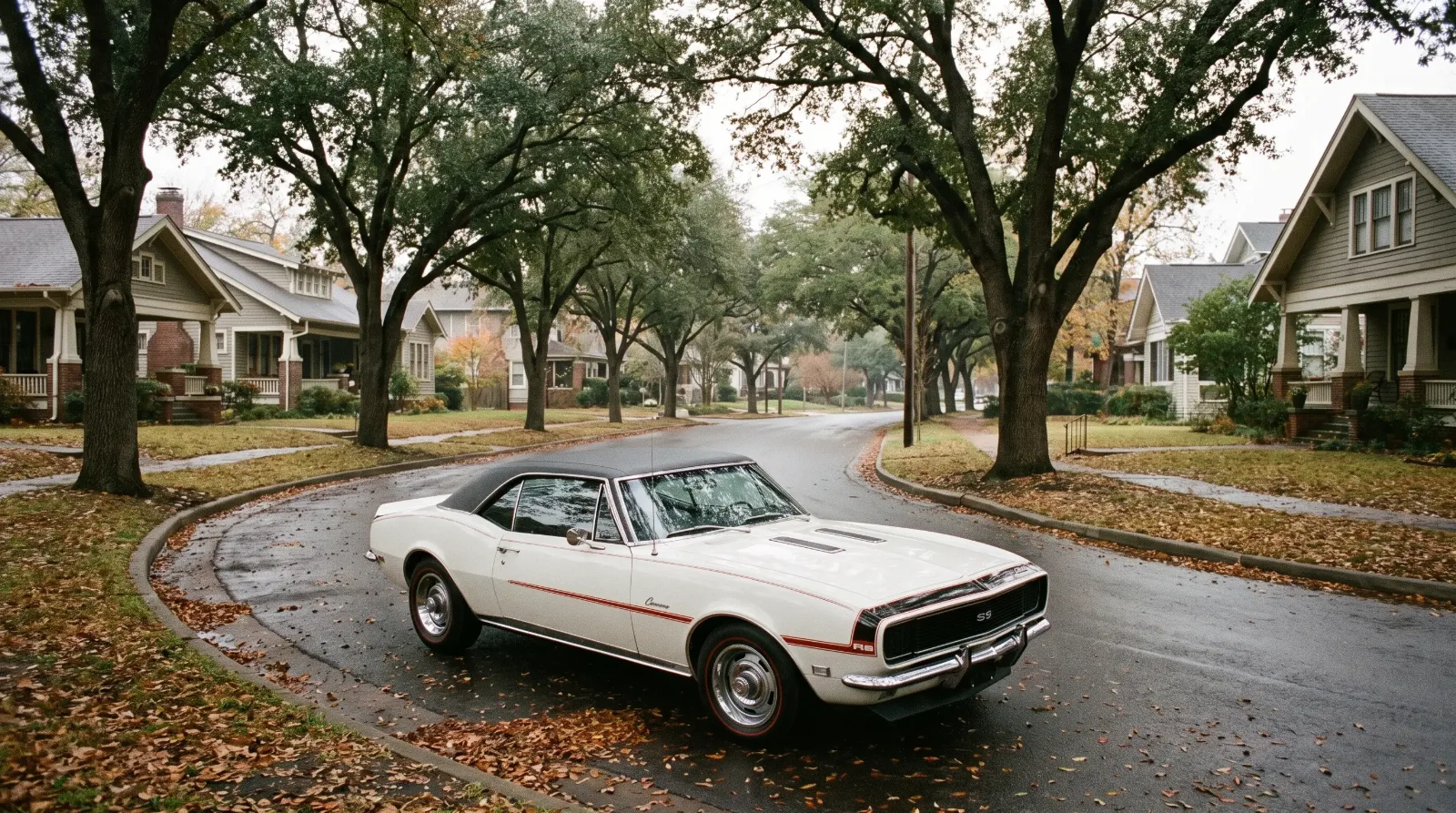
In 1969 one convertible broke the rule. The Z11 Indy pace car package, built on 3,675 RS/SS convertibles, required Z87 with code 720 orange houndstooth. Its cowl tag reads 50 for Dover White paint and 720 for the trim. The Rally Sport package, Z22, was required too. Outside the Z11, no Camaro convertible received houndstooth.
That leaves a strange little puzzle. The orange cloth is the one most people link to the pace car, and it is the one the pace car coupes apparently did not get. The Z10 figure is an estimate with no factory record behind it, so the absence of 720 coupes is an observation, not a rule. It is the kind of gap that keeps registry people up at night.
The show cars of the period played with color in their own way. The Caribe concept used palomino and ivory vinyl with wood accents, closer to a yacht than a showroom coupe, and you can find more on that here.
"Houndstooth was never the loud option on the order form. It was the small decision, made at a desk with a fabric sample, that people still notice more than fifty years later when the door swings open."
Nora Beckett
Reading the tag before you trust the seats
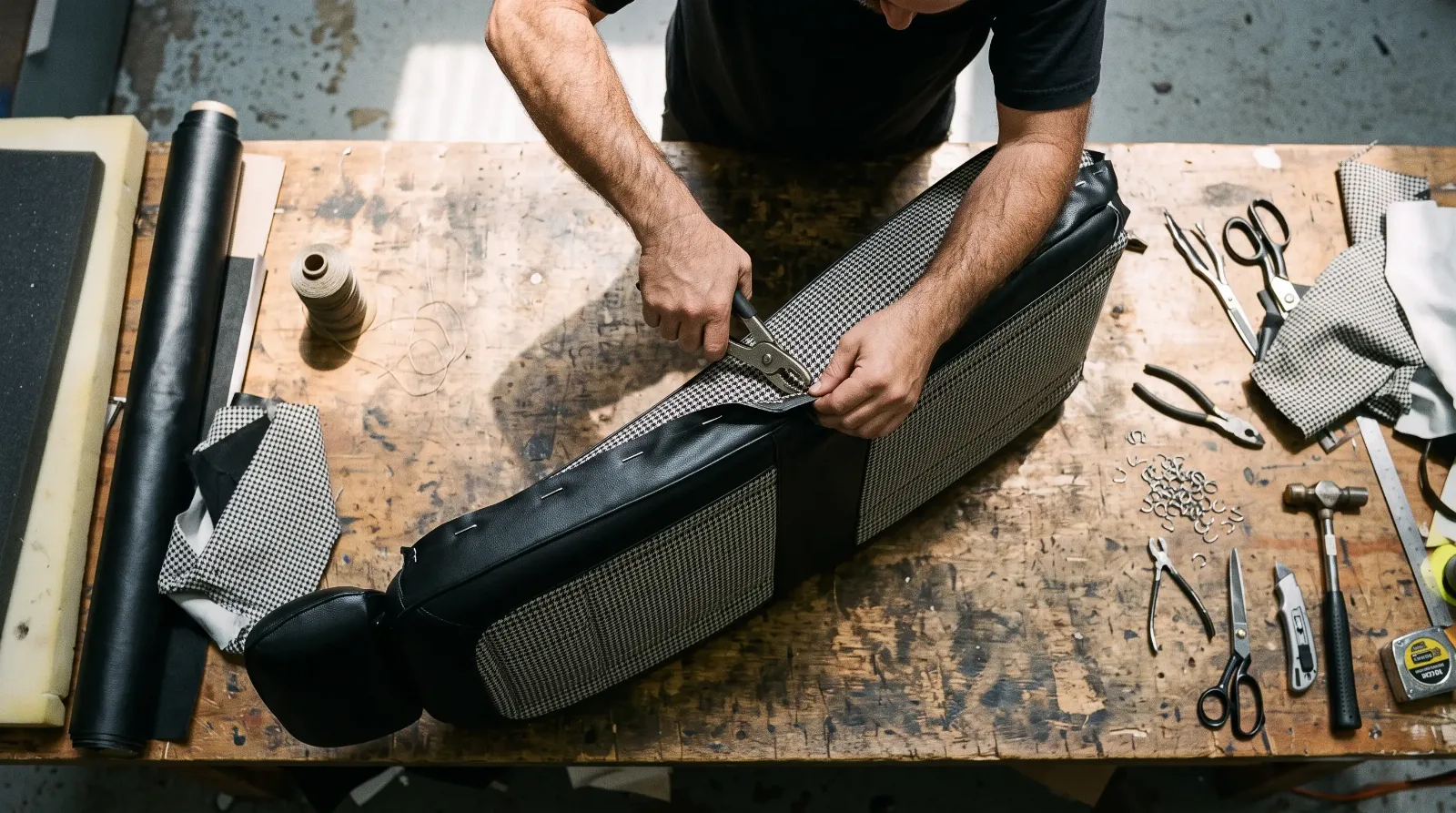
Seat covers are easy to buy and easy to install. That is good news for anyone restoring a tired cabin and bad news for anyone buying one. On a first-gen Camaro, the trim code on the cowl tag is the record of what the body was meant to carry inside. A houndstooth interior over a tag that says plain vinyl is a choice somebody made later.
The pattern came back once more inside the classic years. For 1997, the 30th Anniversary Camaro offered black-and-white houndstooth cloth seat inserts with its Arctic White paint and Hugger Orange stripes, a direct nod to the 1969 pace car. Chevrolet knew what people remembered.
Back in the 1969 coupe, the afternoon light moves across the buckets. The checks blur, sharpen and blur again. It came inside a $105 option, a fabric choice that most people skipped. It is the part of the car they now look at first.
Sources and notes
- Camaro Research Group: 1967 to 1969 interiors, Z87 content and houndstooth shares
- Camaro Research Group: cowl tag and interior trim codes
- Camaro Research Group: the 1969 Z11 and Z10 pace cars
- Camaro Research Group: first-gen RPO production and prices (PDF)
- Camaro Research Group forum: 713 black houndstooth trim
- Wikipedia: Chevrolet Camaro (fourth generation), 30th Anniversary package
Related Reading
Have a
Chevrolet Camaro
for Sale?
Reach thousands of serious classic car collectors across the US.
Sell It Here →
Selling a classic? Here's how: where to sell your classic car online
Are You a Classic Car Dealer?
List your full inventory and connect with targeted classic car buyers.
Join as a Dealer →
#Restoration
#chevrolet camaro
#1969 camaro
#first-gen camaro
#camaro interior
#Houndstooth
#Z87 Custom Interior

About the author
Nora Beckett
Automotive features writer and photographer who tells the human stories behind the cars, from show fields to cross-country road trips.
Related Listings - Chevrolet Camaro




Comments
Be the first to comment on this article.