
In January 1914 the crowd outside Ford's Highland Park plant grew so large, and so desperate, that it turned into a riot. Men had come from all over to stand in the cold for a chance at a job. The company answered by turning fire hoses on them, in the middle of a Michigan winter. That scene, more than any production chart, says what life was like for Ford assembly line workers in the 1910s: the work was hard enough that thousands quit it, and the pay became good enough that thousands more fought to get in.
Car Features
7 min read
Life on Ford's Assembly Line in the 1910s
Repetition, 370 percent turnover, the Five Dollar Day and home inspections: what daily life was like for Ford assembly line workers at Highland Park.
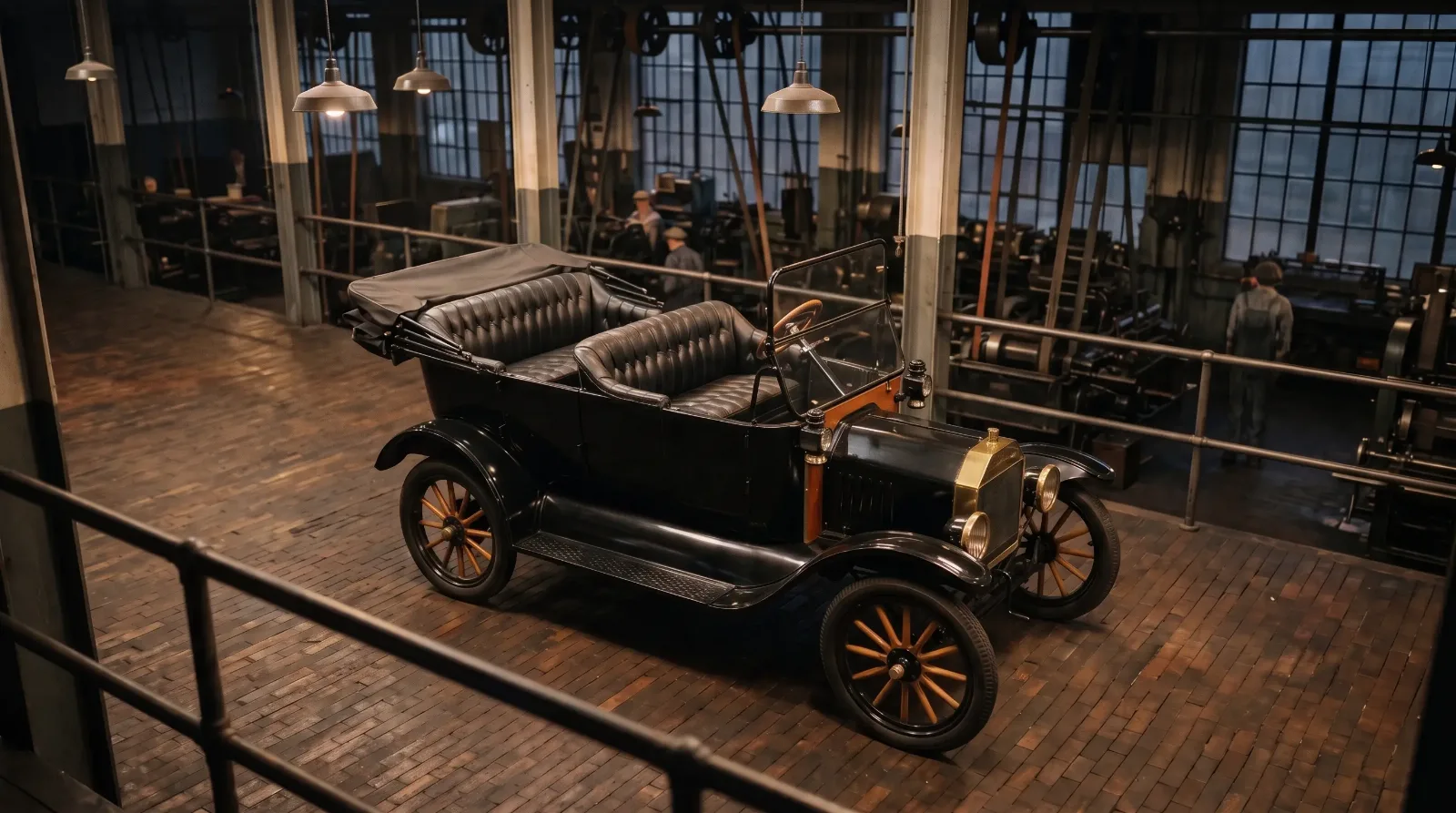
The mechanics of the moving line are covered in the full story of how the Model T was built. This piece stays with the people who stood beside it.
Where Ford assembly line workers spent the day
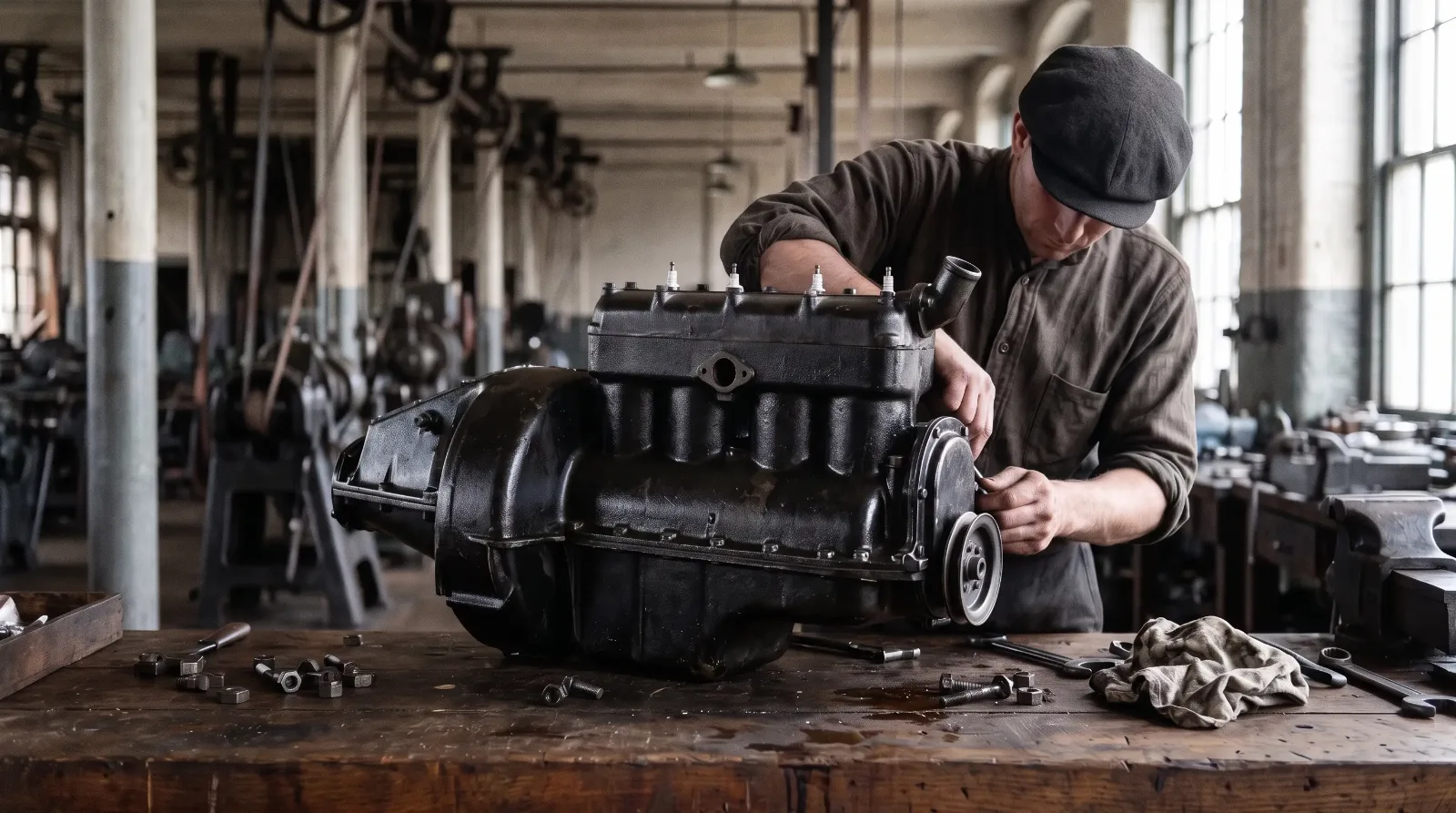
The building itself was unlike any workplace most of these men had seen. Albert Kahn's main structure at Highland Park, nicknamed the Crystal Palace, rose six stories and ran 865 feet long, with more than 50,000 square feet of glass. Daylight fell across the floor in a way the dark brick mills of the previous century never allowed.
It was also crowded with machinery. By 1914 the plant held some 15,000 machine tools. The noise was constant. Parts for three to five thousand cars sat in stock at any time, six to ten days of production, and they moved toward the men rather than the other way around. That was the point of the place.
Light and space did not make the work gentle. In a 1913 photograph, the plant's output for a single day is lined up for the camera: a thousand cars. Every one of them passed through many hands, each doing one small thing, over and over.
Before the line, a skilled man might build a whole flywheel magneto at his bench in about 20 minutes. On April 1, 1913, Ford split that job into a sequence of small steps along a moving line. The time per unit fell to about 13 minutes at first, and within a year, after constant adjustment, to about 5.
For the worker, that improvement had a cost that no stopwatch recorded. The man who once assembled a magneto now tightened one part of it, then the next one arrived, then the next. The chassis line that began moving continuously on October 7, 1913, brought the same logic to the whole car. Labor per chassis eventually fell to about 93 minutes. The pace was set by the line, not by the person.
"It's easy to read the minutes and forget the hands. Each of those saved minutes was taken from somebody's day, and most of the men who gave them up never saw the car they helped build."
Nora Beckett
The engineering of all this rested on parts made precisely enough to fit without filing, a story that belongs to the Model T designers and toolmakers more than to the men on the floor. But it was the men on the floor who lived inside the result.
The year everyone walked out
They did not stay. In 1913, labor turnover at Ford reached about 370 percent, the figure The Henry Ford museum cites most often. In practical terms, the company had to replace its entire workforce several times over in a single year. To keep roughly 14,000 people working at any one moment, Ford hired more than 52,000 during 1913.
Each departure had a reason that was personal to the man who left. But the pattern was plain. Production work paid about $2.34 for a nine-hour day, and the work had been stripped down to repetition. A man could walk across town and earn similar money doing something that felt less like being a part in a machine.
Five dollars, and someone at the door
On January 5, 1914, Henry Ford and vice president James Couzens announced the answer: $5 for an eight-hour day. The economics of that decision have their own story. What mattered to the worker was the condition attached.
To qualify for the profit-sharing half of the money, a man had to live the way the company thought he should. He was expected to stay away from alcohol, not abuse his family, keep a clean home, take in no boarders and save regularly. New hires were limited to men who had lived in Detroit for at least six months.
To check, Ford created the Sociological Department in 1914, first led by personnel head John R. Lee and later by the Reverend Samuel S. Marquis. Its investigators made unannounced visits to workers' homes to judge how clean and orderly they were. For a family newly arrived in Detroit, the knock at the door could decide whether the household earned $2.30 a day or $5. The department was largely dissolved by 1921, but for several years it reached from the factory floor into kitchens and bedrooms across the city.
Learning English at the plant
Many of the men on the line had arrived in America only recently. Highland Park drew thousands of immigrants, many of whom spoke no English and shared no common language with the man at the next station. A popular claim puts the count at 53 nationalities in 1915, but it traces to no primary record. Whatever the exact count, the factory floor was a babel of languages, and the company saw that as a problem to solve.
Its solution was the Ford English School, run under the Sociological Department and founded in 1914, according to The Henry Ford (one older museum page gives 1913). It started with 20 students and a single instructor, and grew to more than 2,200 students and nearly 150 instructors by 1916. The teachers were foremen, clerks and workmen from the plant who volunteered their time.
The school's graduation became a piece of theater. At the "Melting Pot" ceremony of July 4, 1917, graduates in the clothing of their home countries stepped down into a giant "American Melting Pot" and climbed out in matching suits, waving American flags. It was meant as celebration. Read a century later, it is also a picture of how much the job asked of the person who held it: not only his hours, but some part of who he had been.
What the line left behind
The turnover did fall after 1914. Ford later claimed it dropped to 1.4 percent by 1915, a company figure measured differently from the museum's and worth reading with that in mind. The crowds at the gate told the same story in plainer terms. The work had not become easier. The money had become impossible to walk away from.
That trade, repetitive work in exchange for a wage that could carry a family, became the template for industrial jobs for most of the century that followed. The men who first accepted it left few records of their own. What survives is mostly the company's paperwork, a few photographs, and the cars. Somewhere in every surviving Model T is the work of hundreds of people who each spent a day doing one thing well, and then came back the next morning to do it again.
Sources and notes
- Henry Ford: Sociological Department, The Henry Ford
- A new language and a new culture: the Ford English School, The Henry Ford
- Ford's Five Dollar Day, The Henry Ford
- Ford Methods and the Ford Shops, The Henry Ford
- Highland Park Ford Plant, Wikipedia
- Ford Highland Park plant, US Automotive Industry history
Related Reading


Have a
Ford Model T
for Sale?
Reach thousands of serious classic car collectors across the US.
Sell It Here →
Selling a classic? Here's how: sell my classic car
Are You a Classic Car Dealer?
List your full inventory and connect with targeted classic car buyers.
Join as a Dealer →

About the author
Nora Beckett
Automotive features writer and photographer who tells the human stories behind the cars, from show fields to cross-country road trips.
Related Listings - Ford Model T






Comments
Be the first to comment on this article.