
Ask who designed the Model T and most people answer with one name: Henry Ford. The records give a fuller answer. Ford set the goal and controlled the project, but the drawings, the metallurgy and the mechanical solutions came from a small team working in a locked room at the Piquette Avenue plant in Detroit. Their names are Joseph Galamb, Childe Harold Wills and Eugene Farkas, with a handful of others behind them.
Car Features
7 min read
Who Designed the Model T?
Henry Ford set the goal, but Joseph Galamb, C. Harold Wills and Eugene Farkas drew the Model T in a secret room at Piquette Avenue in 1907.
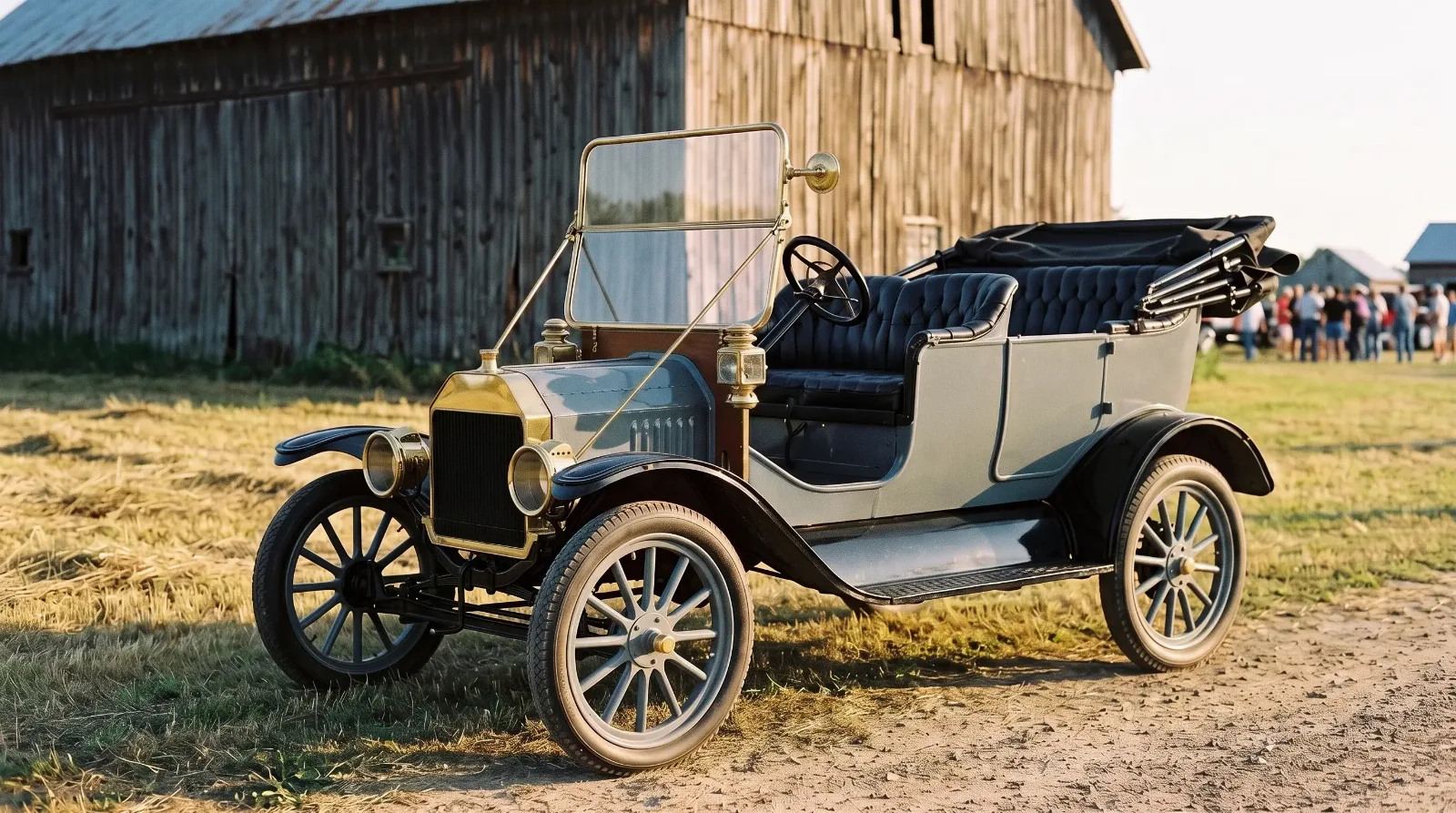
This piece is about the design, not the production. How the finished car was built in volume, and how the moving line changed it, belongs to our assembly line history.
Who designed the Model T: the short answer
The design work began in January 1907, in a secret experimental room in the back corner of the third floor at Piquette Avenue. The sources name three principal designers: Joseph A. Galamb as main engineer, Childe Harold Wills, and Eugene Farkas. They also name a wider group who contributed: Henry Love, C. J. Smith, Gus Degner, Peter E. Martin, Gyula (Jules) Hartenberger and Karoly (Charles) Balogh.
| Name | Role on the Model T | Notes from the record |
|---|---|---|
| Joseph A. Galamb | Main engineer, chief designer | Born 1881 in Mako, Hungary; joined Ford December 1905 |
| Childe Harold Wills | Chief designer and metallurgist | With Ford from 1899 (full-time 1902); left in 1919 |
| Eugene Farkas | Principal designer | Later led the Model A engineering team |
| Henry Love, C. J. Smith, Gus Degner, Peter E. Martin, Jules Hartenberger, Charles Balogh | Contributors | Named in the design team record |
Henry Ford's own part is the hardest to pin down in documents. He chose the people, kept the project in that closed room, and decided what the car had to be: his ninth production model, and the first meant for the mass market. The Piquette museum describes the room as a drafting area on one side and a few machine tools, a chalkboard and his mother's old rocking chair on the other, with Ford leading a hand-picked group of men in their twenties. That places him in the room as the judge of the work. It does not show him at a drawing board, and no document used here credits him with a specific part.
Joseph Galamb, the engineer at the board
Galamb was born on February 3, 1881, in Mako, Hungary. He came to the United States in October 1903 and joined Ford in December 1905. On the Model T he was the main engineer, the man who turned requirements into drawings, and he is the name most often given as its chief designer.
In a memoir he recorded for the Ford museum in 1952, Galamb recalled that Ford asked him early in 1907 to move his drawing board into a separate room, and that the first thing Ford wanted was a new transmission, because the existing one was not practical enough. Whatever the order of the work, the planetary gearbox became the car's defining mechanical feature. Galamb stayed with Ford long after the T was settled. He worked on the Fordson tractor from 1915, and in the 1920s he worked with Edsel Ford on the car that replaced the T. He died in Detroit on December 4, 1955.
The record gives Gyula Hartenberger and Karoly Balogh under their Hungarian first names as well as their American ones, which places more than one Hungarian-born man in that room. That is worth stating precisely and no further: the T was a team product, and the record does not credit any one nationality with it.
C. Harold Wills and the metal
Childe Harold Wills was born in Fort Wayne, Indiana, on June 1, 1878. He worked with Ford from 1899 and full-time from 1902, which made him one of the oldest hands on the team. His titles were chief designer and metallurgist, and the record credits him with three things on the T: the planetary transmission, the detachable cylinder head and the Ford script logo.
His deeper contribution was the steel. Ford had already used vanadium steel on the Model K and the 1907 Model N, and Wills is the man credited with working out how to get enough of it for mass production. The supplier Ford contracted was United Steel Co. of Canton, Ohio, which Ford visited in July 1906 with his consultant metallurgist J. Kent Smith. On the T, the alloy went into the parts that took the most strain, because it was lighter and stronger than standard carbon steel.
"The script on the radiator is the detail I would point a student to. It is the part of the car everyone recognizes, and it came from the same man who chose the steel for the axle. That is how small this team was."
Sarah Whitfield
Wills left Ford in 1919 with a severance of about $1.5 million and founded Wills Sainte Claire, whose Gray Goose car appeared in 1921. The company closed in 1927, the same year the Model T ended. He died on December 30, 1940.
Eugene Farkas and the long view
Farkas is the least documented of the three. The Henry Ford's collection record gives the outline: born in Hungary in 1881, a trained engineer, in the United States from 1906, at Ford briefly in 1907 and 1908, then back in 1913 to run the experimental drafting room. He stayed until he retired in 1947, working on tractors, experimental engines, the Model A chassis and, in the war, B-24 bombers. Other sources go further and name him as one of the three principal designers of the T, and as the man who led the Model A engineering team with Laurence Sheldrick and Frank Johnson. Few people can claim a hand in both of Ford's great four-cylinder cars.
That continuity says something about how Ford worked. The T was not drawn by a single genius and then left alone. It was refined for nearly two decades by men who knew it from the first drawings, which is part of why so many of its basic ideas survived from 1908 to 1927. The full arc of that run is in the Model T history chapter.
Why the team is easy to forget
Part of the reason is Henry Ford himself. His name was on the company and the car, and his public image left little room for engineers. Part of it is the scale of what came next. The T's story quickly became a story of factories, prices and wages, and the 1914 pay raise that drew workers to Highland Park is told here. The designers had finished their main work years before any of that.
For a researcher, the correct answer to the question is a list, not a name. Henry Ford directed the project. Joseph Galamb engineered it. C. Harold Wills chose its metal and designed key parts. Eugene Farkas helped draw it and went on to lead the team behind its successor. And a group of draftsmen and mechanics whose names survive only in the record filled in the rest.
Sources and notes
- Ford Piquette Avenue Plant: history of the plant and the secret experimental room
- The Henry Ford: Ford Motor Company engineer E. J. Farkas, circa 1940
- The Henry Ford: Henry Ford visiting United Steel Company plant, Canton, Ohio, July 1906
- Gati: Joseph Galamb and the Model T (Muszaki Tudomanyos Kozlemenyek), citing his 1952 memoir
- Wikipedia: C. Harold Wills
- Wikipedia: Ford Model T
Related Reading
Have a
Ford Model T
for Sale?
Reach thousands of serious classic car collectors across the US.
Sell It Here →
Selling a classic? Here's how: compare the places to sell classic cars
Are You a Classic Car Dealer?
List your full inventory and connect with targeted classic car buyers.
Join as a Dealer →
#ford model t
#henry ford
#Piquette Avenue
#Joseph Galamb
#Childe Harold Wills
#Eugene Farkas
#vanadium steel

About the author
Sarah Whitfield
Third-generation classic car collector specializing in pre-war American and European coachbuilt automobiles. Researcher and concours enthusiast.
Related Listings - Ford Model T




Comments
Be the first to comment on this article.