
The henry ford assembly line did not arrive in a single morning. It came in stages, part by part, across 1913 and into early 1914, at the Highland Park plant north of Detroit. The records show a factory that tested the idea on small components first, measured every result, and only then put the whole car on a moving line. The story of the Model T Henry Ford built is usually told through its price and its sales. This one stays on the factory floor, where the minutes were counted.
Car Features
9 min read
Henry Ford's Assembly Line: How the Model T Was Built
How Highland Park moved from magnetos to a full moving chassis line in 1913 and 1914, and how Model T labor fell from 12.5 hours to 93 minutes.
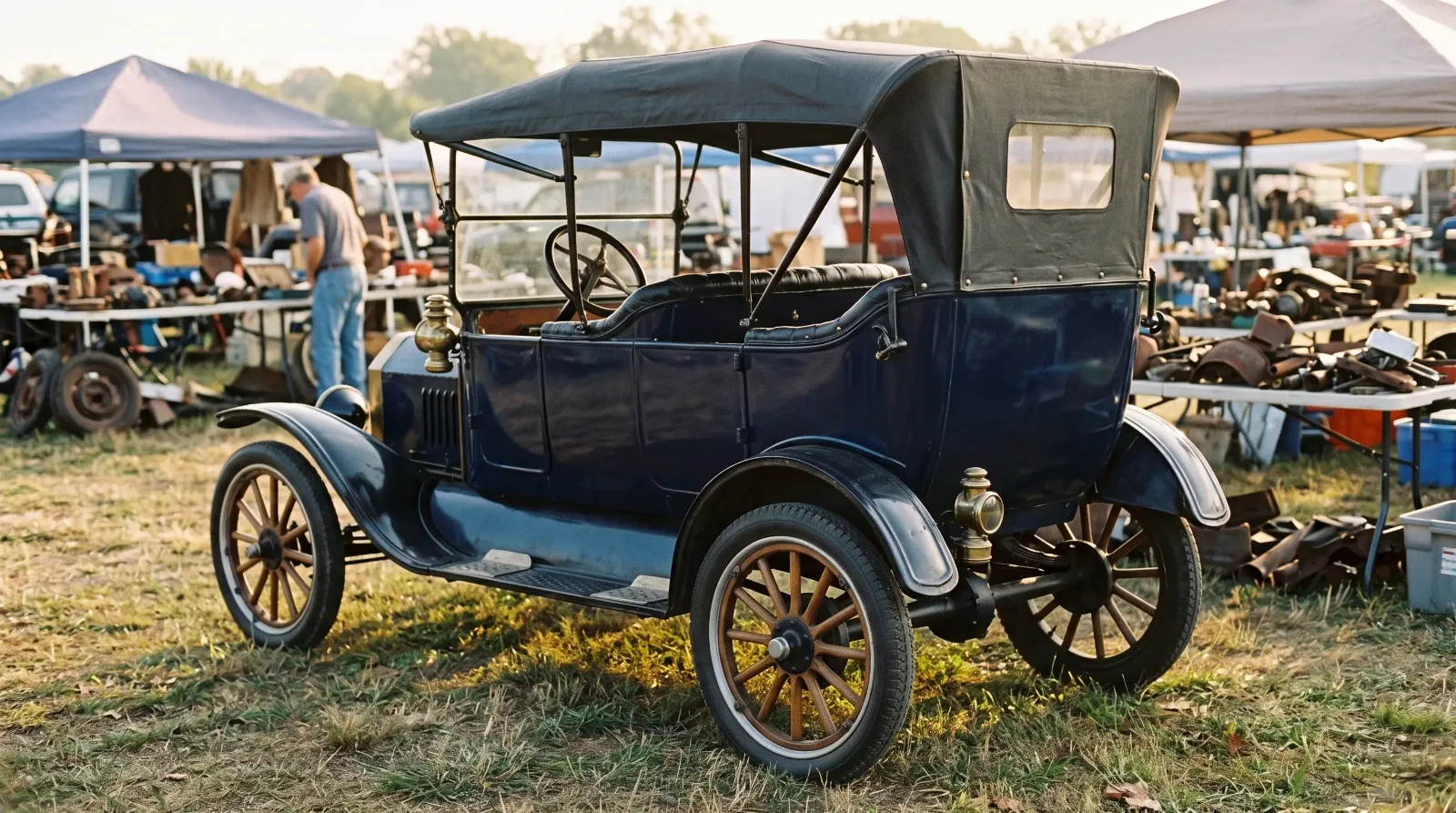
Two popular versions of the tale need gentle correction before we start. The moving line was not invented in one flash of genius, and it was not switched on across the whole plant on one date. Ford's production men ran it as an experiment, then a series of experiments, and the records they left behind let us follow each step.
Before the line: how a Model T was built in place
The first production Model T was completed on September 27, 1908, at the Piquette Avenue plant in Detroit, and sold as a 1909 model. Piquette was a three-story building, 56 feet by 402 feet, and the cars on its floors were built where they stood. Workers and parts came to a stationary chassis. Nearly 12,000 Model Ts were built there before the move to Highland Park.
Highland Park was designed in 1908 and opened in 1910, with Albert Kahn as architect. Most production had moved there by January 1910, and Piquette was fully vacated by October 1910. The new plant's main building, later nicknamed the "Crystal Palace," ran six stories, 865 feet long by 75 feet wide, with more than 50,000 square feet of glass.
Even in the new building, the chassis was still assembled in one spot. That method took about 12.5 hours of labor per chassis. Demand was climbing fast. US production went from 34,858 cars in fiscal 1911 to 68,733 in fiscal 1912 and 170,211 in fiscal 1913, years that ended in September, by the Ford Production Department's own tally. Something had to give, and it was the stationary method.
The first moving line: flywheel magnetos in 1913
The first moving line at Highland Park did not build cars. It built flywheel magnetos, the part of the Model T that generated current for the ignition. A Henry Ford museum curator and a published history of the plant both date it to about April 1, 1913.
Under the old method, one worker assembled a complete magneto in roughly 20 minutes. On the first line, the job was split into small steps, with the work passed from one man to the next. Assembly time dropped to about 13 minutes per unit. Within a year, after further tweaking, it was down to about 5 minutes.
That result told Ford's production men two things. Splitting a job into short repeated tasks saved time, and moving the work past the worker saved more. The next step was to try it on larger assemblies.
In June 1913 the line method was extended to transmissions, cutting assembly time from 18 minutes to 9. By November 1913 engines were on a line as well, and engine assembly fell from 594 minutes to 226. Each subassembly line fed the next stage, so the gains compounded.
How the henry ford assembly line reached the chassis

The chassis was the hard part. It was the whole car minus its body, and it had to keep moving while hundreds of parts were fitted to it. Ford's engineers first applied the line to the chassis as a trial in August 1913. That trial cut chassis labor from 12.5 hours to just under 6 hours.
Here the dates need care. October 7, 1913, is the day most published sources give as the start of moving chassis assembly at Highland Park. The museum's curator puts the first trial in August. One later history gives December 1, 1913, as full implementation. All three can be true. The rollout was staged, and by early 1914 the system was in full use. By October 1913 the chassis time had already fallen to about 3 hours.
By April 1914 the plant was running three parallel chassis lines, and labor per chassis was down to 93 minutes. That figure is often misread as the time it took a car to travel down the line. It was the total labor spent on each chassis, which is a different measure and the more useful one.
"The 93 minutes is real, but read the label. It is labor per chassis on the line, not the time a car spent crawling across the floor. Get that wrong and every comparison after it is off."
Tom Ramirez
The build times, stage by stage
The table below collects the assembly times recorded at Highland Park as each part of the car went onto a line. They come from museum and plant histories that agree on the main figures.
| Assembly | When the line came | Time before | Time after |
|---|---|---|---|
| Flywheel magneto | About April 1, 1913 | About 20 minutes per worker | About 13 minutes, then 5 minutes within a year |
| Transmission | June 1913 | 18 minutes | 9 minutes |
| Engine | November 1913 | 594 minutes | 226 minutes |
| Chassis (trial) | August 1913 | 12.5 hours | Just under 6 hours |
| Chassis (line in use) | October 1913 | 12.5 hours | About 3 hours |
| Chassis (three lines) | April 1914 | 12.5 hours | 93 minutes |
Read down the chassis rows and the pattern is plain. The first trial halved the time. Refinement halved it again. Three parallel lines took it below two hours. None of those steps was a single invention. Each was an adjustment checked against a stopwatch.
Precision parts made the line possible
A moving line only works if every part fits every car without filing or fitting by hand. Ford had been chasing that goal since before the Model T. A 1906 company advertisement, from the Model N era, promised 10,000 of every part, all exactly alike. For the Model T, the design tolerance cited for interchangeable parts is 1/64 inch.
That precision had a practical payoff on the floor. Engines were machined closely enough that Ford could skip testing each one before fitting it to a chassis. On a line moving at a set pace, there was no room for a man to stop and coax a part into place. By 1914 Highland Park had about 15,000 machine tools.
Supply mattered too. The plant kept parts for 3,000 to 5,000 cars on hand, about 6 to 10 days of production. That buffer kept the lines moving when a supplier ran late. A 1913 photograph at Highland Park carries a caption of 1,000 cars built in one day, a sign of where the volume was heading.
The design of the car helped as much as the tooling. The engine and transmission were simple enough to build in short repeated steps. If you want to see how the engines that powered them worked and why they suited this kind of production, that story is told separately.
The workers on the line and the Five Dollar Day
The line saved time, and it cost something in human terms. Work became short, repeated and fast. Men quit in large numbers. Ford's labor turnover in 1913 is most often given as 370 percent, with one Henry Ford museum source putting it at 380 percent by late 1913. The company hired more than 52,000 people that year to keep a workforce of about 14,000 staffed.
The answer came on January 5, 1914, when Henry Ford and vice president James Couzens announced the Five Dollar Day. Pay went from $2.34 for a nine-hour day to $5.00 for an eight-hour day. The structure is often misstated. It was profit-sharing, not a straight raise: a worker kept his base wage, around $2.30, and could earn a bonus of up to $2.70 on top if he qualified.
Qualifying meant meeting rules policed by the company's Sociological Department, created in 1914 under John R. Lee, the head of personnel. The conditions included no alcohol, no family abuse, no boarders, a clean home and regular savings. Hiring required six months of Detroit residence. The department was largely dissolved by 1921.
The announcement drew thousands of job seekers to the plant gate in the January cold. The crowds turned to riots, and fire hoses were used on them. Ford later claimed a steep drop in turnover after the change, though those figures are the company's own and use a different measure from the 370 percent number.
The workforce itself was varied. One plant history counts 53 nationalities at Highland Park in 1915, a figure no primary record confirms. The English School existed partly because so many men on the line spoke little English.
What the line did to output and price
The production numbers after 1913 are the clearest proof that the line worked. US Model T output reached 202,667 in the ten-month fiscal year to July 1914, then 308,162, 501,462 and 735,020 in the fiscal years to July 1915, 1916 and 1917. The peak came in calendar 1923, with 2,011,125 units. The 10 millionth Ford, a Model T, was built in June 1924. On May 26, 1927, Henry Ford watched the 15 millionth car come off the line at Highland Park.
Lower cost per car let Ford cut prices. The Model T sold for $850 as a 1908 touring car and for as little as $260 as a 1925 runabout. Not every dollar of that drop came from the line, but the moving line was the main lever. Each cut widened the market, which raised volume, which pushed cost down again.
The line also set the shape of what came next. When Model T production ended in 1927, there were about six months between the last T and Model A volume production, and Model A assembly moved from Highland Park to the River Rouge complex. Highland Park kept building Fordson tractors and trim, but its years as the center of Ford car assembly were over.
For anyone who owns or studies a Model T built on that line, the factory records are worth knowing. The car is simple because the line demanded it, and the line was fast because the car was simple. That loop, tested one assembly at a time between April 1913 and April 1914, is the real achievement of Highland Park.
Sources and notes
Related Reading
Article
Ford Model T and Model A: The Complete Story of Henry Ford's Cars, 1908 to 1931
Article
Tin Lizzie: The Ford Model T's Nickname, Its Disputed Origins and the Legend
Article
How the Model T and Model A Engines Worked: From 20 to 40 Horsepower

Article
Highland Park: The Plant That Mass Produced the Model T
Article
Piquette Avenue: Where the Model T Was Born
Article
How Long Did It Take to Build a Model T?
Article
The Five Dollar Day: Why Henry Ford Raised Wages in 1914
External
/ford/model-t
Have a
Ford Model T
for Sale?
Reach thousands of serious classic car collectors across the US.
Sell It Here →
Selling a classic? Here's how: the best sites to sell a classic car
Are You a Classic Car Dealer?
List your full inventory and connect with targeted classic car buyers.
Join as a Dealer →
#automotive history
#mass production
#ford model t
#assembly line
#henry ford
#Highland Park
#Five Dollar Day

About the author
Tom Ramirez
Corvette researcher and historian based in Bowling Green, Kentucky. Two decades documenting Corvette production history from original factory records.
Related Listings - Ford Model T

Comments
Be the first to comment on this article.