
Two engines carried the full-size Ford Bronco through most of its life: the 5.0 and the 5.8. Everybody calls them by the metric names now, but Ford badged them as the 302 and the 351 for most of their production run, and the ford bronco 5 0 and 5 8 v8 combination is what actually put these trucks to work for two decades. No turbo, no fancy induction, just displacement and a reputation for running forever if you did not ignore it.
Car Features
7 min read
The 5.0 and 5.8 V8s of the Later Broncos
The 302 and 351 V8s carried the full-size Ford Bronco for sixteen years, and knowing what actually separates them matters more than the badge on the fender.
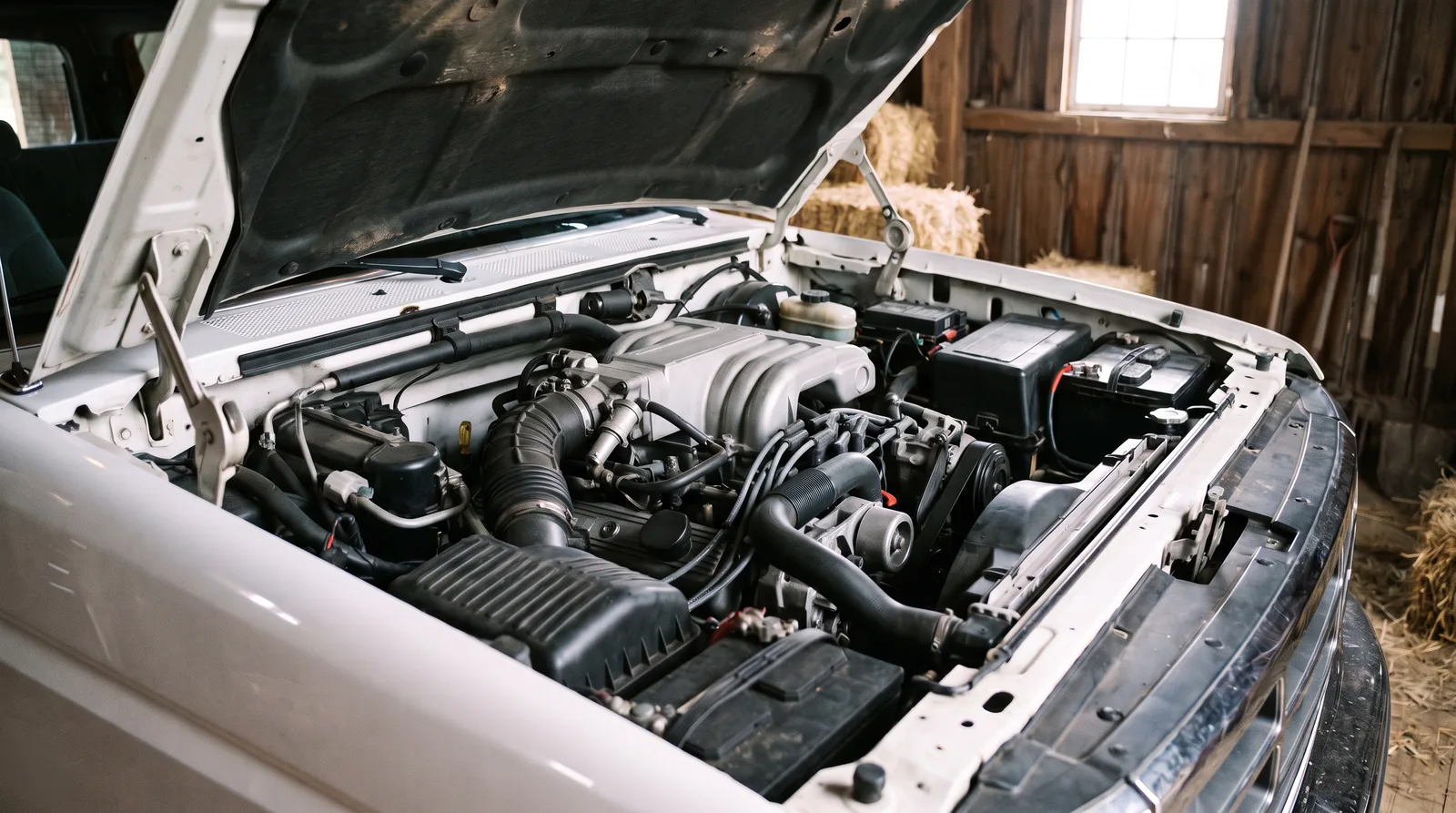
The 302, the volume engine
The 5.0-liter, 302 cubic inch V8 was the base engine across most of the full-size Bronco's run from 1980 through 1996. It made modest power by today's standards, generally in the 130 to 190 horsepower range depending on the year and whether it ran a carburetor or Ford's later electronic fuel injection, which arrived on the 302 in 1985 and pushed output up toward 190 hp. That range is wide because Ford tuned the engine differently across a sixteen-year production run to meet changing emissions rules and buyer expectations, so a 1982 302 and a 1994 302 are not really the same engine in outcome even though the block displacement is identical.
What the 302 lacked in raw output it made up in simplicity. It is one of the most produced V8 designs in American automotive history, used across Mustangs, F-150s, and Broncos alike, which means parts availability today is close to bulletproof. Any independent shop that has touched a Ford product from this era knows this engine, and the aftermarket support for rebuilds, gaskets, and bolt-on parts is deep. That is not a small thing for a truck buyer thinking about long-term ownership costs.
The 351, the one buyers stepped up for
The 5.8-liter, 351 cubic inch V8 was the upgrade option, and it existed in two distinct forms across Ford's lineup broadly speaking, the Windsor and the Cleveland, though the Bronco predominantly used the Windsor variant. Horsepower figures again moved around across the years and emissions changes, generally landing somewhere in the 150 to 210 horsepower range in Bronco applications, with the high-output version reaching 210 hp starting in 1984 and meaningfully more torque than the 302 delivered. That torque advantage mattered more to actual Bronco owners than the horsepower number did, since a full-size truck towing a trailer or climbing a grade cares far more about low-end pull than peak output on a dyno sheet.
Buyers who ordered the 351 tended to be the ones towing something regularly, whether that was a horse trailer, a boat, or camping gear for a family that used the truck the way Ford intended it to be used. The extra weight of the bigger engine did cost a little in fuel economy, never a strong suit on either engine, but the tradeoff made sense for anyone who needed the pulling power on a consistent basis rather than occasionally.
| Engine | Displacement | Typical horsepower | Best suited for |
|---|---|---|---|
| 5.0 V8 (302) | 302 cubic inches | roughly 130 to 190 hp, topping out around 190 hp once fuel injection arrived in 1985 | Daily use, lighter loads, easiest parts sourcing |
| 5.8 V8 (351 Windsor) | 351 cubic inches | roughly 150 to 210 hp, with the high-output version reaching 210 hp starting in 1984 | Towing, heavier loads, buyers who wanted more torque |
What changed with fuel injection
Both engines ran carburetors through the early and mid eighties before Ford transitioned to electronic fuel injection, a shift that improved cold starting, throttle response, and fuel economy without changing the fundamental character of either engine. Fuel injected versions of both the 302 and 351 are generally considered easier to live with day to day, less fussy about altitude and temperature swings, and less prone to the vapor lock issues that occasionally plagued carbureted trucks in hot weather. If you are comparing two otherwise similar Broncos and one has fuel injection while the other does not, that is a real point in favor of the injected truck for anyone planning to drive it regularly rather than trailer it to shows.
Sound and character behind the wheel
Numbers on a spec sheet only tell part of the story. Anyone who has driven both engines back to back will tell you the 351 pulls with a noticeably different feel at low RPM, the kind of shove that makes a loaded trailer disappear behind you without the engine straining to get there. The 302 has to work harder to move the same load, which shows up as more throttle input needed and a bit more engine noise under acceleration. Neither engine sounds particularly exciting by modern standards. These are torque-first American V8s built for utility, not a soundtrack, and that is exactly what most Bronco buyers wanted from them in period.
Fuel economy numbers on both engines are unremarkable and were never a selling point even when new. Expect somewhere in the low teens for city driving on either engine, worse if you are towing, better on the highway if you keep your foot out of it. Nobody bought a full-size Bronco in 1988 because they cared about miles per gallon, and nobody buying one today should expect otherwise. What you are buying instead is durability and a drivetrain that a huge number of independent shops across the country already understand cold.
Which one to actually buy
Here is the blunt version. If you want a Bronco to drive around town and take camping a couple times a year, the 302 does the job and costs less to maintain. If you tow anything heavier than a light utility trailer with regularity, the 351 is worth the extra weight and the marginally worse fuel economy. Neither engine is fast. Neither engine needs to be. Both will run past 200,000 miles with basic maintenance, and both are simple enough that a competent home mechanic can keep one running without special tools or dealer diagnostics.
Do not overthink displacement when you are shopping. Overthink condition instead. A tired 351 with a leaking rear main seal and worn valve guides is a worse buy than a well maintained 302 with service records, every time. Ask for maintenance history, listen for knocking or excessive smoke on startup, and check for oil pressure that holds steady once the engine warms up. Those checks tell you more about what you are actually buying than the number on the air cleaner does.
"People get hung up on which engine is bigger. The bigger question is which one has been maintained. A clean 302 will outlast a neglected 351 every single time."
- Dan Reeves
Both engines sit at the center of a longer full-size Bronco story that stretches from the 1980 introduction through the final trucks built in 1996. For where this started, the fuller history covers how the truck and its engine lineup evolved together over that stretch. And if the numbers above have you ready to go look at a real truck instead of a spec sheet, you can shop classic Bronco listings and start comparing 302 and 351 trucks side by side. Bring a mechanic if you are not one yourself. These are simple engines, but simple does not mean every seller has kept theirs in good shape.
Sources and notes
Related Reading
Have a
Ford Bronco
for Sale?
Reach thousands of serious classic car collectors across the US.
Sell It Here →
Selling a classic? Here's how: the best sites to sell a classic car
Are You a Classic Car Dealer?
List your full inventory and connect with targeted classic car buyers.
Join as a Dealer →
#302 V8
#351 Windsor
#classic truck engines
#Ford Bronco
#Ford truck history
#full-size Bronco engines

About the author
Dan Reeves
Performance engine builder from North Carolina's motorsports corridor, focused on swaps, forced induction and making real, repeatable power.
Related Listings - Ford Bronco




Comments
Be the first to comment on this article.