
Long before anyone called it the Baja 1000, the race that made the Ford Bronco Mexican 1000 pairing famous went by a different name entirely. NORRA, the National Off Road Racing Association, staged the original Mexican 1000 Rally in 1967, running a rough line south from Tijuana down the Baja California peninsula to La Paz. It was less a polished motorsport event than an organized dare, and the trucks that showed up, Broncos among them, were figuring out desert racing as a discipline in real time.
Car Features
7 min read
The Bronco at the Original Mexican 1000
Before it was the Baja 1000, NORRA's Mexican 1000 Rally was where early Bronco teams learned desert racing the hard way.
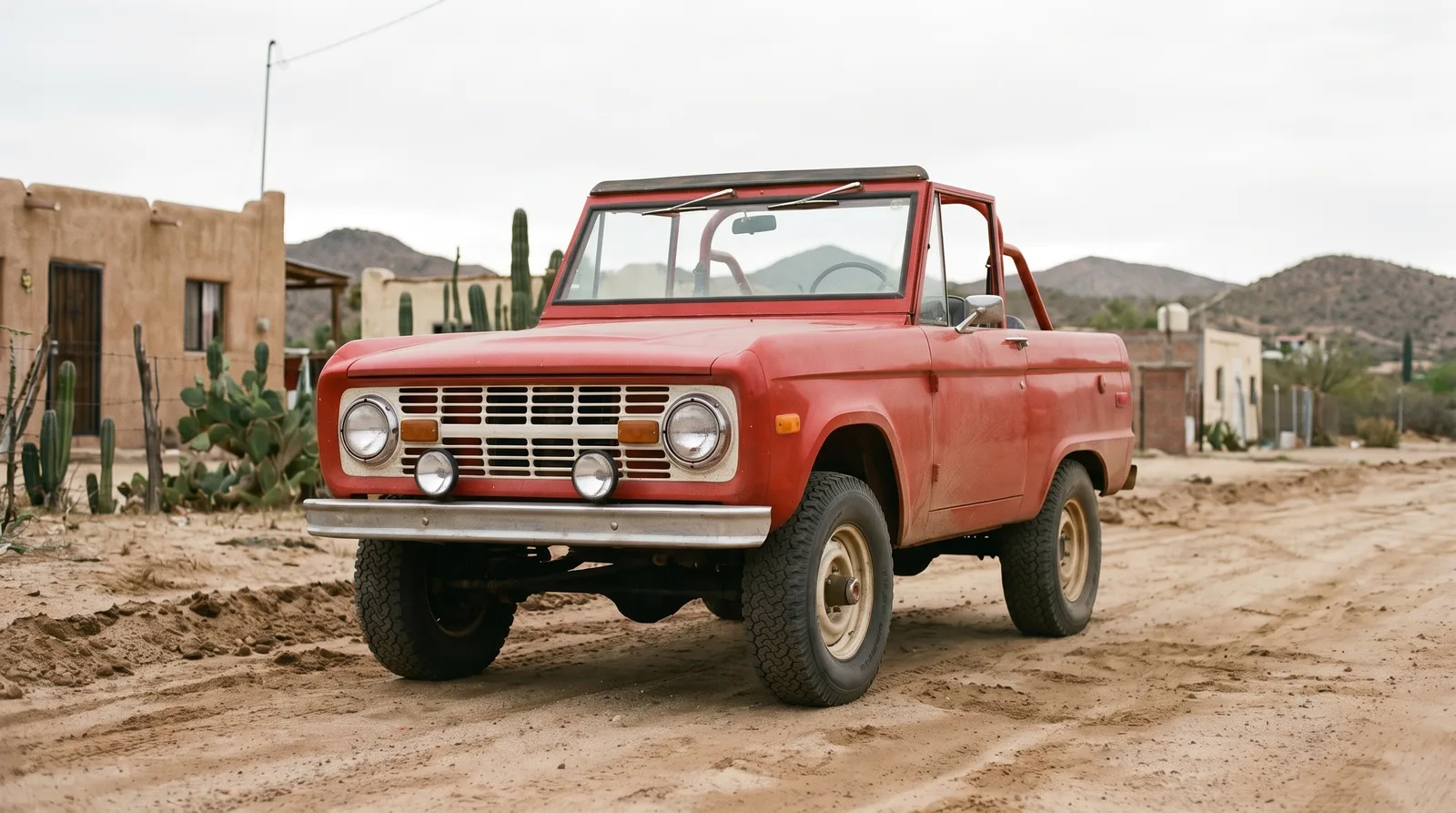
How the Mexican 1000 got started
The founders of NORRA were motorcyclists and off-road drivers who had been running informal timed passes down the Baja peninsula for a few years before deciding to formalize the whole thing into a real race. The 1967 Mexican 1000 drew a mixed field, motorcycles, dune buggies, and a handful of production-based trucks, all pointed at a course that had no real precedent. There were no established pit strategies, no standard suspension setups for the terrain, and no guarantee that any given vehicle class could even survive the distance. Everyone involved was working out the rules of desert racing as the race itself unfolded.
Ford's Bronco, still new to the market at that point, entered this environment almost by accident of timing. The truck had launched for 1966 as a compact 4x4 aimed at hunters, ranchers, and outdoor recreation buyers, not racers. But its simple leaf-spring suspension and short wheelbase turned out to translate well to rough terrain once teams started reinforcing the chassis and protecting the drivetrain, and word of that potential spread quickly among the small community of desert racers paying attention.
Early Bronco teams and what they learned
The Mexican 1000's early years were as much a proving ground for preparation techniques as they were a competition. Teams running Broncos discovered through trial and painful error which components failed first under sustained abuse, and which reinforcements actually held up over hundreds of miles of washboard and rock. Fuel systems needed protection from punctures. Suspension mounts needed reinforcement well beyond stock specification. None of this was published anywhere. It was learned the hard way, race after race, by mechanics standing in the desert at two in the morning trying to get a truck running again before the time limit expired.
That accumulated knowledge did not stay contained to one team. Desert racing in this period was a small, tight community, and lessons learned by one Bronco crew tended to circulate to others within a season or two. By the time Rod Hall and Larry Minor drove a Bronco to an overall win at the race in 1969, they were building on years of accumulated preparation wisdom from earlier Mexican 1000 entries, not starting from nothing.
The Bronco's place in a growing sport
As the Mexican 1000 grew from an eccentric one-off into an annual fixture on the off-road racing calendar, the Bronco's participation grew with it. Ford's competition department took notice of the truck's grassroots success, and by the early 1970s factory-supported programs, including Bill Stroppe's operation out of Long Beach, were building purpose-prepared Broncos specifically for this race and others like it. For the full arc of how that factory involvement developed, read the background on the Stroppe shop and the racing program it built around the truck.
What made the Bronco's Mexican 1000 story distinct from other manufacturers' racing efforts was how directly it connected back to an ordinary production vehicle. A buyer could walk into a Ford dealership and drive out in a truck that shared its basic architecture with the one racing across Baja that same season. That connection between showroom and startline was part of what built such loyal enthusiasm around the Bronco in desert racing circles, and it is a big part of why the truck's off-road racing history still gets discussed so often decades later.
"Nobody at that first Mexican 1000 knew what they were building. They just knew the desert didn't care about your paint job, and the Bronco guys figured that out faster than most."
- Wayne Coburn
The rivals Bronco teams actually raced against
The Mexican 1000's early fields were a genuine mix rather than a single class of similar machinery. Motorcycles made up a large share of entries and often set a brutal early pace on the tighter sections of trail. Purpose-built dune buggies, stripped down to a bare frame and a big engine, represented the opposite extreme from a Bronco, sacrificing every ounce of comfort and utility for raw speed. Against that field, a production-based truck carrying its full body, glass, and stock-derived running gear looked like an underdog on paper.
What Bronco teams discovered, race after race, was that the underdog label did not hold up once the course turned genuinely rough. A motorcycle offered no protection from a spill at speed and demanded constant physical effort from its rider across hundreds of miles. A stripped buggy, built light for speed, often lacked the structural reinforcement to survive a hard impact with a rock or a washed-out section of trail. The Bronco's relative bulk, once reinforced properly, became an asset rather than a liability, giving drivers and co-drivers a platform that could absorb punishment other vehicle types simply could not.
Why this era still matters to collectors
Enthusiasts researching early Bronco racing history often find the Mexican 1000 years harder to document than the later, more publicized Baja 1000 campaigns. Records from the late 1960s are thinner, photography less widespread, and many of the trucks themselves were modified, wrecked, or simply used up over the course of hard racing seasons and never survived to become collector pieces. That scarcity is part of the appeal for serious historians, who treat any verified Mexican 1000-era Bronco documentation as a genuinely rare find.
For most buyers, connecting with this chapter of Bronco history means owning an honestly represented early production truck rather than chasing a race survivor that likely no longer exists in any recognizable form. The early Bronco body style that ran those first Mexican 1000 races remains available on the collector market today, and anyone interested in that era of desert racing history can find a classic Bronco that carries the same basic shape and mechanical layout the earliest desert racers were learning to trust.
How the Mexican 1000 shaped later races
The template NORRA established with the Mexican 1000 became the model that later desert races, including the event eventually renamed the Baja 1000, built upon directly. Course layout philosophy, the point-to-point format across a fixed peninsula route, timing and checkpoint procedures, and even the informal culture of a small, dedicated community of drivers and mechanics all traced back to lessons learned during those first few runnings. Organizers who took over the event in later years inherited a framework that had already been tested under real conditions rather than starting from scratch.
Bronco teams who competed in those foundational years carried that same institutional knowledge forward as the sport professionalized. Crews who had learned to reinforce a frame rail by hand in a makeshift garage in 1967 were often the same people, or the same shops, advising newer teams a few years later as more structured, better-funded programs entered the sport. That continuity between the Mexican 1000's scrappy early years and the more organized Baja racing that followed is easy to overlook, but it is a real thread running through the entire history of Bronco competition in the region.
Sources and notes
Related Reading


Have a
Ford Bronco
for Sale?
Reach thousands of serious classic car collectors across the US.
Sell It Here →
Selling a classic? Here's how: sell my classic car
Are You a Classic Car Dealer?
List your full inventory and connect with targeted classic car buyers.
Join as a Dealer →

About the author
Wayne Coburn
Longtime Corvette owner, judge and club figure who knows the cars, the records and the people behind them.
Related Listings - Ford Bronco


Comments
Be the first to comment on this article.