
There was a shop in Long Beach, California, where the floor was always damp from washing desert silt off truck frames, and where a man named Bill Stroppe decided what a Ford was allowed to survive. If you want to understand why the words ford bronco baja still carry weight sixty years later, you start there, in a building full of half-built four-wheel drives and a coffee pot that never got cleaned, rather than in Dearborn.
Car Features
11 min read
The Baja Bronco and Bill Stroppe: Ford's Off-Road Racing Legend
Bill Stroppe turned a utility truck into a desert legend, sold Baja Broncos through Ford dealers, and built Big Oly for Parnelli Jones. This is where the Bronco's reputation was actually earned.
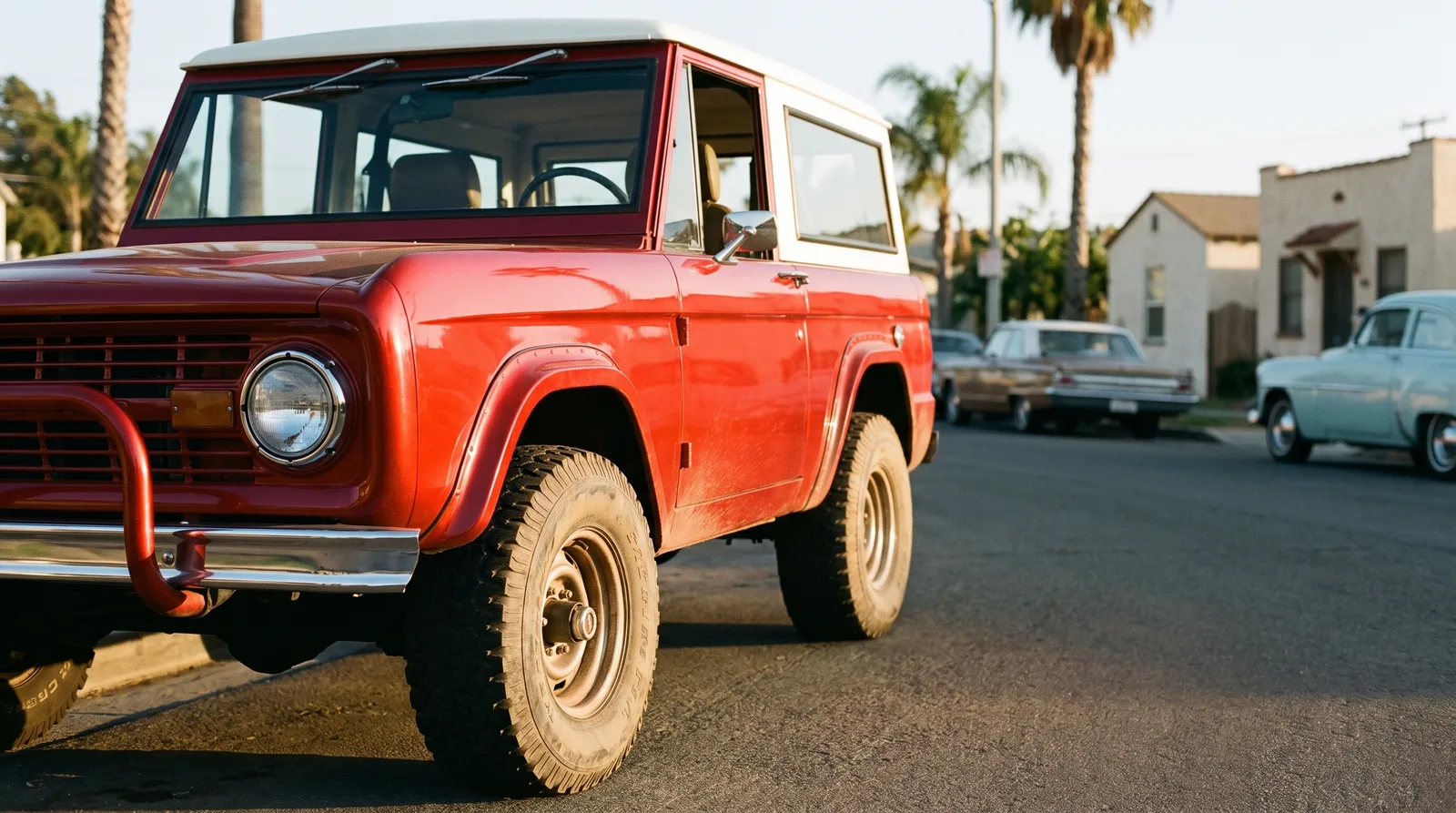
Stroppe was not a Ford employee in the way most people assume. He was a contractor, an outside racer with an inside track, and for two decades he was the reason Ford products showed up at events where nobody expected them and came home in one piece. The Bronco was the last and best chapter of that arrangement.
The man before the truck
Bill Stroppe came out of the Southern California hot rod world of the late 1930s, the same scene that produced the dry lakes racers and, eventually, most of American motorsport. He partnered with the cam grinder Clay Smith, and the two of them built Mercurys that won things Mercurys had no business winning. Their Lincolns took the Carrera Panamericana in the early fifties, running the length of Mexico on roads that ate cars and occasionally drivers.
Smith died at a race in 1954. Stroppe kept the business and kept the woodpecker logo that Smith had used, which is why you still see a cartoon bird on Stroppe-associated cars decades after both men were gone. By the mid sixties Stroppe and Associates was Ford's unofficial West Coast racing arm, handling the projects that did not fit neatly inside a corporate budget line.
Then Ford launched a small four-wheel drive in August 1965, and somebody in California realized the thing had a short wheelbase, a light body and a V8 option. The rest happened fast.
Ensenada, and the invention of the Mexican 1000
In 1967 a group of promoters organized a race from Tijuana to La Paz down the length of the Baja California peninsula. There was no paved highway. There was barely a road. The event was called the Mexican 1000, it was run under the NORRA banner, and it attracted motorcycles, dune buggies, production sedans and a small number of people who thought a factory four-wheel drive might make it.
Broncos were there from the beginning. Not because Ford had a plan, but because California off-road racers had already figured out that the Bronco's 92-inch wheelbase and coil-sprung front end made it unusually good at absorbing whoops. Stroppe's shop began preparing them properly. Heavier shocks, real skid plates, fuel cells, roll structure, seats that would hold a human being through 20 hours of hammering.
Those early runs were brutal and mostly unsuccessful, which is exactly what makes the next part matter. The Bronco spent two seasons learning the peninsula before it did anything worth advertising.
It is worth pausing on what the race actually was in those years. There were no chase helicopters, no satellite tracking, no medical helicopters standing by. Teams buried fuel caches in the desert weeks in advance and hoped nobody found them. Navigation was done off hand-drawn notes and whatever a co-driver could remember from a pre-run. Cars disappeared for a day and turned up in a village with a bent axle and a driver who had slept in a ditch. Finishing was the achievement. Winning was almost incidental.
Rod Hall, Larry Minor and the win that changed everything
Rod Hall was a Nevada man with a mechanic's patience and an absolute refusal to break things. Larry Minor was a farmer from Hemet, California, who had money in the ground and dirt under his nails. Together, in 1969, they drove a Bronco the length of Baja faster than anyone else in the field, including the buggies that were supposed to be untouchable.
Understand what that means. A dune buggy weighed a fraction of what the Bronco weighed and was purpose-built for exactly one job. The Bronco was a production truck with a steel body, a full roof and four driven wheels, and it beat them on their own ground. Hall's method was not speed. It was arriving. He drove within the truck's limits, kept it out of the deep silt beds that swallowed faster cars, and let attrition do the rest.
Ford understood immediately what it had. The win landed in showroom literature within months. For a company that had spent the sixties building a marketing identity out of Le Mans and Indianapolis, a desert win by a utility vehicle was an unexpected gift, and it did more for the Bronco's image than any amount of magazine advertising. The wider arc of how the truck arrived and what it was built to do sits in our ford bronco retrospective, but the racing chapter is where the personality came from.
The Baja Bronco you could actually buy
Here is the part that still surprises people. From 1971 you could walk into a Ford dealer, sign a piece of paper, and take delivery of a Bronco that had been through Bill Stroppe's shop. Ford supplied the trucks. Stroppe converted them. The dealer handled the sale and the warranty. It was as close as any American manufacturer came to selling a homologation special for the desert.
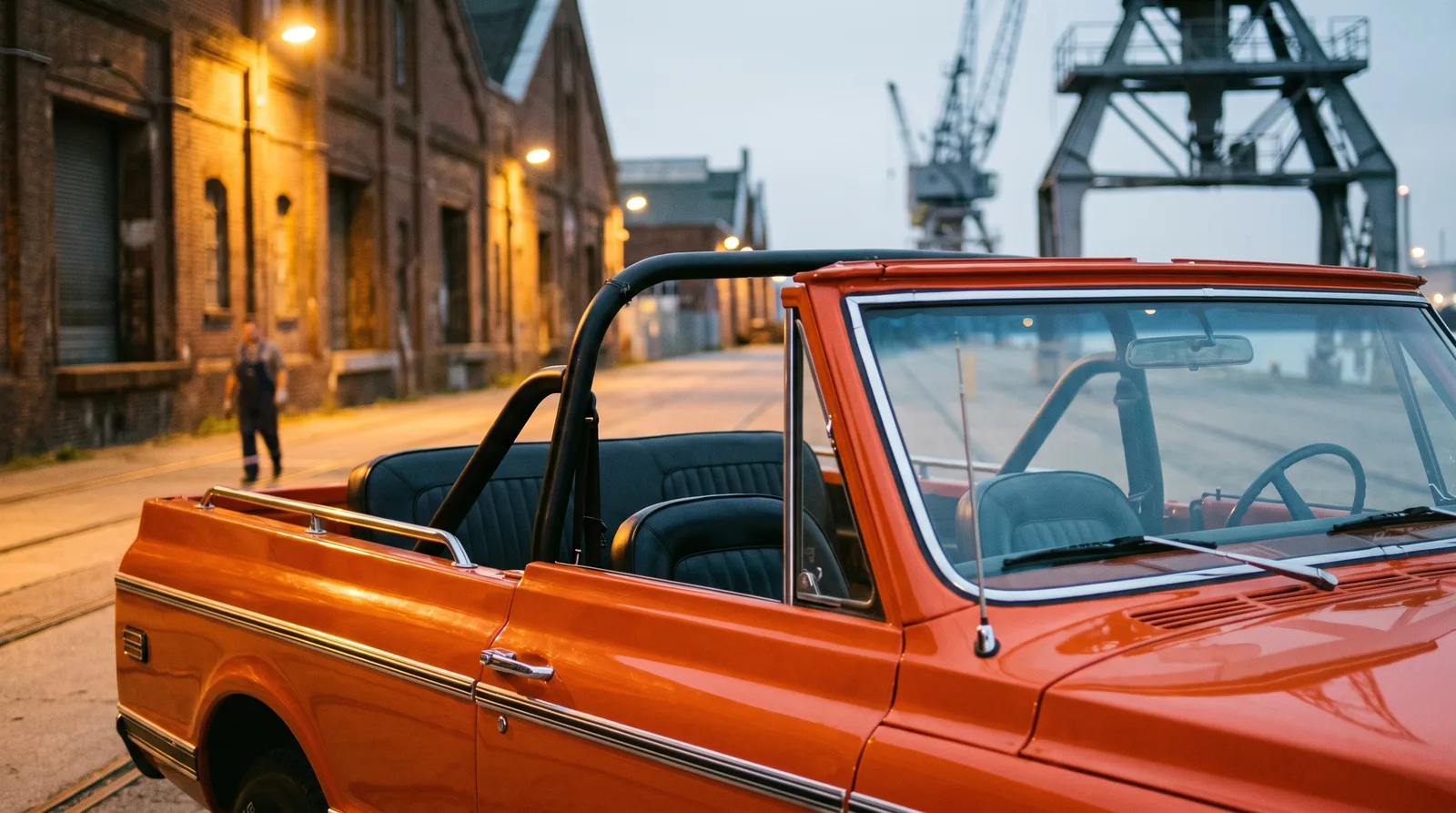
The Baja Bronco was not a stripe package. The rear fenders were cut and flared to clear taller tires. It ran dual shocks at each corner, a roll bar, a padded steering wheel with a quick-ratio box, a heavy-duty automatic transmission, and the 302 V8. The paint was Wimbledon White with red, white and blue Stroppe striping, and a black hood treatment to kill glare. Gates Commando tires. The look is so specific that a correct one is recognizable from across a field.
| Stroppe Baja Bronco | Detail |
|---|---|
| Years offered | 1971-1974, sold through Ford dealers |
| Estimated production | 650 units |
| Base vehicle | Ford Bronco wagon, 92-inch wheelbase |
| Engine | 302 cu in V8 |
| Transmission | Automatic, heavy duty |
| Suspension | Dual shock absorbers at each corner, reinforced mounts |
| Bodywork | Cut and flared rear fenders, roll bar, padded wheel |
| Finish | Wimbledon White with red, white and blue Stroppe stripes, blacked hood |
| Approximate price when new | $5,566, versus $3,665 for a standard V8 Bronco |
The buyer for this thing was never entirely clear, and that is part of its charm. It cost substantially more than a standard Bronco at a moment when a standard Bronco was already a specialty purchase. Most people who wanted a desert truck built their own for less. What the Baja Bronco sold was authorship. Somebody who had actually won in Mexico had put his hands on your truck before it reached the dealer, and in 1972 that was a story worth paying for at a bar, a trailhead or a stoplight.
Roughly 650 were built across four model years, which is a rounding error against total Bronco production. That scarcity is the entire reason a documented Baja Bronco now trades at multiples of a comparable standard early Bronco. It is also the reason for the fakes. Stripes and flares are easy to copy. Paperwork is not.
Big Oly and Parnelli Jones
By 1970 Stroppe had a new partner and a bigger idea. Parnelli Jones had won the Indianapolis 500 in 1963 and had nothing left to prove on pavement. What he wanted was Baja, and what he wanted for Baja was not a modified production truck.
Big Oly was a tube-frame racing car wearing a fiberglass Bronco shell. Aluminum panels, a wing across the roof to keep the nose down at speed, the driver sitting low and far back, the engine set behind the front axle line. It weighed a fraction of a production Bronco and looked like a Bronco only in the way a race car looks like the road car it is named after. The name came from Olympia Beer, whose sponsorship paid for it, and the truck wore that gold and white livery like a uniform.
Jones drove it the way he drove everything, which is to say flat out and slightly angry. Stories from the period describe him arriving at checkpoints ahead of schedule with the truck's crew unsure whether to be delighted or alarmed. The wing on the roof was not decoration. At the speeds Big Oly reached across the dry lakes sections, the nose wanted to come up, and Stroppe's answer was aerodynamic rather than mechanical, which tells you how far the project had traveled from the showroom.
Jones and Big Oly won the Baja 1000 in 1971, setting a course record of 14 hours 59 minutes, and again in 1972 in 16 hours 47 minutes, that second run co-driven by Bill Stroppe himself. Two overall wins, in a vehicle that had been built specifically to punish the peninsula rather than survive it. The truck later became one of the most valuable off-road racing vehicles in existence, selling at auction for well over a million dollars in the early 2020s.
"Ford never had to explain the Bronco to anyone in California. Stroppe had already done it, out loud, at high speed, in front of witnesses. By 1972 the truck had a reputation the marketing department could only follow around and take notes on."
- Patrick Walsh
Buying into the legend today
The Stroppe story creates three distinct things a collector might chase, and they are not equal. At the top sit the genuine race vehicles, which are museum pieces with auction records to match. In the middle sit documented dealer-sold Baja Broncos, rare enough that the community roughly knows where the survivors are. At the bottom sit tribute trucks, which can be beautifully done and which cost a fraction of the real thing.
None of that is a reason to avoid a tribute. A well-built Stroppe-style Bronco drives like the real one and looks like the real one, and nobody at a show is going to think less of you for it as long as you are honest about what it is. The trouble starts when a tribute is priced like an original. Verification on these trucks lives in build records, period photographs, known ownership chains and the small conversion details that are hard to replicate correctly.
If you are working out where an honest early Bronco sits against a Stroppe-inspired build, start by looking at what a straight classic Bronco for sale actually costs today, then add the conversion premium on top. The gap tells you a great deal about what the desert history is worth to the market.
What the desert left behind
Bill Stroppe died in 1995, a year before the last full-size Bronco was built. Rod Hall raced Baja into his seventies and won more class trophies there than anyone alive. The Mexican 1000 became the Baja 1000, the peninsula got a paved highway, and the sport turned into a professional enterprise with trophy trucks costing more than houses.
What survived all of it is a reputation. The Bronco is the four-wheel drive that once beat the buggies outright, and no amount of suburban leather trim in the 1990s ever quite erased that. If you want to see how the truck's body styles and engines fed into everything Stroppe did with them, keep exploring, because the roadster, the half cab and the 302 are the raw material of the whole story.
Sources and notes
Related Reading

About the author
Patrick Walsh
Automotive journalist covering classic car shows, events, and the enthusiast community across North America.
Related Listings - Ford Bronco
Comments (1)
E
Eddie Carlisle
2 days ago
the table says 302 and a heavy duty automatic, nothing about the motor itself. did stroppe touch the engine on the dealer trucks or was it a stock 302 with his suspension and bodywork? i've had two of these apart that the owners swore were baja trucks and both had bone stock cams. want to know if that's right or a red flag.
Eddie, every owner of a documented truck I have talked to tells the same story: Stroppe's shop worked on what kept the truck alive in the desert, the shocks, the fenders, the roll bar, the steering, and left the 302 essentially as Ford built it. So a stock cam on its own is not a red flag. What I would want is the paper trail, the dealer invoice and any Stroppe conversion records, because flared fenders and red, white and blue stripes are the easiest part of the truck to fake.