
The Ford Bronco NORA 1000 chapter of this truck's history is really the story of a sport figuring itself out, with the Bronco right in the middle of the mess. NORRA, the National Off Road Racing Association, ran the events that turned Baja California into the proving ground for American desert racing in the late 1960s and early 1970s, and Broncos were there from close to the beginning, getting torn apart and rebuilt between races by crews who were inventing the playbook as they went.
Car Features
7 min read
The Bronco in Off-Road Racing's Golden Age
NORRA's early desert races were where Bronco crews learned that durability, not speed, was what actually won thousand-mile events.
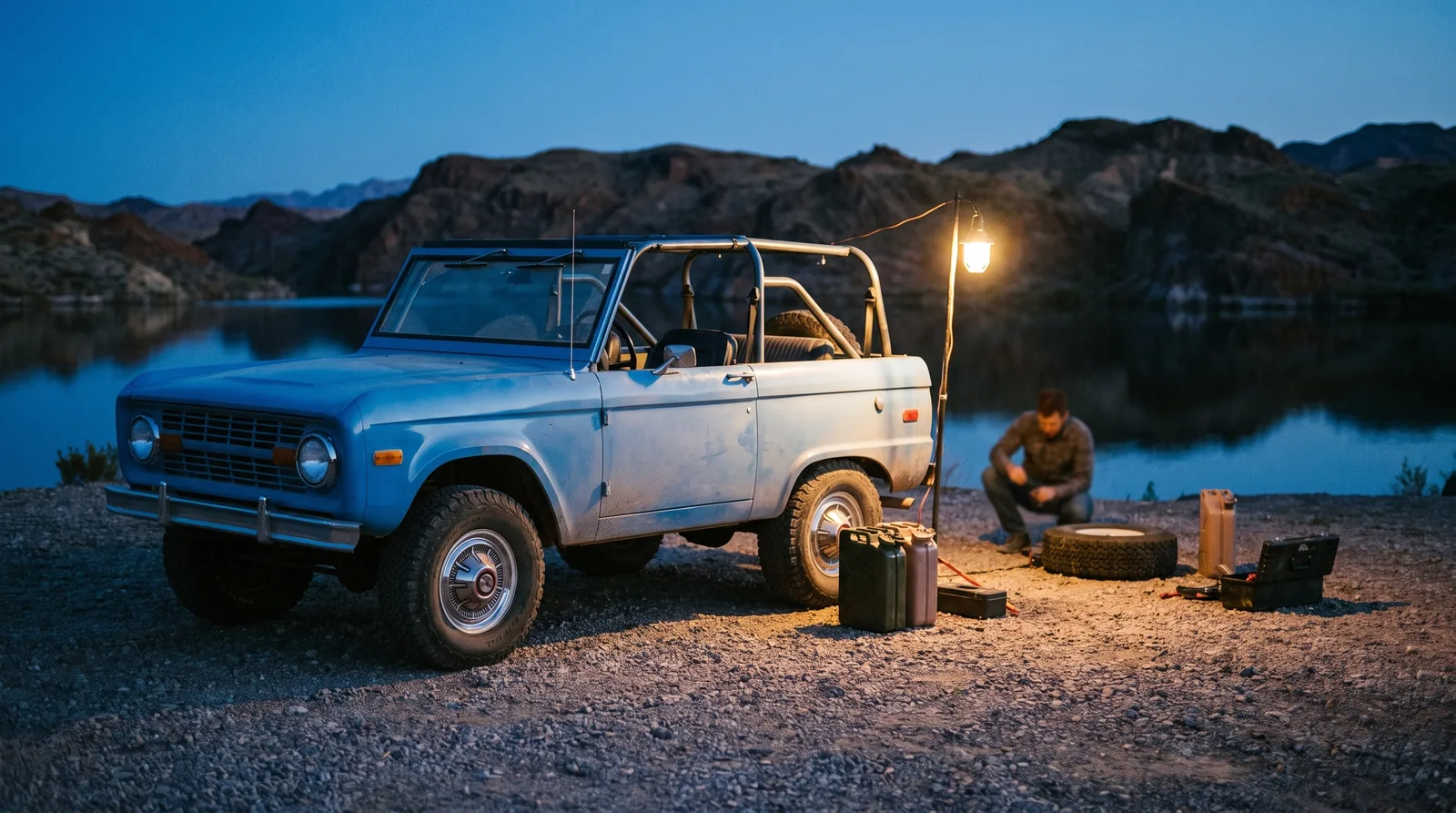
What NORRA actually was
NORRA formed out of a group of drivers and organizers who had been running informal timed runs down the Baja peninsula and decided the sport needed real structure. Their events, the Mexican 1000 chief among them, became the foundation of what most people now think of as classic desert racing: long-distance, point-to-point courses across brutal terrain, with minimal support and even less margin for error. There was no template for how to build a truck for this kind of punishment. Every team learned by breaking things and fixing them better the next time.
I've spent enough time under a truck to know that theory only gets you so far. NORRA's races were where theory met a thousand miles of silt beds, rock gardens, and washboard road, and the trucks that survived were the ones whose crews had actually anticipated failure points instead of just hoping for the best. Broncos, with their relatively simple mechanical layout, gave crews fewer systems to fight and more time to focus on the reinforcements that actually mattered.
What golden age Bronco racing actually looked like from the shop
Forget the glamorous finish-line photos for a second. The real work of this era happened in garages and makeshift shops in the days before a race, and in the desert at three in the morning during it. Crews reinforced frame rails by hand, relocated shock mounts to handle travel the factory never engineered for, and built skid protection out of whatever steel plate they could source and shape to fit. None of it was pretty. All of it was necessary.
Engines got detuned as often as they got built up, because a Bronco that finished at a sustainable pace beat a Bronco that led for two hundred miles and then cooked a bearing. That is a lesson every good wrench eventually learns on any project, race truck or daily driver: reliability is a design choice, not a stroke of luck. NORRA-era Bronco crews learned it under real pressure, with a clock running and a truck that either kept moving or didn't.
Why Broncos held their own against faster machinery
NORRA events drew a genuinely mixed field, purpose-built buggies, motorcycles, and production-based trucks all running the same brutal course. On paper, a lightweight buggy with a tuned engine should have had every advantage over a Bronco built from a truck sold to hunters and ranchers. In practice, reliability closed that gap more often than anyone expected. A Bronco that survived the whole distance beat plenty of faster machines that didn't, and that pattern repeated often enough across NORRA's early events that it became a genuine strategic lesson rather than a lucky outlier.
That lesson is one any experienced mechanic recognizes immediately. Speed wins races on paper. Durability wins races that actually happen in the desert, at night, five hundred miles from the nearest tow truck. Bronco crews who understood that distinction built trucks that finished, and finishing, in an event where a large share of the field did not, was often enough to win outright.
"You don't win a NORRA race by being the fastest truck at the starting line. You win it by being the only truck still running at the finish, and that comes down to what you did in the shop, not what you do on the gas pedal."
- Mike Sullivan
Lessons that still hold up in the shop today
A lot of what NORRA-era crews figured out by trial and error has since become standard practice for anyone building a serious off-road vehicle, whether it is headed to a desert race or just a rough trail. Reinforce before you need to, not after something breaks. Choose components you can actually service with the tools you can realistically carry. Build in redundancy for anything that stops the truck cold if it fails. None of that is glamorous advice, but it is the kind of advice that came directly out of what NORRA Bronco crews learned the hard way, one broken part at a time, decades ago.
I still see owners today make the same mistakes those early crews eventually stopped making, chasing horsepower before addressing reliability, or trusting a stock component in an application it was never designed to handle. The Bronco's NORRA-era history is a pretty direct rebuttal to that approach. The trucks that won were not always the fastest ones off the line. They were the ones built by crews who thought hard about what would break and fixed that problem before the race, not during it.
What this era left behind
The techniques and the reputation built during NORRA's early years carried directly into the more publicized Bronco racing programs that followed, including Bill Stroppe's factory-connected shop and the Big Oly race truck that became the era's most famous machine. For the fuller arc of how this grassroots foundation led into that better-documented chapter, our complete history covers the connection in more detail.
For anyone working on a period-correct Bronco build today, or just trying to understand why the truck earned such a strong reputation in desert racing circles, the NORRA years are the place to start. It is where the durability-first approach that defined Bronco racing actually got proven, one broken part and one field repair at a time. Enthusiasts drawn to that history who want to own a piece of the platform that made it possible can browse classic Bronco listings and start with a truck built on the same fundamentally simple, fundamentally tough architecture those early racers trusted.
What separated the good crews from the rest
Not every NORRA-era Bronco team got the reliability formula right, and the ones that didn't provide as much of a lesson as the ones that did. Teams chasing headlines and fast qualifying times sometimes skimped on the unglamorous reinforcement work in favor of engine builds that looked impressive on paper. Those trucks tended to have short, dramatic races, fast for a stretch, then parked on the side of a trail with a broken component and a crew waiting on a tow that might not come for hours.
The teams that consistently finished, Bronco or otherwise, treated preparation as the actual competition and the race itself as the proof of whether that preparation had been thorough enough. That mindset is not unique to desert racing. Any mechanic who has kept an older vehicle running reliably for years recognizes the same underlying discipline: address the weak points before they fail, not after, and never assume a component will hold just because it has held so far.
Sources and notes
Related Reading
Have a
Ford Bronco
for Sale?
Reach thousands of serious classic car collectors across the US.
Sell It Here →
Selling a classic? Here's how: the best sites to sell a classic car
Are You a Classic Car Dealer?
List your full inventory and connect with targeted classic car buyers.
Join as a Dealer →

About the author
Mike Sullivan
Detroit-area muscle car enthusiast and restoration specialist with three decades of hands-on experience working on American iron.
Related Listings - Ford Bronco
Comments
Be the first to comment on this article.