
Ford built more than 15 million Model Ts, and every one of them had to be sold by someone. The factory gets the attention, but the sales network was the other half of the equation. Ford signed its first dealer in 1902, and by 1930 it had more than 8,000 in the United States. The early Ford dealers were not car people in any modern sense. They were machinists, blacksmiths, livery men and hardware merchants, and Ford turned them into the most effective retail system the car business had yet seen.
Car Features
7 min read
How Ford's Dealer Network Sold Millions of Model Ts
From one San Francisco dealer in 1902 to more than 8,000 by 1930: how early Ford dealers sold, serviced and financed millions of Model Ts.
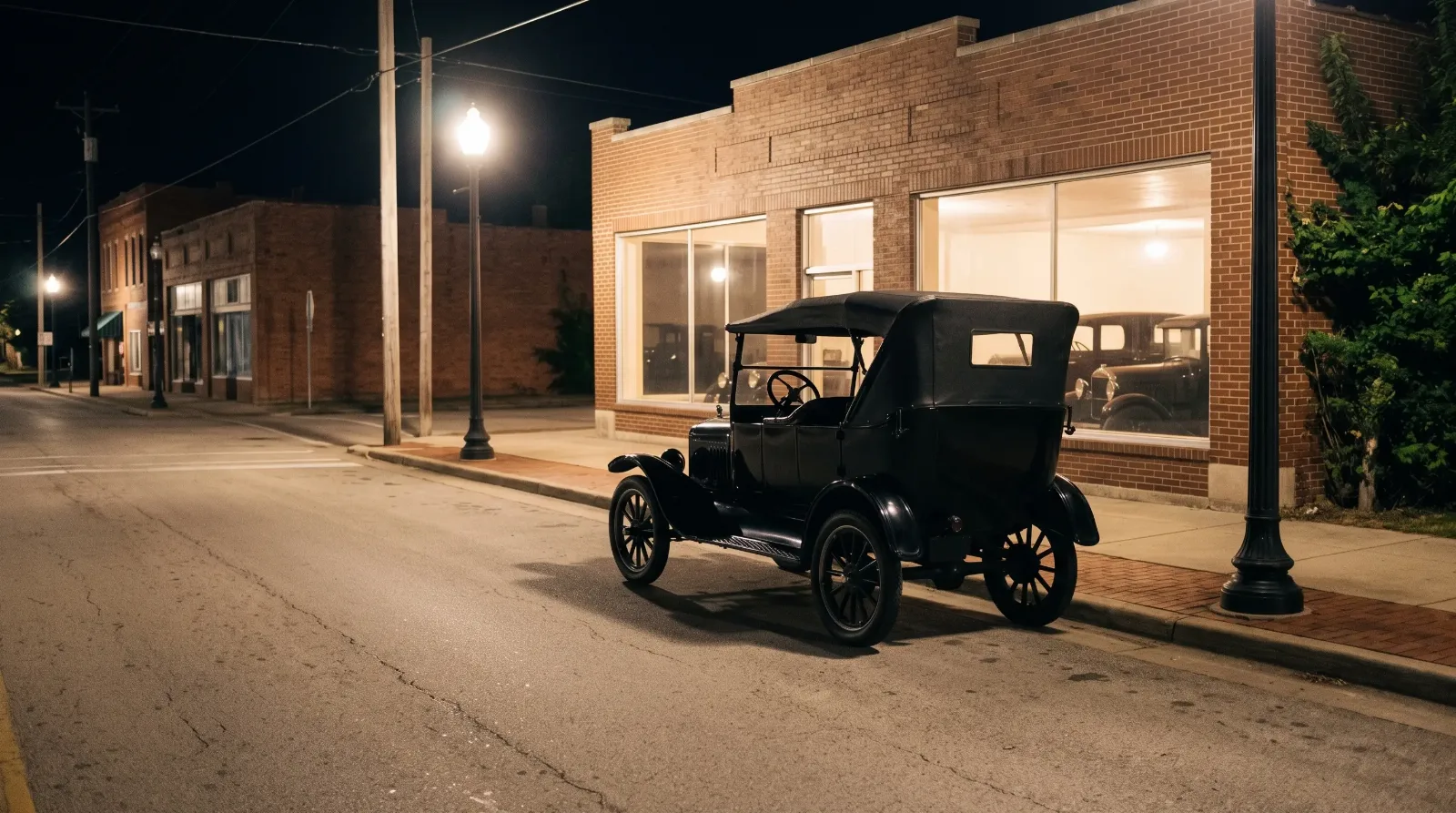
The production side, how Ford mass produced the car, explains why the Model T could be cheap. The dealer side explains how a cheap car reached a farm in Iowa or a small town in Georgia, and why Ford held the market as long as it did. The numbers here are thinner than the factory records, and I flag the soft ones, but the pattern is clear.
Early Ford dealers: who they were and what Ford asked
Ford's first dealer was Billy Hughson of San Francisco, signed in 1902, six years before the Model T. The men who followed him came from trades that already dealt with machines or transport. A blacksmith could fix a broken spring. A livery stable owner already had customers who needed to get somewhere. A hardware merchant knew how to stock and sell small parts to farmers.
Ford asked two things of them that mattered more than salesmanship. Dealers had to stock parts, and they had to train at Ford schools. That made the dealership a service point as much as a showroom. For a car sold largely to first-time owners in rural areas, the nearest dealer was also the nearest mechanic, and Ford's requirement put a trained one within reach of many buyers.
The franchise gave each dealer the right to sell Ford cars within a specific territory. The Henry Ford, describing a 1913 dealer agreement, notes that Ford paid discounts and rebates to high sellers, while low-selling dealers risked losing their territories. Ford wanted volume from every territory and could find another operator if a dealer fell short. The system grew fast: the museum's archivists put the count at more than 7,000 dealerships as early as 1913, many of them never properly recorded.
| Year | Dealer network milestone | Figure |
|---|---|---|
| 1902 | First Ford dealer signed, Billy Hughson, San Francisco | 1 dealer |
| 1907 | Norval Hawkins becomes full-time sales and distribution manager | 14,877 Ford vehicles sold |
| 1908 | Ford Times launched; Model T orders taken before production | 15,000 orders |
| 1913 | Dealerships across the US | More than 7,000 |
| 1917 to 1923 | Ford stops national advertising; dealers keep advertising | About $3 million a year |
| 1923 | Peak US Ford car output | 1,817,891 cars |
| Nov 1927 | Model A launch campaign through the dealers | $2 million in 2,000 newspapers |
| 1930 | US dealer count | More than 8,000 |
Norval Hawkins and the system behind the dealers
The network had an architect. James Couzens began building Ford's dealer and branch network, and Norval Hawkins expanded it after he joined as full-time sales and distribution manager in 1907. He held that job until 1918. In 1908 he also started Ford Times, the company magazine that kept dealers and customers informed.
The figure usually attached to Hawkins is Ford's sales growth during his tenure. The Henry Ford's caption for his portrait puts annual sales at 14,877 vehicles in 1907 and 946,155 in 1919, roughly a sixty-fold rise. Whether his tenure ended in 1918 or 1919 varies between sources, but the scale of the growth is not in question. Ford's own production records show output climbing from tens of thousands of cars to hundreds of thousands in that period, and the dealers had to move all of it.
The demand was there from the start. Before the factory had built a single Model T, dealers had collected 15,000 orders in 1908, nearly twice Ford's total sales of the previous year. That kind of backlog does something to a sales organization. It teaches dealers that the product sells itself and that their job is distribution, delivery and service. For most of the next fifteen years, that lesson held.
Selling without advertising, 1917 to 1923
The most telling fact about the network is what happened when Ford stopped advertising. From 1917 to 1923 the company ran no national ads, because demand outran production. The dealers did not stop. They kept advertising locally at about $3 million a year. In practice the dealer body was carrying Ford's marketing during some of the car's best years, including 1923, when Ford built 1,817,891 cars in the United States.
Credit was the other tool. In the 1920s Ford offered a Weekly Purchase Plan with payments as low as $5. Combined with a Runabout price that fell to $260 in 1925, that put a new car within reach of buyers who could not pay cash. The dealer was where that arithmetic happened.
Dealers were also local businesses with their own ideas, and some of the Model T's most interesting offshoots came from them. Virgil D. White, a dealer in West Ossipee, New Hampshire, invented the snowmobile conversion kit for the car. E. G. Kingsford held the Upper Peninsula distributorship from Iron Mountain, Michigan, from 1908, and later helped Ford acquire timberland there. An Indianapolis dealer, Barber-Warnock Ford, entered a single Fronty-Ford in the 1923 Indianapolis 500, and L. L. Corum drove it to fifth.
"Ford's dealers were not just a sales channel. They were the parts counter, the repair shop, the credit office and, for six years, the ad budget. That is why the network outlasted the car it was built for."
David Mercer
When the network had nothing to sell
The weakness of a single-product network showed in the 1920s. General Motors sold a range of cars under Alfred P. Sloan's line, "a car for every purse and purpose," and Chevrolet passed Ford for first place in 1927. A Ford dealer had one car to offer, and when buyers wanted something better, he had nothing to trade them up to. The rest of the race with General Motors follows from that difference.
Then Ford stopped building cars altogether. Model T production ended in May 1927, and the plants were shut for about six months while the Model A was readied. For dealers that meant months with no new cars. Trade press numbers from November 1927 show the depth of it: Ford built 550 cars in one week, against 20,000 in the same week of 1926, while Chevrolet built 6,682.
The Model A launch: the network's biggest week

The recovery ran through the same dealers. Ford prepared about 2,000 sets of a 26-page launch portfolio, "Introduction of the New Ford Car," for its sales organization. A five-day advertising campaign starting November 28, 1927, spent $2 million in 2,000 newspapers. When the car was shown on December 2, more than 9 million Americans reportedly visited Ford dealers that week. In Kansas City alone, 2,250 cars were sold on announcement day.
That week is the best evidence of what Ford had built. A factory can make a car, but it took thousands of local businesses, trained and stocked and still standing after months without product, to turn a launch into orders. My view is that the dealer network was Ford's most durable asset of the period. The Model T ended, the Highland Park line went quiet, and the dealers were still there to sell what came next.
Sources and notes
- Ford Motor Company: early Ford dealers, from Billy Hughson to 8,000 by 1930
- The Henry Ford: dealer agreement with Markt and Hammacher Company, 1913
- The Henry Ford: information about Ford Motor Company dealers
- The Henry Ford: portrait of Norval Hawkins, sales manager, circa 1910
- The Henry Ford: advertising the Model T
- Mac's Motor City Garage: December 2, 1927, the Model A Ford is introduced
Related Reading
Have a
Ford Model T
for Sale?
Reach thousands of serious classic car collectors across the US.
Sell It Here →
Selling a classic? Here's how: the best sites to sell a classic car
Are You a Classic Car Dealer?
List your full inventory and connect with targeted classic car buyers.
Join as a Dealer →

About the author
David Mercer
Classic car market analyst with two decades of experience tracking collector car valuations, auction results, and investment trends.
Related Listings - Ford Model T




Comments
Be the first to comment on this article.