
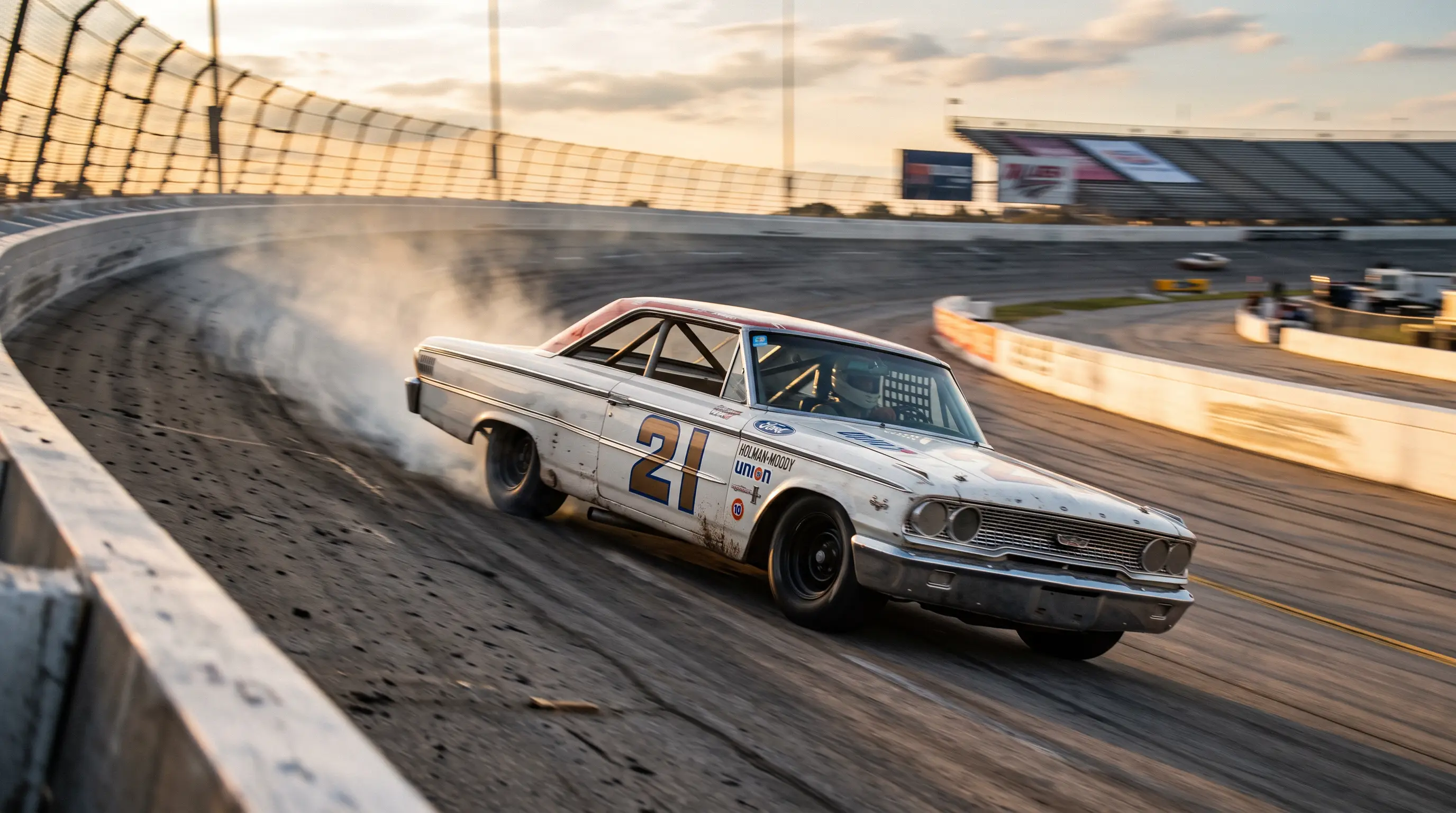
Marvin Panch was already a champion before the ford galaxie 1963 marvin panch holman moody chapter began, and that is exactly why what happened at Daytona in February of 1963 hit the racing world so hard. Panch had won the Daytona 500 outright the year before. By the time the 1963 season rolled around, he was tangled up in one of the strangest and most human stories in the sport's history, and Holman-Moody, the shop building Ford's fastest Galaxies, sat right at the center of it.
Car Features
6 min read
Marvin Panch, Holman-Moody and the 1963 Fords
How a fiery crash, a rescue, and a Holman-Moody built Galaxie turned into one of NASCAR's most remarkable Daytona 500 stories.
A crash, a rescue, and a seat that needed filling
Weeks before the 1963 Daytona 500, Panch was testing an experimental Ford-powered Maserati Tipo 151 sports car at the speedway when it flipped and caught fire. He was pulled from the wreck by a group of mechanics and drivers, most famously stock car racer Tiny Lund, who ran to the burning car and hauled Panch out. Panch survived with serious burns, and the sport spent the following weeks watching him recover in a Daytona hospital instead of preparing for the race everyone expected him to defend.
Holman-Moody had Panch's Galaxie ready and no driver to put in it. Panch himself made the call from his hospital bed: put Tiny Lund, the man who had just saved his life, in the car for the 500. It is the kind of decision that sounds invented for a movie, and it happened exactly as described, well documented by the racing press of the day.
Tiny Lund's Daytona 500 in Panch's car
Lund had not even been entered in the 1963 Daytona 500 before Panch's call. He climbed into a car built by Holman-Moody's crew for a driver who was not on the grid, and he won the race, an upset that became one of the defining stories of Ford's entire 1963 racing season. The car itself was a product of Holman-Moody's careful factory-backed preparation, the same shop responsible for turning production Galaxies into machines that could survive 500 miles of superspeedway punishment without falling apart.
For Ford, the win did double duty. It delivered a Daytona 500 trophy in a season the company badly wanted to dominate, and it produced a human interest story, a rescuer winning in the rescued man's car, that no advertising department could have scripted better. Total Performance, Ford's racing-to-showroom marketing push, got a gift it never could have planned for.
What Holman-Moody actually contributed
It is easy to let the Panch and Lund story overshadow the engineering behind it, but the car itself mattered enormously. Holman-Moody, based in Charlotte, was Ford's primary factory-supported NASCAR operation through this era, responsible for chassis setup, engine preparation on the 427 FE big block, and the kind of durability work that determined whether a car finished a 500 mile race at all. Ralph Moody and John Holman ran an operation that took Ford's production Galaxie underpinnings and built them into cars capable of running competitively against Chevrolet, Plymouth, and Pontiac's own factory efforts.
Their reputation in the garage area was built on reliability as much as raw speed. A Holman-Moody Galaxie that led laps was one thing. A Holman-Moody Galaxie that was still running, and running strong, in the final quarter of the race was the thing that actually won championships, and 1963 is remembered as one of their strongest years for exactly that reason.
| Person / Team | Role in the 1963 story |
|---|---|
| Marvin Panch | 1962 Daytona 500 winner, injured in pre-race crash, gave up his seat to Lund |
| Tiny Lund | Rescued Panch, then won the 1963 Daytona 500 in Panch's Holman-Moody Galaxie |
| Holman-Moody | Ford's lead factory NASCAR shop, Charlotte, NC |
| Car | Ford Galaxie, 427 FE big block |
"You could tell that story a hundred different ways and it would still stop a room. A man pulls another man out of a burning car, and three weeks later he's driving that same man's Ford to a Daytona win. Nobody writes a better script than that."
- Patrick Walsh
What happened to Panch after the crash
Panch's recovery was slow and his burns were serious enough that his own return to competitive driving that season was in genuine doubt for weeks. He did come back, and he kept racing for years afterward, but 1963 became defined for him less by his own driving that season and more by the decision he made from a hospital bed to hand his ride to the man who had saved him. That kind of selflessness under pressure is rare enough in any sport that it would have been remembered regardless of the outcome. The fact that Lund actually won the race made it into one of NASCAR's most enduring stories rather than just a footnote about a driver switch.
Lund, for his part, never fully escaped being known as the man who won the 1963 Daytona 500 in someone else's car after pulling that same someone out of a fire. He carried that story with him for the rest of his career, and it followed him into how the sport remembered him after his death in a multi-car crash at Talladega Superspeedway on August 17, 1975. The Panch rescue remained, decades later, one of the defining moments people associated with his name.
Why this story still matters to Galaxie people
Panch went on to keep racing after his recovery, and the 1963 season stands as one of the most remembered years in Ford's NASCAR history precisely because of how this one moment tangled together human drama and factory racing success. For anyone tracing the full arc of that season, our complete history covers the wider context Panch and Lund's story fits into, and readers wanting to dig further into the Total Performance era should keep exploring the drag racing side of Ford's 1963 push as well.
Cars connected to Holman-Moody's factory program from this specific season, even loosely, carry real weight with serious collectors today. If you are hunting for one of your own, there is a classic Galaxie for sale worth a look, and knowing this history helps separate a genuinely significant example from one just wearing the right badges.
The wider takeaway from Panch and Lund's story is how thoroughly the human element and the engineering element depended on each other that season. Holman-Moody's fabrication work meant nothing without a driver willing to get in the car, and Lund's courage at the crash site meant nothing to the championship standings without a properly prepared Galaxie underneath him at Daytona weeks later. Neither half of that story works without the other, which is part of why it has stayed so central to how people remember Ford's 1963 racing season, decades after most of the year's individual race results have faded from casual memory.
Sources and notes
Related Reading
Have a
Ford Galaxie
for Sale?
Reach thousands of serious classic car collectors across the US.
Sell It Here →
Are You a Classic Car Dealer?
List your full inventory and connect with targeted classic car buyers.
Join as a Dealer →
About the author
Patrick Walsh
Automotive journalist covering classic car shows, events, and the enthusiast community across North America.
Related Listings - Ford Galaxie




Comments
Be the first to comment on this article.