
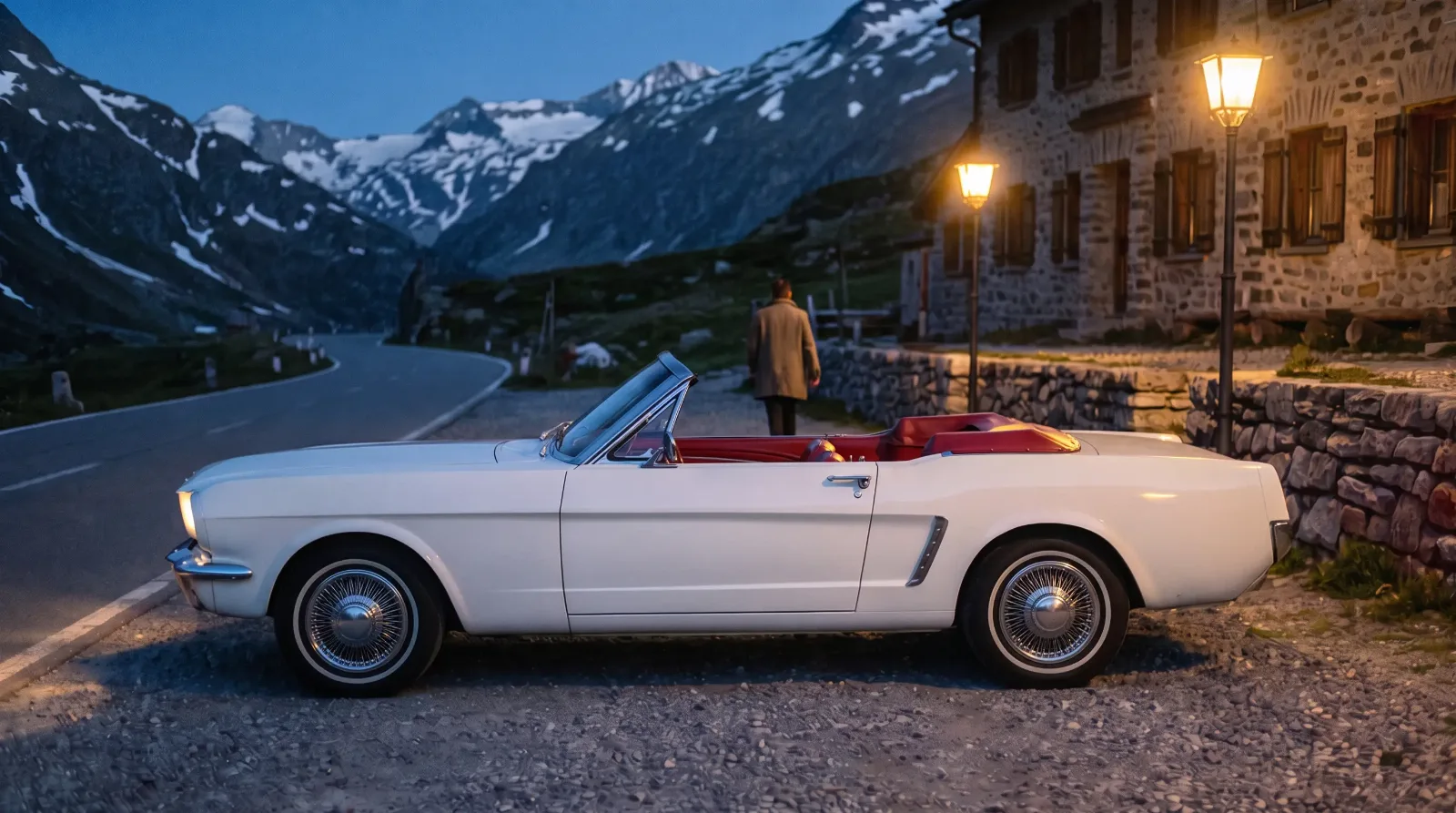
A white convertible on an Alpine road, top down, a young woman at the wheel, and James Bond somewhere in the same stretch of film. That is the Goldfinger Mustang in one frame, and it reached cinema screens in September 1964, five months after Ford first showed the car to the public. Nobody had owned a Mustang long enough to wear out the tires. Yet here it was, sharing a movie with the most famous spy in fiction.
Car Features
8 min read
Goldfinger: The Mustang's First Bond Film
A Wimbledon White 1964½ convertible, Tilly Masterson at the wheel, five months after launch. What the record shows about the Goldfinger Mustang.
The record on this car is shorter than the legend, and that is worth saying up front. Plenty of what gets repeated about it comes from fond memory and fan lore. This piece sticks to what the sources actually show: which Mustang it was, who drove it on screen, how it got there, and where it sits among the Mustangs in pop culture that followed it.
Five months old and already in a Bond film
Timing is the whole story. Ford introduced the Mustang on April 17, 1964, at the New York World's Fair in Flushing Meadows, and it went into showrooms the same day. Goldfinger had its London premiere on September 17, 1964, and opened across the UK the next day. American audiences waited until December 22, 1964.
Put yourself in one of those London seats that autumn. For most of the people around you, the Mustang was a car they had read about, if they had heard of it at all. Seeing one move, in color, on a mountain road, did something no magazine photo could. And the film kept working long after the premiere night, which is the part Ford cared about.
The car on screen was a 1964½ convertible. That is the early-production Mustang, built before July 31, 1964, carrying a VIN that starts with "5" because Ford titled every one of them as a 1965. Those first-season cars have their own following among Mustang people, and this one is probably the best-traveled of them.
What the record shows about the Goldfinger Mustang
Here is the core of it. The car is a Wimbledon White convertible, and it was there as Ford product placement. Tilly Masterson drives it, played by Tania Mallet, and the Mustang appears in the film's Swiss Alps scenes. Ford was supplying cars to the production, and the Mustang was the newest thing it had to offer.
Bond drives an Aston Martin DB5 in the same part of the film, and the DB5's wheel-mounted tyre cutters are what stop Tilly's Mustang on the mountain road. So the Ford shares its big scene with a British car that has had a fan following of its own ever since. People who remember the movie tend to remember the Aston first. The Ford plays the supporting role, which fits, because Tilly is a supporting character too. Supporting roles still get seen by everyone who buys a ticket.
The white paint matters more than it looks. Ford also put a Wimbledon White convertible in front of the crowds at the London premiere in September 1964. Same color, same body style, on screen and on the pavement outside. That reads like a plan rather than a coincidence: one image, repeated wherever the audience happened to be standing.
The location is on record: the Swiss scenes, including Tilly's attempt to shoot Goldfinger, were filmed on the Furka Pass. What the sources do not settle is just as useful to know. How many Mustangs the production used, and the terms Ford agreed with the producers, are not pinned down in the records that hold up. When a version of this story gets more specific than that, it is fair to ask where the extra detail came from.
A whole Ford fleet in Goldfinger
The Mustang was one car in a larger arrangement. Ford supplied several vehicles to the film, and they turn up in very different jobs. Some of them have better screen moments than the Mustang does.
| Vehicle | What the record says it does in the film |
|---|---|
| Ford Mustang convertible (1964½) | Wimbledon White; driven by Tilly Masterson in the Swiss Alps scenes |
| Ford Thunderbird | Felix Leiter's car |
| Ford Country Squire | Station wagon supplied for the production |
| Lincoln Continental | Crushed, with Mr. Solo inside |
| Ford Falcon Ranchero | Hauls the crushed Continental away |
Read that list the way a Ford marketing man would have in 1964. The Thunderbird goes to the American agent. The Mustang goes to a young woman driving a convertible through the mountains. The Lincoln gets crushed, and a Ranchero carries off what is left. It takes a confident company to let one of its luxury cars be destroyed on screen, but a car crushed in a Bond film is a car people talk about.
On screen the Mustang reads as young, quick and a little reckless. That is my reading of the screen, not a line from any Ford memo. If you want the bigger frame of how the car came to exist at all, the Mustang's history starts years before anyone in Goldfinger turned a key.
Not the Mustang's first film, but its first Bond film
This is where the story usually goes wrong. Goldfinger gets described as the Mustang's screen debut, over and over. It was not. The Mustang had already appeared in The Troops of St. Tropez (1964), where a Poppy Red 1964½ convertible was driven by Geneviève Grad. So the first Mustang on film was a convertible from the same early production run, in a louder color, in a film with no spies in sight.
That makes the claim on this page a precise one. Goldfinger is the Mustang's first Bond film, not its first film. The distinction matters to people who care about firsts, and Mustang people care about firsts more than most.
What Goldfinger had was reach. The film was made on a budget of $3 million and has taken about $124.9 million worldwide in total. The Mustang rode along on every print of it. Another film put the car on screen first. A Bond film put it in front of a worldwide audience and kept it there for decades.
"Tilly's Mustang is not the hero car, and it never pretended to be. Doesn't matter. In the autumn of 1964 most of the world had never seen a Mustang move. Ford got a white convertible onto an Alpine road in a Bond picture before the car's first birthday, and that picture has never stopped playing somewhere."
Patrick Walsh
Thunderball and the road to Diamonds Are Forever
Ford came back for the next one. In Thunderball the Mustang is again a convertible, this time in a turquoise blue with a white top, and it belongs to Fiona Volpe, the SPECTRE agent who picks Bond up in Nassau. Off screen, a Tropical Turquoise coupe, paint code O, was used at the film's Tokyo premiere on December 9, 1965. The switch is telling: the Mustang went from a friendly character's car to a villain's car in a single year. It no longer needed the clean, simple introduction Goldfinger gave it. It was already a familiar car, and it could be cast in other ways.
The bigger Bond Mustang moment came six years later, in Diamonds Are Forever, with a 1971 Mach 1 and Sean Connery himself at the wheel. That car got a two-wheel run through a Las Vegas alley. Tilly's convertible got a mountain road in the Alps. Both did the same job for Ford, at very different stages of the car's life.
Looking back from 2026, the white 1964½ convertible is still the one that set the pattern. A brand-new American car, a British spy film, and a studio happy to take the cars Ford offered. Every Mustang that went on to a film role followed a path this car tested first, in the Alps, in September 1964, while the paint on the production line was still fresh.
Sources and notes
- Goldfinger (film): production, Furka Pass location, Ford cars, release dates and box office (Wikipedia)
- Ford Mustang: Wimbledon White placement car, first film appearance, Thunderball premiere coupe (Wikipedia)
- The James Bond Vehicle Library: Ford Mustang convertible in Goldfinger and Thunderball
- James Bond Lifestyle: the Mustang convertibles of Tilly Masterson and Fiona Volpe
- The Henry Ford: Stanley Tucker and Mustang Serial Number One
- RM Sotheby's: 1964½ Ford Mustang, build window and VIN
Related Reading
#1964 mustang
#Ford Mustang
#Mustang convertible
#James Bond
#mustang in film
#Goldfinger
#Product placement

About the author
Patrick Walsh
Automotive journalist covering classic car shows, events, and the enthusiast community across North America.
Related Listings - Ford Mustang




Comments
Be the first to comment on this article.