
Every genre needs an origin point, and for American muscle cars that point has a build date. In the fall of 1963, Pontiac engineers under John DeLorean took the 389 cubic inch V8 out of the full-size Catalina parts bin and dropped it into the mid-size Tempest LeMans, a car that GM's own corporate policy said should never carry an engine that big. The result, sold from October 1963 as the Tempest LeMans GTO option package, is the car most historians point to when they explain where the muscle car era actually began. That is the case for calling the GTO "the godfather of muscle cars," and it is a case built on paperwork, not just nostalgia.
Car Features
8 min read
Why the GTO Is Called the Godfather of Muscle Cars
Pontiac's 1964 workaround of GM's displacement rules didn't just create a fast Tempest, it wrote the rulebook every muscle car rival would copy.
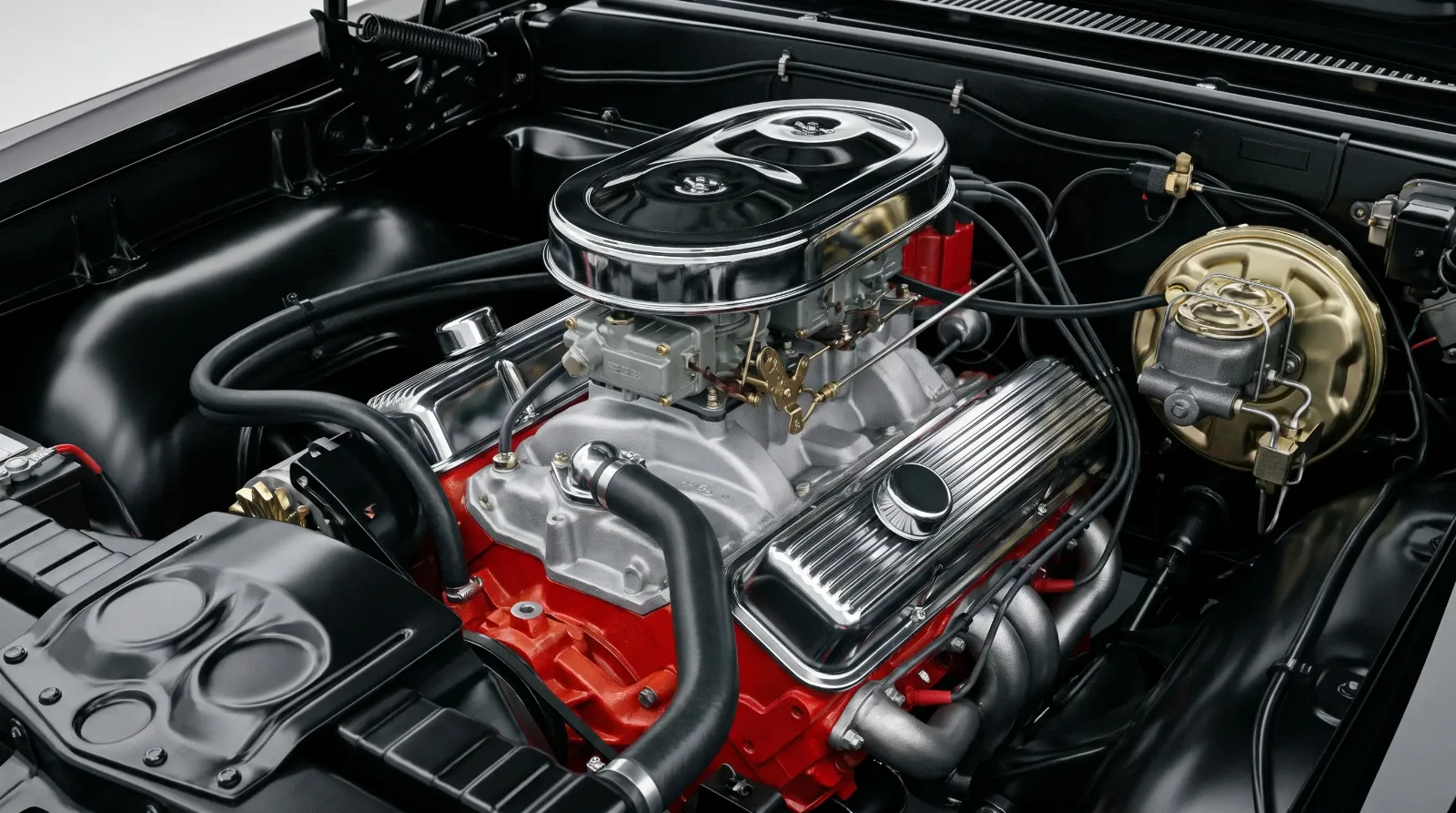
The claim needs context, because Pontiac was not inventing the idea of a big engine in a light body. Chrysler had letter-series 300s in the 1950s, and Chevrolet had already put big-block power in intermediate bodies in isolated cases. What the GTO did differently was turn that formula into a regular-production option any Pontiac dealer could order, at a price a working buyer could finance, and back it with a national ad campaign that gave the concept a name people repeated at the drive-in. That combination, not the engineering alone, is what historians credit when they trace the muscle car format back to Pontiac's option code 382.
The GM policy the GTO worked around
General Motors had an internal displacement-to-weight rule limiting intermediate-size cars to engines around 330 cubic inches. It existed partly out of caution after safety hearings earlier in the decade, and partly to keep divisions from cannibalizing each other's full-size lineups. DeLorean's team, including Bill Collins and Russell Gee, treated the GTO as an option package rather than a distinct model, which meant it did not require the same sign-off a new nameplate would. Pontiac general manager Elliot "Pete" Estes approved it on that technicality, and the corporate committee that might have blocked a standalone model never got a clean chance to veto an option line on an existing car.
That paperwork maneuver matters to the "godfather" argument because it set the template every rival used afterward. Oldsmobile's 4-4-2, Buick's Gran Sport, and Chevrolet's Chevelle SS 396 all arrived as option packages on existing intermediates rather than new platforms, the same workaround Pontiac had already proven out. Ford and Chrysler's later entries followed a similar logic even as displacement rules loosened through the late 1960s.
Production numbers that made the case
Pontiac projected around 5,000 GTO orders for 1964 and sold roughly 32,450 instead, a number that told every general manager in Detroit there was real demand for a car like this. That volume, not a press release, is what convinced GM to let the rule quietly lapse for 1965, and it is the figure Pontiac historians cite most often when explaining why the GTO gets credit as the format's true starting point rather than an earlier one-off.
| Year | Base engine | Optional engine | Approx. production |
|---|---|---|---|
| 1964 | 389 cid V8, 325 hp | 389 Tri-Power, 348 hp | ~32,450 |
| 1965 | 389 cid V8, 335 hp | 389 Tri-Power, 360 hp | ~75,352 |
| 1966 | 389 cid V8, 335 hp | 389 Tri-Power, 360 hp | ~96,946 |
You can trace the GTO name and myths back to that same 1964 launch, since the badge itself, borrowed from Ferrari's racing designation, was part of what made the option package feel like more than a trim level. Pontiac never asked Ferrari's permission, and Ferrari reportedly considered legal action before deciding the free publicity from an American reference to their homologation class was not worth the fight.
Why rivals credit Pontiac first
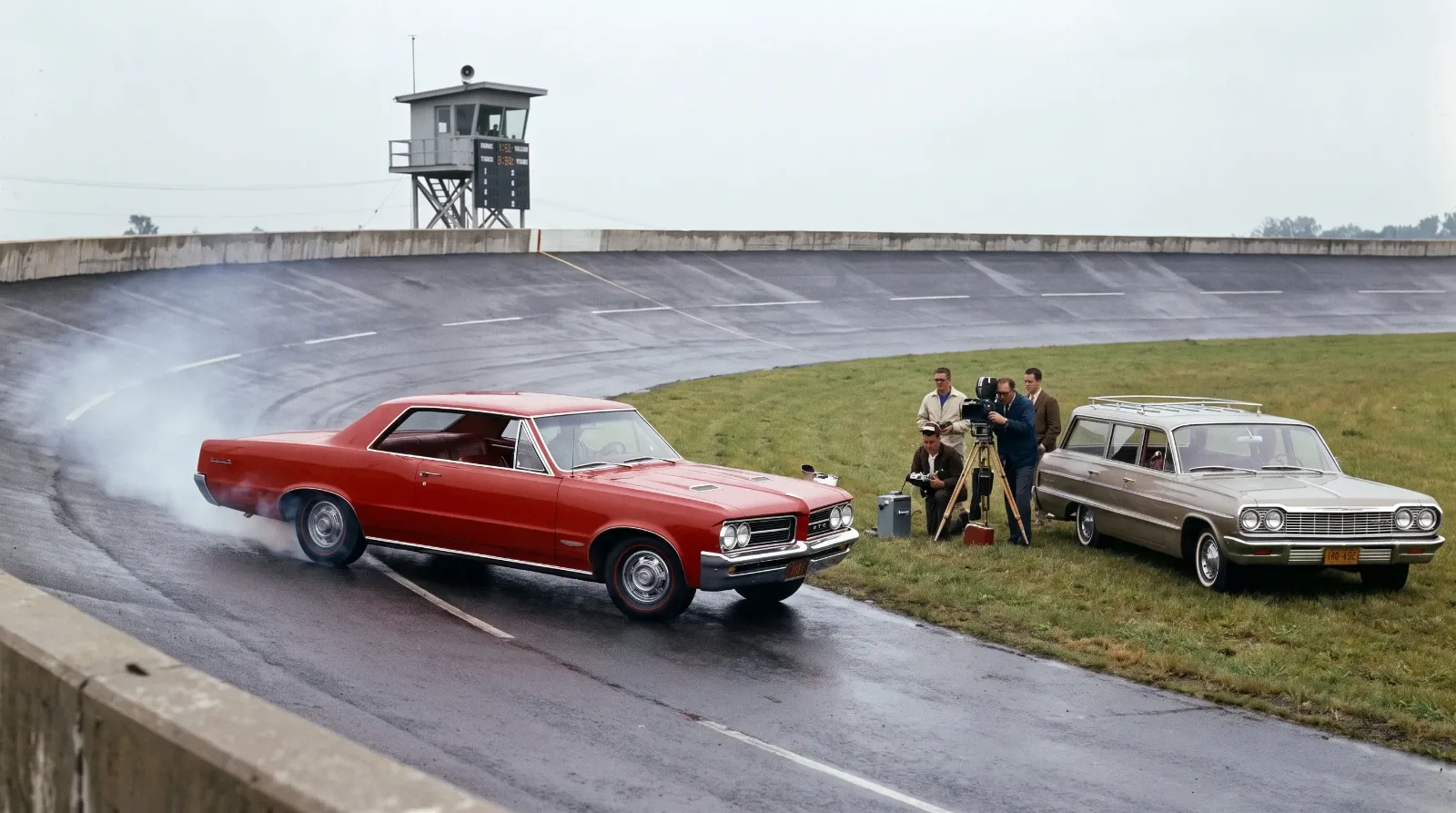
Automotive journalists at the time were already framing the GTO as a category unto itself. Car and Driver's March 1964 cover story, headlined "GTO vs. GTO," dressed up a Royal Pontiac-tuned GTO with a 421 engine quietly swapped in for the stock 389, and no Ferrari actually took part in any side-by-side test; the Ferrari 250 GTO appeared only in name and on the cover illustration. The stunt drew criticism once the ringer engine came to light, but it still showed how quickly the press treated Pontiac's car as a genre-defining product rather than one more option package. Competing engineers at Oldsmobile and Buick have said in later interviews that their own mid-size muscle programs were greenlit specifically because sales data proved the GTO formula worked, which is about as direct a lineage claim as an industry ever produces.
Chevrolet's response took longer to arrive in a fully realized form. The Chevelle SS 396 did not show up until 1965 as a limited option and did not become a broad production reality until 1966, roughly two full years after Pontiac had already proven the market. That gap is central to why GTO gets first-mover credit in most muscle car histories, even from writers who personally prefer a Chevelle or a Road Runner.
"Every option code tells a story if you're patient enough to read it. Code 382 on a 1964 Tempest LeMans order sheet is the moment a division worked around its own parent company and by doing that, wrote the rulebook every competitor copied for the next decade."
Tom Ramirez
The name earned its own mythology
Part of what cemented the "godfather" framing is how the GTO name itself became shorthand for the entire category. Within a couple of years, buyers and journalists were using "GTO-style" as a generic description for any mid-size car with an oversize engine, regardless of make. That kind of linguistic drift, where a specific product name becomes the word for the whole product class, tends to happen only with genuine category originators, and it happened to the GTO faster than it happened to most of its rivals.
Pontiac leaned into the reputation rather than shying from it. Later ad copy referred back to the original 1964 model explicitly, treating it as a founding document the way a company might reference its first factory or its founder's original patent. That self-mythologizing, paired with the actual production and sales figures, is why the "godfather" label has stuck in enthusiast circles for six decades rather than fading as a marketing slogan usually does.
None of this erases the real engineering contributions of Oldsmobile's Rocket 88 lineage or Chrysler's letter cars, and serious historians are careful to say the GTO invented a production format rather than the underlying idea of a big engine in a light car. But format is what turned muscle cars from a scattered handful of factory hot rods into a recognizable, mass-market segment with rules other divisions could follow, and that format traces directly back to a Pontiac engineer's workaround memo in 1963.
What "godfather" leaves out of the story
Any nickname this durable eventually gets more credit than the full history strictly supports, and it is worth being precise about what the term actually claims. Nobody serious argues Pontiac invented the idea of a powerful engine in a lighter body. Chrysler's 300 letter cars did that in the 1950s on a full-size platform, and various regional dealers and independent shops had been dropping big engines into smaller cars for years before 1964 in ways that never reached national production. What the GTO did that none of those earlier efforts managed was scale the idea into a repeatable, factory-backed, nationally marketed product with a name buyers actually wanted printed on their fender.
That distinction between inventing an idea and industrializing it matters, because it is the same distinction that separates a garage tinkerer from a company that changes an entire market. Pontiac's engineers did not stumble onto anything mechanically that a good speed shop couldn't have managed on its own. What they had that a speed shop never could was GM's assembly line, GM's dealer network, and GM's advertising budget, and putting those resources behind DeLorean's workaround is what actually earned the GTO its reputation as a category founder rather than just another fast car among many built in small numbers.
Even Pontiac's own later marketing acknowledged this nuance indirectly, framing the GTO less as a technical breakthrough and more as the car that proved a market existed. That is a more accurate, and honestly more interesting, claim than pure invention, and it is the version of the godfather story that holds up best under scrutiny six decades later.
If you want the fuller story of the people involved, read on.
Sources and notes
- Wikipedia - Pontiac GTO, the 330 cubic-inch rule and the 1963 workaround
- Ate Up With Motor - Three Deuces, Four Speeds: the rise and fall of the Pontiac GTO
- Curbside Classic - the Car and Driver GTO vs. Ferrari ringer story
- Hagerty - the GTO origin story
- HotCars - how Pontiac borrowed Ferrari's GTO name
- GM Heritage Collection - 1964 Pontiac GTO
Related Reading
Have a
Pontiac GTO
for Sale?
Reach thousands of serious classic car collectors across the US.
Sell It Here →
Are You a Classic Car Dealer?
List your full inventory and connect with targeted classic car buyers.
Join as a Dealer →

About the author
Tom Ramirez
Corvette researcher and historian based in Bowling Green, Kentucky. Two decades documenting Corvette production history from original factory records.
Related Listings - Pontiac GTO


Comments
Be the first to comment on this article.