
The 1958 Impala debut did not arrive as its own model. It arrived as a name stitched onto the top of the Bel Air lineup, a single trim level competing for attention against fins, quad headlights, and a completely new frame. Within a year that name would outgrow Bel Air entirely. Within a decade it would be the best selling nameplate in America. None of that was obvious in January 1958, when Chevrolet dealers first unveiled the car and most customers walked past it looking for the cheaper six-cylinder sedan.
Car Features
6 min read
1958: The Year Impala Went From Trim to Icon
The 1958 Impala debut started as a single Bel Air trim level built on Chevrolet's new X-frame, and its reception convinced Chevrolet to promote it into its own model line the following year.
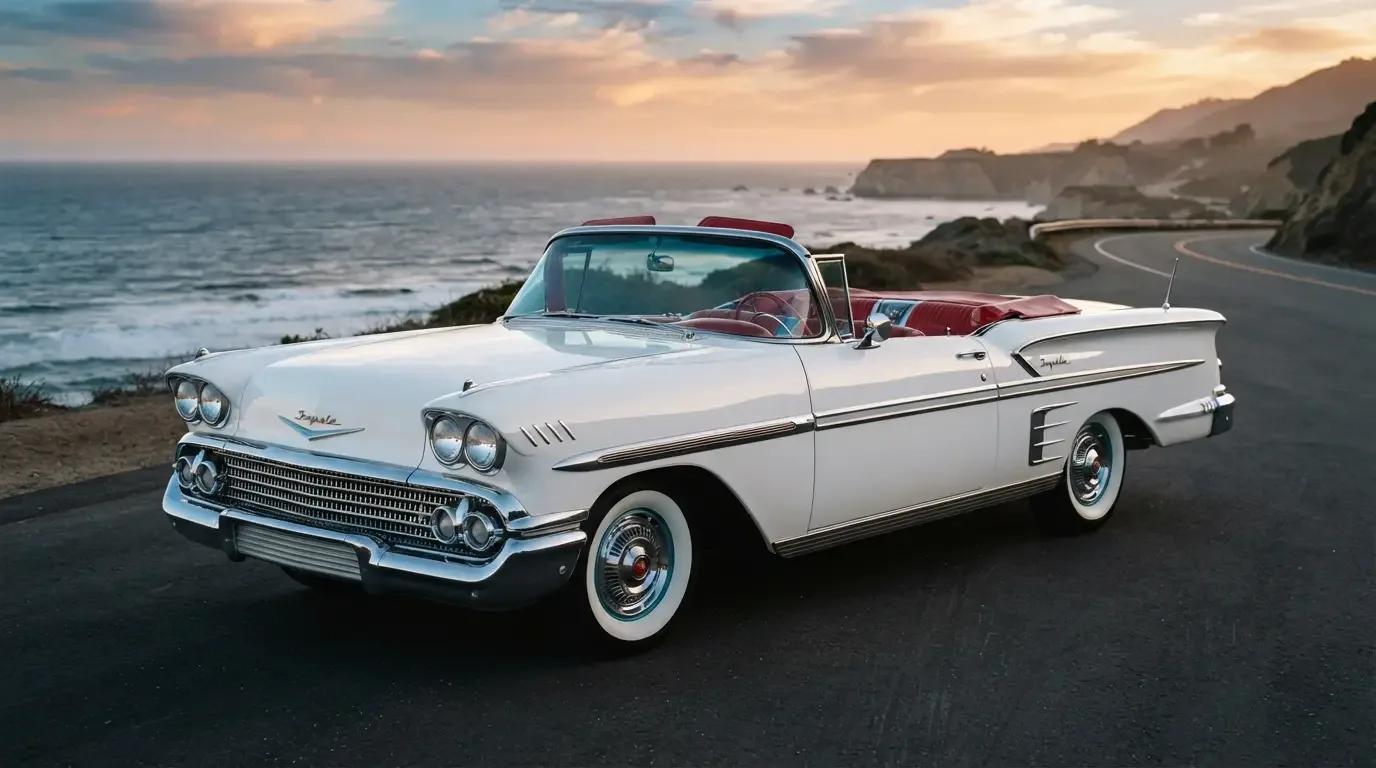
Chevrolet needed something new for 1958 because everything about the division's product line was changing at once. General Motors had committed the corporation to quad headlights, a wider stance, and a lower roofline across every division, and Chevrolet's engineers had also finished a new perimeter frame, marketed as the "Safety Girder" X-frame, that let stylists drop the body several inches without sacrificing structure. That frame is easy to overlook in retrospectives that focus on chrome and taillights, but it is the reason the 1958 cars look so different from the 1957 models they replaced. The Impala rode on that new architecture from its first day on sale.
A trim level with a job to do
Internally, Chevrolet needed a way to sell a genuinely upscale two-door without building an entirely new body shell, and without cannibalizing sales from the Bel Air four-door and wagon lines that still made up the bulk of dealer volume. The solution was to take the Bel Air Sport Coupe and Convertible, the two body styles most likely to be cross-shopped against Pontiac and Oldsmobile, and dress them as a distinct sub-series called Impala. Buyers got a longer list of standard brightwork, a unique grille treatment, and a triple-unit taillight design on each side rather than the single round lamp used on lesser Bel Airs. It was, in practice, a halo car built from an existing body.
The name itself came from product planning rather than an ad agency contest, and Chevrolet's own designers have said the antelope imagery was meant to suggest speed and grace without borrowing a competitor's cue. Whatever the origin story, the badge worked. Dealers reported that showroom traffic gravitated toward the Impala coupe even when buyers ultimately left with a cheaper trim, and that kind of aspirational pull is exactly what a halo model is supposed to generate.
What made the 1958 debut car different
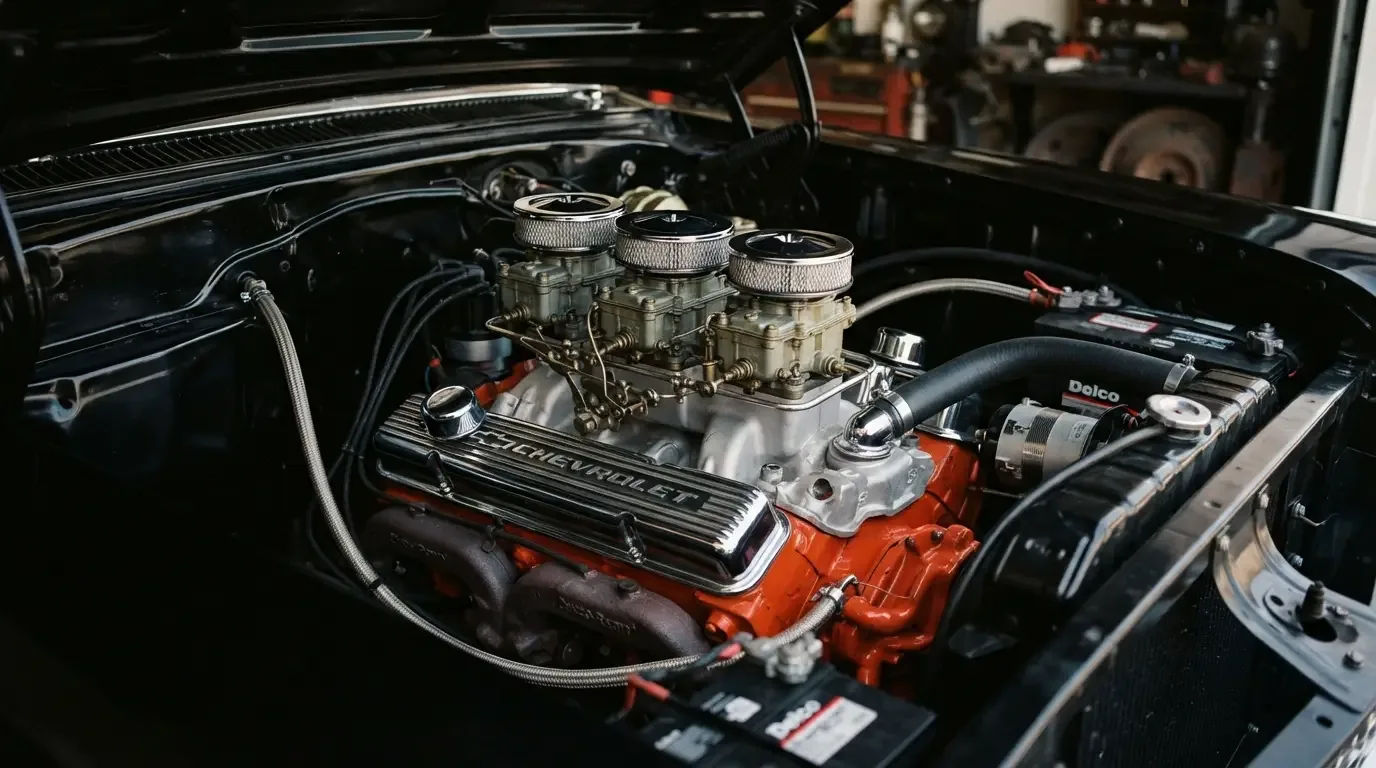
Beyond the frame and the quad headlights shared with the rest of the range, the 1958 Impala carried its own grille insert, a wider rear bumper with cutouts to house the triple taillights, and interior trim that used more chrome and better cloth than the standard Bel Air. Chevrolet also reserved its new 348 cubic inch W-series V8, the division's first true big-block, as an option exclusive to the upper trims, and the Impala was the car most likely to be ordered with it. You can read more about that engine in a related story, but the short version is that the 348 gave the 1958 debut car a genuine performance credential to go with its styling.
The base engine remained the familiar 235 cubic inch inline six for buyers who wanted the Impala's looks without the price of a V8, and a 283 small-block filled the middle ground. That spread of powertrains mattered because it let Chevrolet sell the Impala image at multiple price points, which is exactly the kind of range-building that keeps a halo model profitable rather than a marketing exercise that loses money on every unit.
The market Chevrolet was debuting into
1958 was a recession year, and new car sales across the industry dropped sharply from 1957. Chevrolet's overall output fell along with everyone else's, which makes the Impala's reception more impressive rather than less. A brand new sub-series, launched into a contracting market, still managed to move enough units that Chevrolet's planners felt confident expanding it into a full model line for 1959. That confidence was not universal within the corporation. Some product planners argued for folding the Impala name back into Bel Air trim levels once the recession eased, and it took strong first-year results to settle the argument in the other direction.
Ford and Plymouth were making their own styling statements that year, and buyers cross-shopping the segment would have seen the 1958 Impala next to a heavily reworked Fairlane and a finned Plymouth Belvedere. In that company, the Impala's combination of a genuinely new frame, a distinctive rear treatment, and an available big-block V8 gave it a case for itself that did not depend on nostalgia for older Chevrolet full-size cars.
"Chevrolet didn't launch a new model in 1958, it launched an argument for one. The sales figures settled that argument fast enough that by the following year there was no more debate."
- Tom Ramirez
Why the debut year still matters to collectors
Because the 1958 Impala existed for exactly one model year in its original two-body-style form, it occupies a specific place in Chevrolet's history that later Impalas, spread across a full range of body styles and multiple decades, do not share. Collectors who focus on 1958 impala history treat the debut cars as a distinct chapter rather than simply the first page of a longer story, and that distinction shows up in how the cars are judged at shows and how they are priced at auction. A 1958 Sport Coupe or Convertible represents a specific transitional moment for Chevrolet, sitting between the finned 1957 cars and the longer, lower Impalas that would define the 1960s.
For anyone chasing an original example, the debut year cars reward patience. Fewer were built than in the peak years that followed, and the combination of the X-frame chassis, the triple taillights, and the optional 348 make an authentic, well-documented 1958 Impala a car with a clear story to tell rather than one more full-size Chevrolet from the era. Buyers who want to see what is currently on the market can find Impalas for sale now and compare how debut-year examples are priced against the rest of the decade's Impala production.
The legacy of getting the debut right
What Chevrolet learned from the 1958 launch shaped how the division handled Impala for the next several years. A halo trim that sells on its own merits, rather than one that simply borrows attention from cheaper models, is worth promoting into its own lineup. That lesson led directly to the 1959 expansion, and from there to the Impala becoming, by the middle of the following decade, the single best selling car in the United States. The 1958 debut is easy to treat as a footnote next to that later success, but it is the year that proved the concept could work at all.
Sources and notes
- Wikipedia: Chevrolet Impala
- Paddock Parts: 1958-90 Impala Production Figures
- Classic.com: 1958 Chevrolet Impala Market
- Hagerty Media: Cars With Quad Headlights Before They Were In Vogue
- Curbside Classic: 1957 Cars With Alternate Quad and Single Headlight Front Ends
- autoevolution: 1958 Chevrolet Impala 348 Tri-Power
Related Reading
Have a
Chevrolet Impala
for Sale?
Reach thousands of serious classic car collectors across the US.
Sell It Here →
Are You a Classic Car Dealer?
List your full inventory and connect with targeted classic car buyers.
Join as a Dealer →

About the author
Tom Ramirez
Corvette researcher and historian based in Bowling Green, Kentucky. Two decades documenting Corvette production history from original factory records.
Related Listings - Chevrolet Impala
Comments
Be the first to comment on this article.