
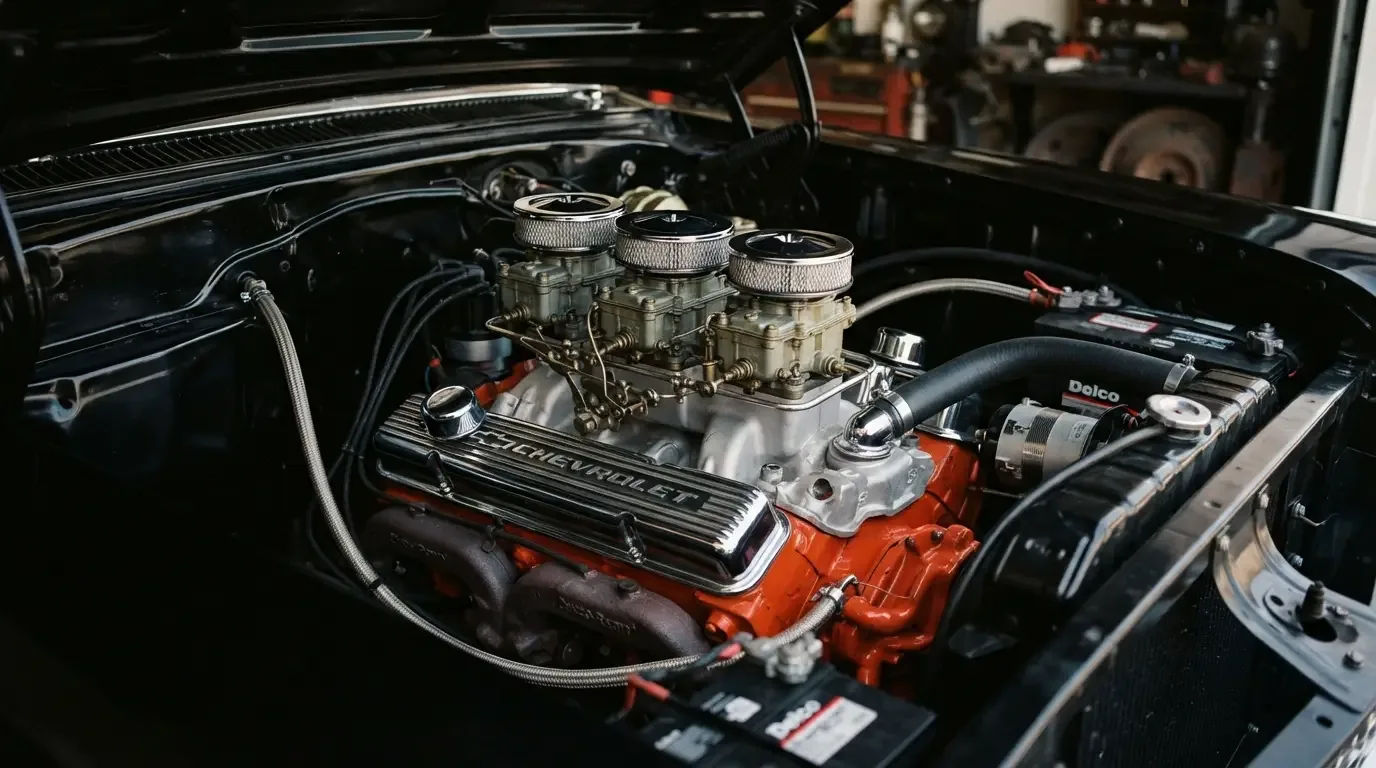
The 1958 Impala 348 Tri-Power option is one of those footnotes that turns out to matter more than the sales brochure ever suggested. Chevrolet's new W-series big-block, offered for the first time that year, gave the Impala something it had never had before: an engine built specifically to move a heavier, lower, wider car with authority rather than one carried over from the previous generation and tuned a bit harder. The triple two-barrel carburetor setup sitting on top of it was the headline option, and it turned a comfortable boulevard cruiser into something a numbers-minded owner could actually take seriously at a stoplight.
Car Features
7 min read
The Tri-Power 348: The 1958 Impala's Big Gun
Chevrolet's first big-block, the W-series 348, became a genuine performance engine in 1958 once the triple two-barrel Tri-Power induction option arrived to solve its airflow limits.
Why Chevrolet needed a big-block at all
Through the mid-1950s, Chevrolet's performance reputation rested almost entirely on the small-block 265 and 283 V8s, engines that were light, efficient, and genuinely quick for their displacement. The problem in 1958 was packaging. The new full-size body was bigger and heavier than the car it replaced, and GM's other divisions were all fielding larger displacement engines to match. Chevrolet's answer was the 348 cubic inch W-series, named for the distinctive shape of its valve covers, and it was engineered from the outset as a truck and heavy-car engine that could be tuned upward for passenger cars. That dual purpose explains some of its unusual design choices, including a combustion chamber shape borrowed more from industrial thinking than from the small-block's racing-honed architecture.
Putting a truck-derived block under the hood of the brand new halo car might sound like a step down, but the 348 solved a real problem. It gave Chevrolet's flagship the torque to move a bigger body without asking the small-block to work outside its comfort zone, and it left room to grow. That growth path became clear almost immediately with the Tri-Power induction option.
What Tri-Power actually changed
The base 348 arrived with a single four-barrel carburetor and was already the strongest engine Chevrolet had ever offered in a passenger car. The Tri-Power version added two additional two-barrel carburetors on the outboard sides of the intake manifold, engaged progressively as the driver got deeper into the throttle. At light cruising loads, only the center carburetor did any work, which kept fuel economy reasonable for a car most owners drove to church and back. Get into the throttle and the outer two carburetors opened in sequence, and the difference was not subtle.
Output on the Tri-Power 348 for 1958 is rated at 280 horsepower, up from 250 horsepower on the standard single four-barrel version, a figure that made it one of the most powerful engines available in any American passenger car that year, ahead of most of what Ford and Chrysler were fielding in a comparable full-size body. Period road tests treated the Tri-Power 348 as a genuine performance option rather than a marketing gimmick, and that reputation followed the W-series engine family for the rest of its production run.
| Spec | 1958 Impala 348 Tri-Power |
|---|---|
| Displacement | 348 cubic inches |
| Induction | Three two-barrel carburetors |
| Peak horsepower | 280 hp (base four-barrel 348 rated 250 hp) |
| Engine family | W-series, Chevrolet's first big-block |
| Availability | Optional on Impala and select Bel Air trims |
An engineer's read on why it worked
What makes the Tri-Power 348 interesting from an engineering standpoint is how much of its performance came from breathing rather than displacement. The base four-barrel 348 already had the bore and stroke to make good torque; the triple-carburetor setup mainly solved the airflow bottleneck at higher RPM. That is a cleaner solution than simply installing a bigger carburetor, because it lets the engine idle and cruise on a small, efficient throttle body while still opening up real capacity when the driver demands it. It is the same basic principle GM would use again on later high-output engines, and the 1958 348 is one of the earliest production examples of Chevrolet applying it at scale.
The trade-off, and it is a real one, is complexity. Three carburetors means three sets of linkage, three sets of gaskets, and three times the tuning headaches if any single unit falls out of sync. Chevrolet's own service literature acknowledged that a Tri-Power setup needed more careful attention than the standard four-barrel, and that reputation for finickiness is part of why so many original Tri-Power engines were swapped for simpler four-barrel setups over the decades that followed.
"The Tri-Power 348 wasn't Chevrolet chasing a bigger number for the brochure. It was solving an airflow problem the small-block genuinely could not solve on its own, and that is a very different kind of engineering decision."
- Emily Chen
Tri-Power on the track and in the showroom
Chevrolet did not have to sell the Tri-Power 348 hard. NASCAR and drag strip results from 1958 and into 1959 did much of the talking, since a Tri-Power big-block Chevrolet running against Ford's and Plymouth's own big-inch offerings gave Chevrolet dealers something concrete to point to when a customer asked why they should pay more for the option. That kind of on-track credibility mattered more in the late 1950s than it does now, when performance claims are easy to check against a dozen independent sources. In 1958, a strong showing at a sanctioned event was often the only proof a buyer had beyond the dealer's word, and the 348 delivered enough of those results to justify its reputation.
Order rates for the Tri-Power option were never close to universal. Most 1958 Impala buyers who chose the 348 stuck with the standard four-barrel version, which was already a strong engine and considerably simpler to live with day to day. That makes the Tri-Power cars a minority within a minority, since the 348 itself was already an upgrade over the small-block that most buyers chose. The rarity of the combination is part of why it draws so much attention from collectors focused specifically on 1958 Impala history rather than the model's broader run.
What it means for collectors today
A documented 1958 Impala with the factory Tri-Power 348 is a meaningfully different car from one built with the base six-cylinder or even the small-block 283, and buyers researching the option should treat it as a distinct category rather than an interesting footnote. Because so many Tri-Power setups were removed or modified over the decades, an intact, numbers-matching example carries a real premium, and verifying originality matters more here than on almost any other 1958 full-size Chevrolet option. Anyone building out a fuller picture of the car should start with our complete history of the 1958 Impala before zeroing in on engine-specific details, since the powertrain decisions only make sense in the context of the car Chevrolet was trying to build that year.
For buyers shopping the current market rather than just reading about it, it is worth comparing how Tri-Power cars are priced against standard 348 and small-block Impalas before you go looking. You can find a classic Impala and see for yourself how much of a difference the engine option makes to asking prices today. The gap tends to be larger than casual observers expect, which tells you something about how seriously the collector market takes Chevrolet's first big-block, more than sixty years after it left the factory floor.
Sources and notes
Related Reading
Have a
Chevrolet Impala
for Sale?
Reach thousands of serious classic car collectors across the US.
Sell It Here →
Are You a Classic Car Dealer?
List your full inventory and connect with targeted classic car buyers.
Join as a Dealer →

About the author
Emily Chen
Bay Area engineer with a deep focus on vintage Japanese and European performance cars. Approaches classic car research and restoration with an analytical eye.
Related Listings - Chevrolet Impala




Comments
Be the first to comment on this article.