
Figuring out 1958 Impala production numbers is harder than it should be, and that difficulty is itself part of the story. Because the Impala launched as a Bel Air sub-series rather than a fully separate model line, Chevrolet's own production records from the period sometimes group Impala output together with related Bel Air figures, and later published totals have varied depending on the source and how strictly they define what counts as an Impala for that first year. What is clear is that Chevrolet built enough of them, in a recession year, to justify expanding the name into a full lineup for 1959.
Car Features
6 min read
How Many 1958 Impalas Were Built
1958 Impala production totals are harder to pin down than later years because the car launched as a Bel Air sub-series, but the numbers were strong enough to justify a full lineup by 1959.
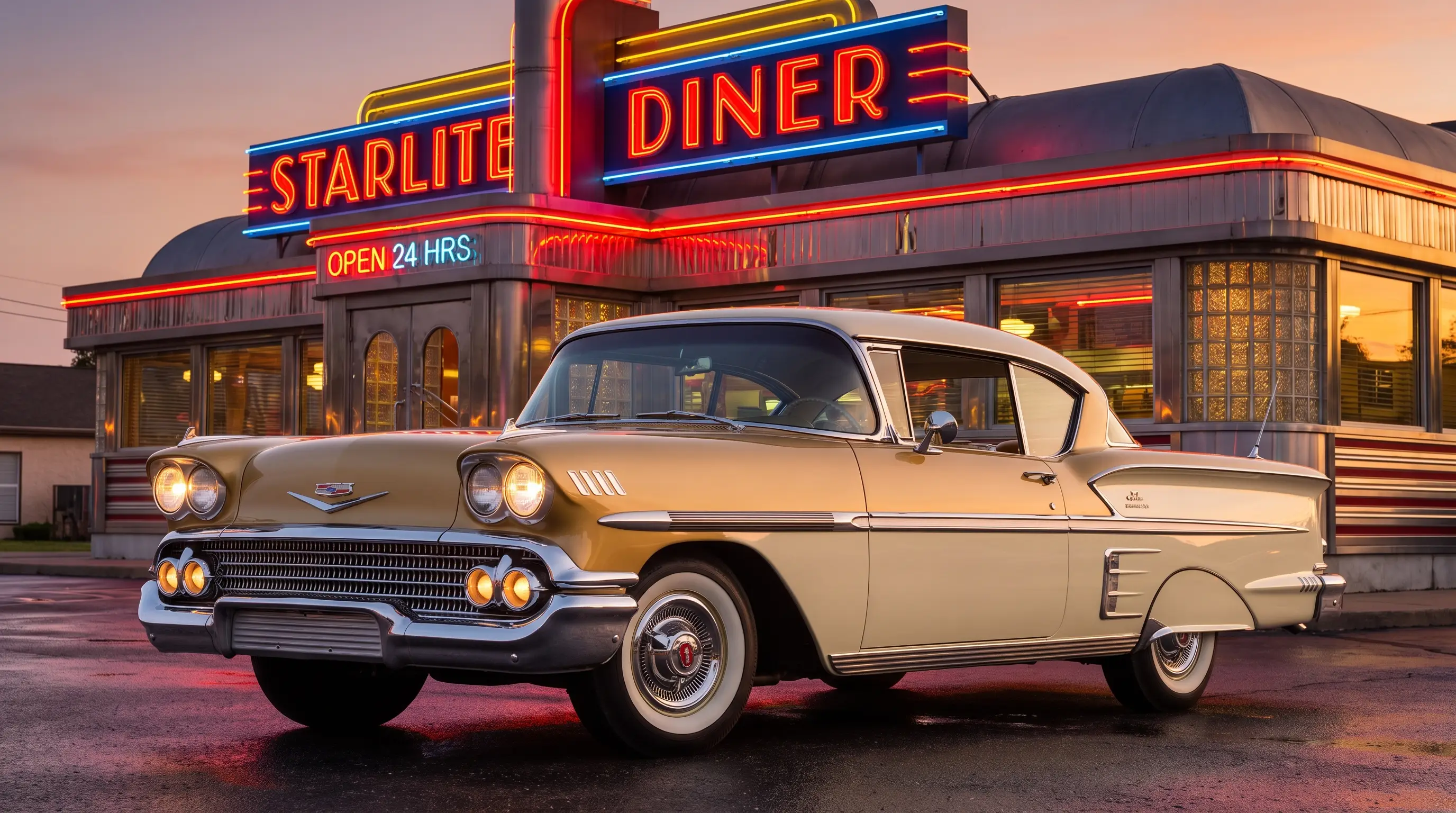
Why the debut year numbers are hard to pin down
Total 1958 Impala production across both body styles comes to 181,469 units: 125,480 Sport Coupes and 55,989 Convertibles, according to factory production figures widely cited by Chevrolet historians. Chevrolet's own record-keeping from the period was built around the broader full-size lineup rather than around Impala as an isolated model, since Impala did not yet exist as its own separate series in the corporation's internal accounting for that year, which is part of why some secondary sources have repeated slightly rounded or varying totals over the years.
None of that uncertainty changes the basic shape of the story. The 1958 Impala sold well enough, during a year when new car sales across the industry were falling, that Chevrolet's planners had the confidence to promote it into a standalone series for 1959, dropping the Bel Air sub-series structure entirely.
How the two body styles split the total
Within that overall production figure, the Sport Coupe accounted for the larger share by a wide margin, which tracks with the pattern seen across nearly every full-size American convertible and hardtop pairing of the era. Convertibles cost more to build, required additional structural reinforcement to compensate for the missing fixed roof, and simply appealed to a smaller slice of buyers who wanted the open-air experience badly enough to pay for it. That imbalance in original production numbers is the single biggest driver of the price gap collectors see today between 1958 Impala Sport Coupes and Convertibles in comparable condition.
| Body Style | Approximate Share of 1958 Production |
|---|---|
| Sport Coupe | 125,480 units, about 69 percent of the total |
| Convertible | 55,989 units, about 31 percent of the total |
What the recession year context adds
1958 was a difficult year across the entire American auto industry, with total new car sales dropping well below 1957 levels as the broader economy slowed. Every manufacturer felt that pressure, and Chevrolet's full-size lineup, Impala included, was not exempt from it. Seen against that backdrop, the Impala's production numbers look considerably stronger than a flat comparison to a normal sales year would suggest, since the model was launching into genuinely difficult conditions rather than a receptive, growing market.
That context matters for how collectors should read the debut year's numbers today. A brand new trim level moving a meaningful volume of cars during an industry-wide downturn is a stronger signal of real demand than the same volume would represent in a boom year, and Chevrolet's own decision to expand Impala into a full lineup for 1959, rather than wait for the economy to recover first, reflects how seriously the division took that signal.
Why production numbers drive today's collector market
Lower original production, especially for the Convertible body style, translates directly into scarcity for today's collectors, and scarcity is one of the clearest drivers of value in this specific market. A well-documented 1958 Impala, particularly a Convertible or a Sport Coupe equipped with the optional 348 engine, benefits from the fact that relatively few were built compared to the Impala's later, higher-volume years once the model became a full lineup and eventually the best selling car in America. Readers looking for the fuller debut year context should see our 1958 impala retrospective, and anyone specifically curious about how production scarcity translates into collector pricing should also look at a related story covering the model as an investment.
"The exact number Chevrolet built in 1958 depends on which ledger you trust. What doesn't depend on the source is that it was enough to convince the corporation the Impala name deserved its own lineup."
- Tom Ramirez
Comparing 1958 to the years that followed
Once Chevrolet expanded Impala into a full lineup for 1959, adding four-door sedans and a wagon body alongside the existing coupe and convertible, total annual production jumped substantially above what the 1958 debut year had managed. That jump makes sense given the broader range of body styles suddenly available under the Impala name, but it also means the 1958 cars represent a genuinely smaller slice of total Impala production across the model's long history. By the time the Impala became the best selling car in America in the mid-1960s, annual production had grown to a scale the 1958 debut year never approached, since that later volume came from a full range of body styles rather than just two.
Seen against that later growth, the 1958 debut year production numbers look almost modest, and that is precisely why they carry the weight they do with today's collectors. A car built during the Impala's smallest, most tightly defined production year occupies a different tier of scarcity than one built during the peak volume years that followed, even though the later cars often get more attention simply because there were so many more of them built and sold.
Verifying production details on a specific car
For anyone evaluating an individual 1958 Impala rather than the model's production totals in general, the trim tag and body data plate remain the most reliable way to confirm a specific car's original body style, engine, and color combination against the broader production picture. Matching those codes against known reference material is worth the effort before assuming a car's rarity based on body style alone, since paint and trim combinations varied in popularity even within the Sport Coupe and Convertible totals. Buyers who want to see how production scarcity plays out in current asking prices can find Impalas for sale now and compare documented, verifiable examples against the broader market.
It is worth repeating that a car's paperwork carries more weight than its appearance when production numbers are this uncertain. A Sport Coupe with a fully verified trim tag and matching engine number is a more trustworthy purchase than a Convertible whose data plate raises questions, no matter how clean either car looks in photographs. Production scarcity only benefits a buyer when it can actually be proven for the specific car in front of them, not just claimed for the model year as a whole.
Sources and notes
Related Reading
Have a
Chevrolet Impala
for Sale?
Reach thousands of serious classic car collectors across the US.
Sell It Here →
Are You a Classic Car Dealer?
List your full inventory and connect with targeted classic car buyers.
Join as a Dealer →

About the author
Tom Ramirez
Corvette researcher and historian based in Bowling Green, Kentucky. Two decades documenting Corvette production history from original factory records.
Related Listings - Chevrolet Impala
Comments
Be the first to comment on this article.