
Step inside a 1958 Impala interior and the first thing you notice is how much effort Chevrolet put into making a car built from an existing Bel Air shell feel like something entirely new. The dashboard, the upholstery patterns, the switchgear, all of it was dressed to signal that this was the top of Chevrolet's full-size range, and the cabin carried that message with as much conviction as the exterior sheet metal did. For a halo trim built on borrowed bones, the 1958 Impala's interior does not feel like an afterthought.
Car Features
7 min read
Inside the 1958 Impala
The 1958 Impala interior used color-keyed upholstery, chrome-accented gauges, and coordinated trim to make Chevrolet's new halo car feel as distinct inside as it looked outside.
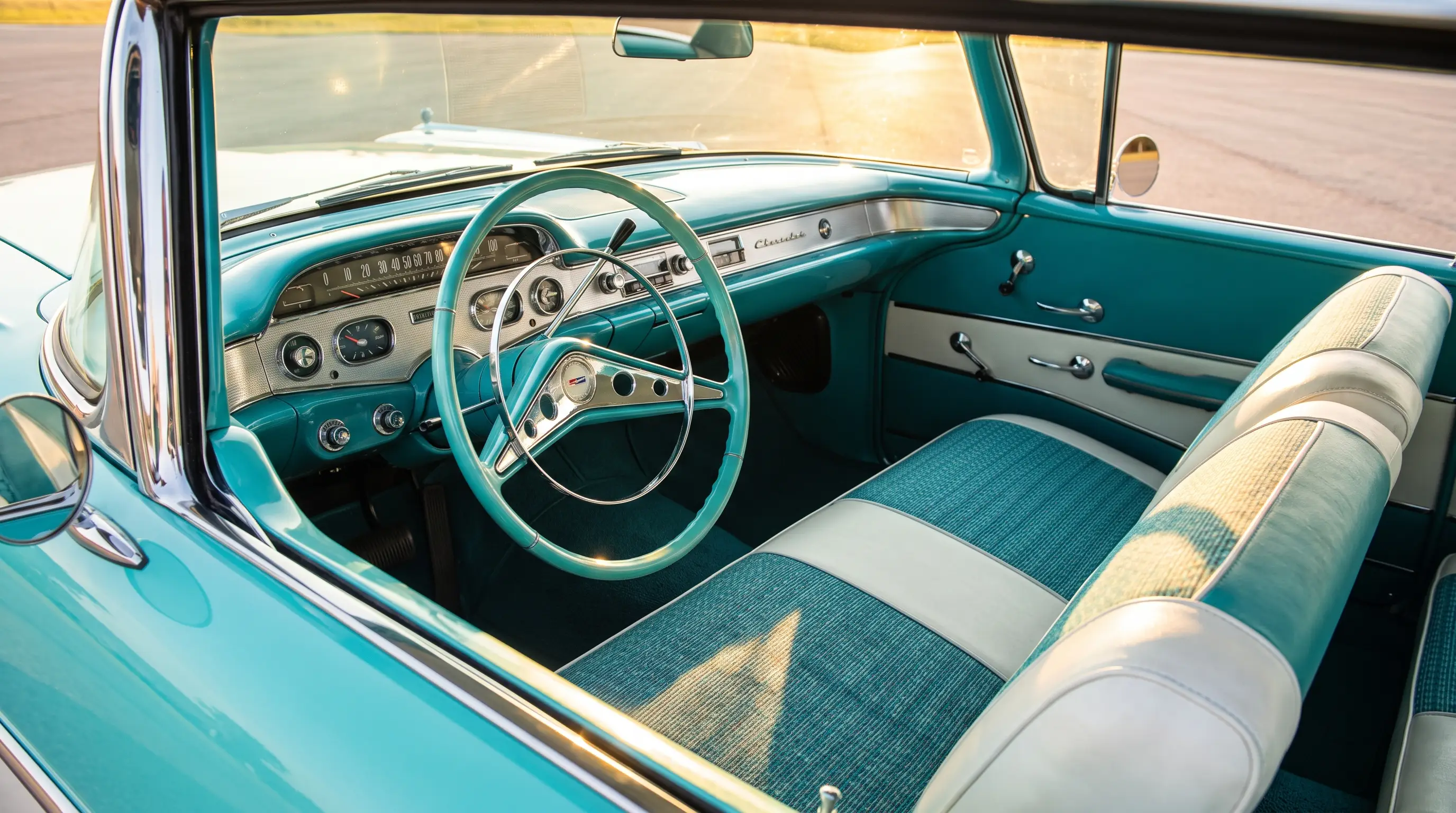
A dashboard built for the jet age
The instrument panel followed the same visual language as the rest of the car's styling that year, wide and symmetrical, with a cluster of gauges set into brightwork trim that echoed the chrome used across the exterior. Chevrolet's designers were working within the same corporate mandate that produced the quad headlights and lower roofline outside, and the dashboard reflects that mandate just as clearly. It reads as confident rather than cluttered, with a speedometer and supporting gauges arranged for quick reading rather than pure decoration, though decoration was clearly part of the intent as well.
Materials mattered here in a way they had not always mattered on lower Chevrolet trims. The Impala's dash used more chrome accents and a richer color-keyed finish than a standard Bel Air, and that distinction was deliberate. Chevrolet wanted a buyer sitting behind the wheel to feel the price difference the moment they climbed in, not just see it from the curb.
Upholstery and color-keyed trim
Seat upholstery on the 1958 Impala combined patterned cloth with vinyl bolsters in most configurations, and the pattern choices leaned into the same geometric, slightly futuristic look that showed up in contemporary furniture and appliance design of the period. Chevrolet offered these patterns across a range of interior colors that could be matched or contrasted against the exterior two-tone paint schemes, which meant a buyer could specify a genuinely coordinated look from the outside in. That level of coordination was part of what separated the Impala experience from a standard Bel Air, where interior choices were more limited and less clearly tied to the exterior appearance.
Door panels carried additional brightwork and integrated armrests finished to match the seat trim, and the overall cabin avoided the bare, utilitarian feel that cheaper full-size cars of the era sometimes had. None of this was subtle. The Impala interior was built to be noticed, and Chevrolet's own sales materials from the period leaned hard into descriptions of the cabin's richness as a selling point in its own right.
| Interior Feature | 1958 Impala Treatment |
|---|---|
| Seat material | Patterned cloth with vinyl bolsters, color-keyed options |
| Dashboard | Wide symmetrical gauge cluster with chrome accents |
| Door panels | Integrated armrests, matched trim brightwork |
| Steering wheel | Deep-dish design with horn ring, chrome spokes |
How the cabin experience shifted between body styles
The Sport Coupe's fixed roof let Chevrolet commit fully to a formal, quiet cabin with a proper headliner and door seals built for a closed car, while the Convertible's open-top design demanded different priorities, including more weather-resistant materials near the window frames and a seating position adjusted for top-down driving. Both body styles shared the same essential dashboard and trim level, but small details, like how the door panels handled water intrusion or how the seat height interacted with the folding top mechanism, meant the two cabins were never quite identical in feel even though they used the same basic components.
Buyers who wanted the fuller picture of how the 1958 Impala differentiated itself, inside and out, from the standard Bel Air should look at the full story of the model's debut, since the interior choices only make sense in the context of the halo positioning Chevrolet was building around the name that year.
"The interior is where you feel the difference between a Bel Air and an Impala most directly. Chevrolet didn't just add chrome outside and call it a day."
- Sarah Whitfield
Small details that separated Impala from Bel Air
Chevrolet was careful to make sure the Impala's interior distinction did not rely on a single obvious feature that could be easily copied or faked by a dealer dressing up a plain Bel Air. Instead, the differences were spread across dozens of small touches: unique steering wheel trim, a specific horn ring design, brighter anodized accents on the glove box door, and a particular grain and stitching pattern on the seat vinyl that a Bel Air simply did not get. Any one of these details on its own would be a minor footnote. Together, they add up to a cabin that reads as clearly upscale the moment you sit in it, which was exactly the effect Chevrolet's product planners were after when they built the case for a distinct halo trim in the first place.
That layered approach also explains why originality checks on a 1958 Impala interior go well beyond just confirming the upholstery pattern. A restorer or appraiser working through a car in detail will look at glove box trim, horn ring design, and even the specific color of the steering column finish, because any one of those details being wrong can indicate parts sourced from a Bel Air or a later model year rather than correct, period Impala trim. Buyers who assume a correct-looking seat pattern means the whole interior is original sometimes miss these smaller tells, and they matter to serious judges even when a casual observer would never notice.
Condition and originality inside the cabin
Interior condition matters enormously to collectors evaluating a 1958 Impala, arguably more than it does on many other classics, because the cabin was such a deliberate part of the car's original sales pitch. Original upholstery patterns are difficult to source correctly today, and reproduction fabric that does not match the period weave or color can undercut an otherwise well-restored car's value at judging. Buyers should look closely at seat pattern accuracy, dashboard chrome condition, and whether the door panel trim matches factory specification for the car's original color-keyed scheme before assuming an interior is correct simply because it looks period-appropriate at a glance.
For anyone shopping rather than simply researching, it is worth sitting in a few different examples before committing to a purchase, since photographs rarely capture how the color-keyed trim and upholstery pattern actually read in person. You can browse classic Impala listings and compare interior condition across the current market, which will tell you quickly how much variation exists between a merely presentable cabin and one that still carries its original, correctly specified trim.
Take your time with that comparison. Interior work is expensive to do correctly, and a seller's photos rarely reveal whether a headliner, a seat pattern, or a set of door panels came from a reputable reproduction source built to period specification or from a generic aftermarket supplier cutting corners on pattern accuracy. The difference shows up quickly once you are sitting in the car, and it is one of the clearest ways to separate a genuinely well-restored 1958 Impala from one that only looks the part in a listing photo.
Sources and notes
Related Reading
Have a
Chevrolet Impala
for Sale?
Reach thousands of serious classic car collectors across the US.
Sell It Here →
Are You a Classic Car Dealer?
List your full inventory and connect with targeted classic car buyers.
Join as a Dealer →

About the author
Sarah Whitfield
Third-generation classic car collector specializing in pre-war American and European coachbuilt automobiles. Researcher and concours enthusiast.
Related Listings - Chevrolet Impala
Comments (1)
C
Chuck Perkins
1 month ago
Good writeup. One thing I'd add is the regional price variation — Southwest cars vs. Rust Belt cars at similar asking prices aren't comparable purchases.