
The 1958 Impala value story is fundamentally a scarcity story. This was the only year Chevrolet built the Impala as a two-body-style Bel Air sub-series before promoting it into a full lineup, and that one-year window shapes how the collector market prices these cars today. Buyers looking at a 1958 Impala are not just buying a full-size Chevrolet from the late 1950s. They are buying the debut year of one of the most successful nameplates in American automotive history, and pricing reflects that distinction.
Car Features
7 min read
The 1958 Impala as a Collector Car
1958 Impala value is driven by body style, engine documentation, and originality, with Tri-Power 348 Convertibles commanding the strongest premiums in today's market.
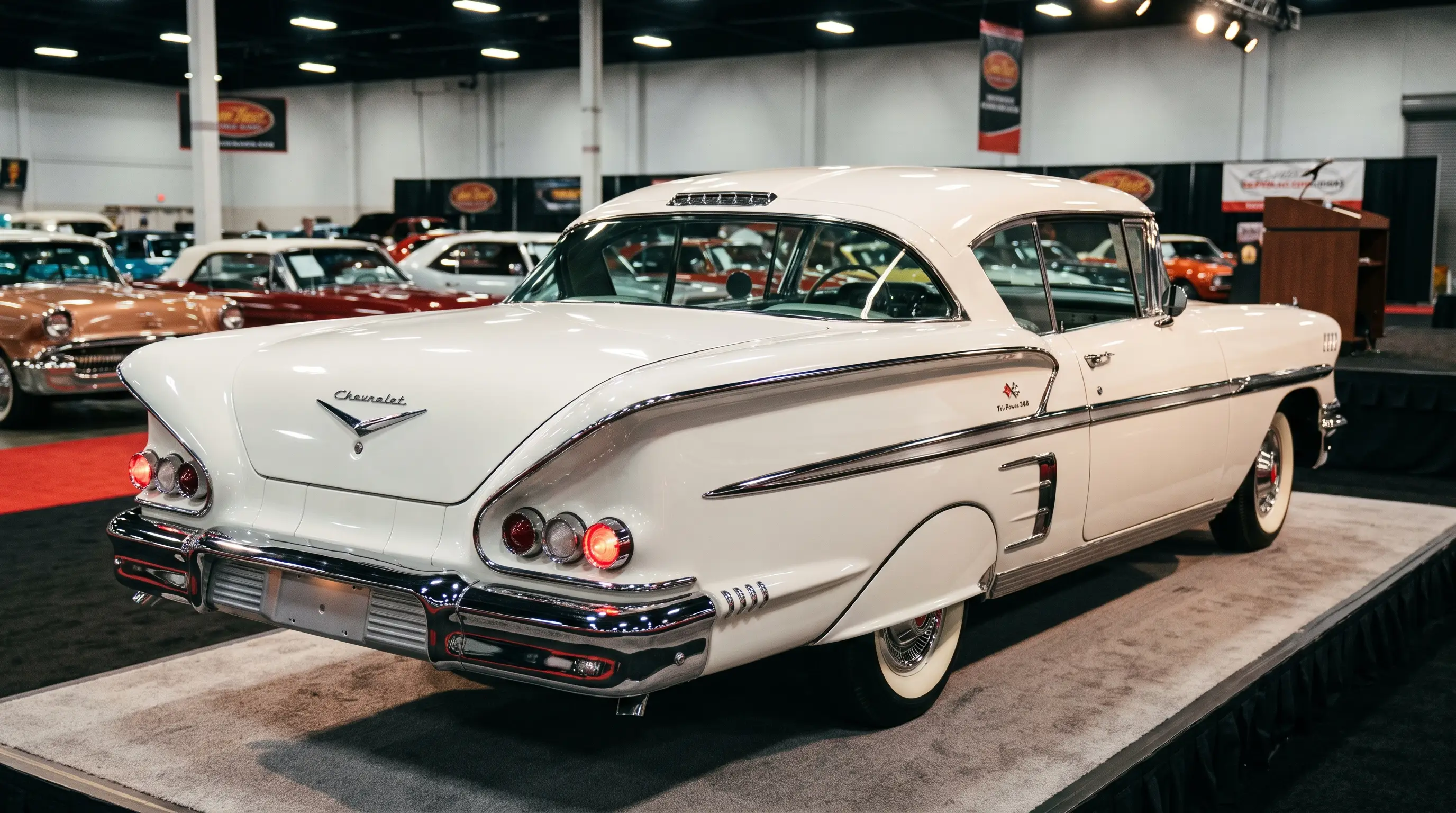
What actually drives price on a 1958 Impala
Body style is the single biggest variable. Convertibles consistently command more than Sport Coupes in comparable condition, driven by lower original production numbers and the stronger collector demand that open cars generally attract across almost every era and manufacturer. Engine choice is the second major factor, and a documented, numbers-matching 348 V8, especially in Tri-Power configuration, adds a real premium over a car built with the base six-cylinder or the small-block 283. Stack a Convertible body style on top of a Tri-Power 348 and you are looking at one of the strongest combinations available in the entire 1958 Impala range.
Beyond body style and engine, documentation matters more on these cars than casual buyers expect. Because the debut year sits at a specific, well-defined moment in Chevrolet's history, buyers and judges alike put real weight on whether a car's trim tag, body data plate, and any surviving factory paperwork line up cleanly with its claimed specification. A car that "looks right" but cannot back that up with matching numbers sells for less than one that can, even when the two are visually indistinguishable.
| Factor | Effect on 1958 Impala Value |
|---|---|
| Body style | Convertible commands a premium over Sport Coupe |
| Engine | Tri-Power 348 adds significant value over base engines |
| Documentation | Numbers-matching cars outsell undocumented equivalents |
| Originality | Correct trim and upholstery patterns matter to judges and buyers |
Reading the current market honestly
Auction results for well-documented 1958 Impalas have trended upward over recent years, in line with broader strength across late-1950s American full-size collectibles, but the market is not uniform. Recent listings and sale results for the model year span roughly the low five figures for project-grade cars up into the low six figures for restored, documented Convertibles, with exceptional Tri-Power 348 Convertibles bringing more still. A rough, undocumented Sport Coupe with the base six-cylinder engine sits in a completely different price tier than a numbers-matching Tri-Power 348 Convertible with clean documentation, and buyers who treat the model as a single price category are setting themselves up to overpay or underbid depending on which end of that range they are actually looking at.
Liquidity is reasonably strong for well-documented examples, since the 1958 Impala has a dedicated following distinct from later, higher-volume Impala years, and that following tends to be knowledgeable enough to recognize a genuinely correct car when one comes up for sale. Undocumented or heavily modified examples are a harder sell, not because interest in the model is weak, but because serious buyers in this specific niche have learned to be cautious about paying debut-year prices for a car that cannot prove it deserves them.
"Buy the documentation as much as you buy the car. On a 1958 Impala, a clean trim tag and a matching engine number are worth more to your resale value than another coat of paint."
- David Mercer
Risks buyers should weigh before committing
Downside risk on a 1958 Impala concentrates around originality claims that don't hold up to scrutiny. Given the premium the market places on Tri-Power 348 cars specifically, and given how many original Tri-Power setups were swapped out over the decades for simpler four-barrel carburetors, buyers need to verify engine and induction claims carefully rather than take a seller's description at face value. The same caution applies to Convertible claims on cars that show signs of a body style conversion, which does happen in this market given the price gap between the two body styles.
Restoration costs are the other major variable, and they run higher on Convertibles specifically because of the folding top mechanism, weatherstripping, and structural reinforcement unique to that body style. A buyer working from a modest budget is generally better served by a solid, honest Sport Coupe than by a Convertible project that looks like a bargain on paper but demands a disproportionate amount of specialized restoration work to bring back to a sellable standard.
How the 1958 Impala compares to other collectible full-size cars of the era
Against its direct 1958 competitors, a well-documented Impala tends to hold its value at least as well as comparable Ford and Plymouth full-size models from the same year, and in the specific case of Convertibles and Tri-Power 348 cars, often better. Part of that comes down to the Impala nameplate's later success, which gives the 1958 debut year a story that a one-off competitor model from a less enduring nameplate simply cannot match. Buyers researching the model are not just buying a 1958 full-size car. They are buying the first chapter of a nameplate that went on to become one of the best selling cars in American history, and that narrative carries real weight in how the market prices these cars against otherwise comparable competitors from the same model year.
That said, buyers should not assume the Impala name alone guarantees strong resale value regardless of condition or documentation. A poorly maintained or heavily modified 1958 Impala will still underperform a clean, honest example of a competing make, and the nameplate's reputation is not a substitute for doing the due diligence any serious collector car purchase requires. Treat the Impala's historical significance as context that supports a well-documented purchase, not as a justification for skipping the verification work in the first place.
The bottom line for buyers today
For a buyer who wants exposure to the 1958 Impala specifically, rather than the model's later, more common years, the clearest path is a well-documented example with verified originality, prioritizing paperwork and numbers-matching status over cosmetic condition alone, since cosmetic issues are far easier and cheaper to correct than a documentation gap. Readers who want the fuller context behind why this specific year commands the attention it does should read the background on the car's debut before deciding where their own budget fits into this market.
For anyone ready to compare actual asking prices rather than general guidance, you can find a classic Impala currently on the market and see firsthand how body style, engine, and documentation stack up against the pricing patterns described here. That direct comparison will tell you more about where the real value sits than any single number ever could.
Patience serves buyers well in this niche. The right combination of body style, engine, and documentation does not come up constantly, and chasing a deal on a car missing one of those pieces usually costs more in the long run than waiting for a correctly specified example to surface. Treat the 1958 Impala market the way a seasoned buyer treats any scarce asset: value the paperwork, verify the claims, and let the car's actual condition, not its reputation, set the final price you are willing to pay.
Sources and notes
Related Reading
Have a
Chevrolet Impala
for Sale?
Reach thousands of serious classic car collectors across the US.
Sell It Here →
Are You a Classic Car Dealer?
List your full inventory and connect with targeted classic car buyers.
Join as a Dealer →

About the author
David Mercer
Classic car market analyst with two decades of experience tracking collector car valuations, auction results, and investment trends.
Related Listings - Chevrolet Impala
Comments
Be the first to comment on this article.