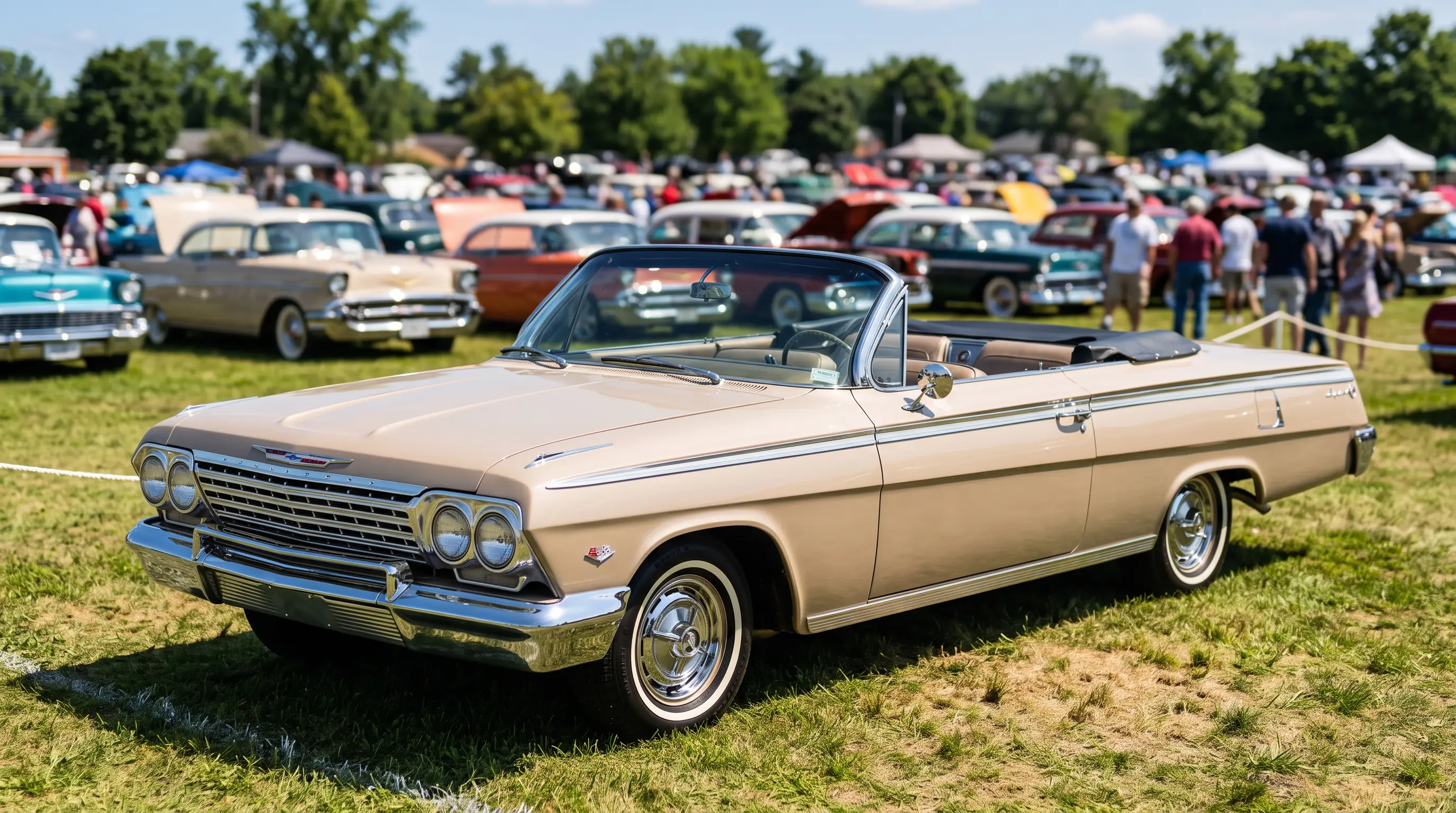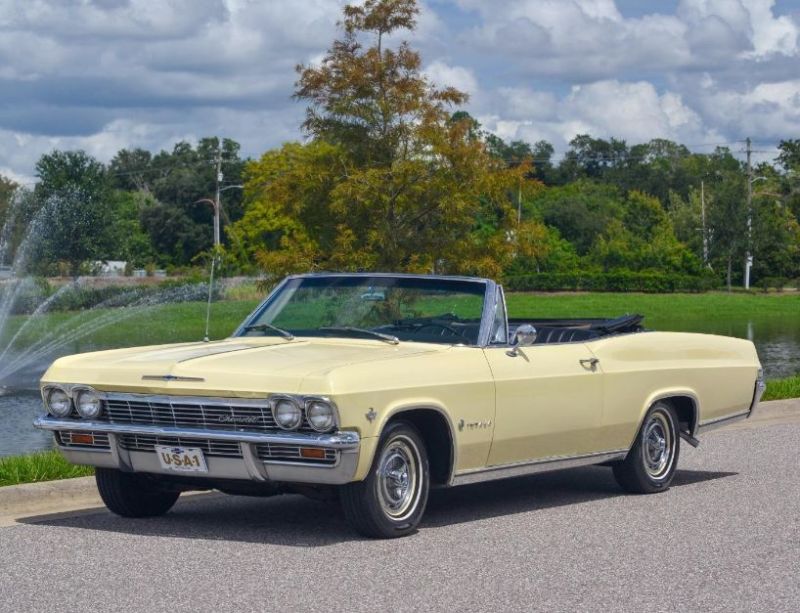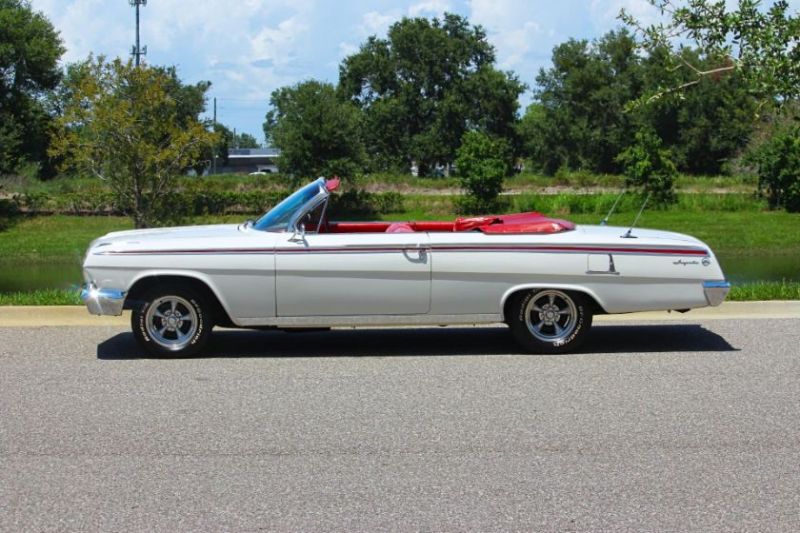
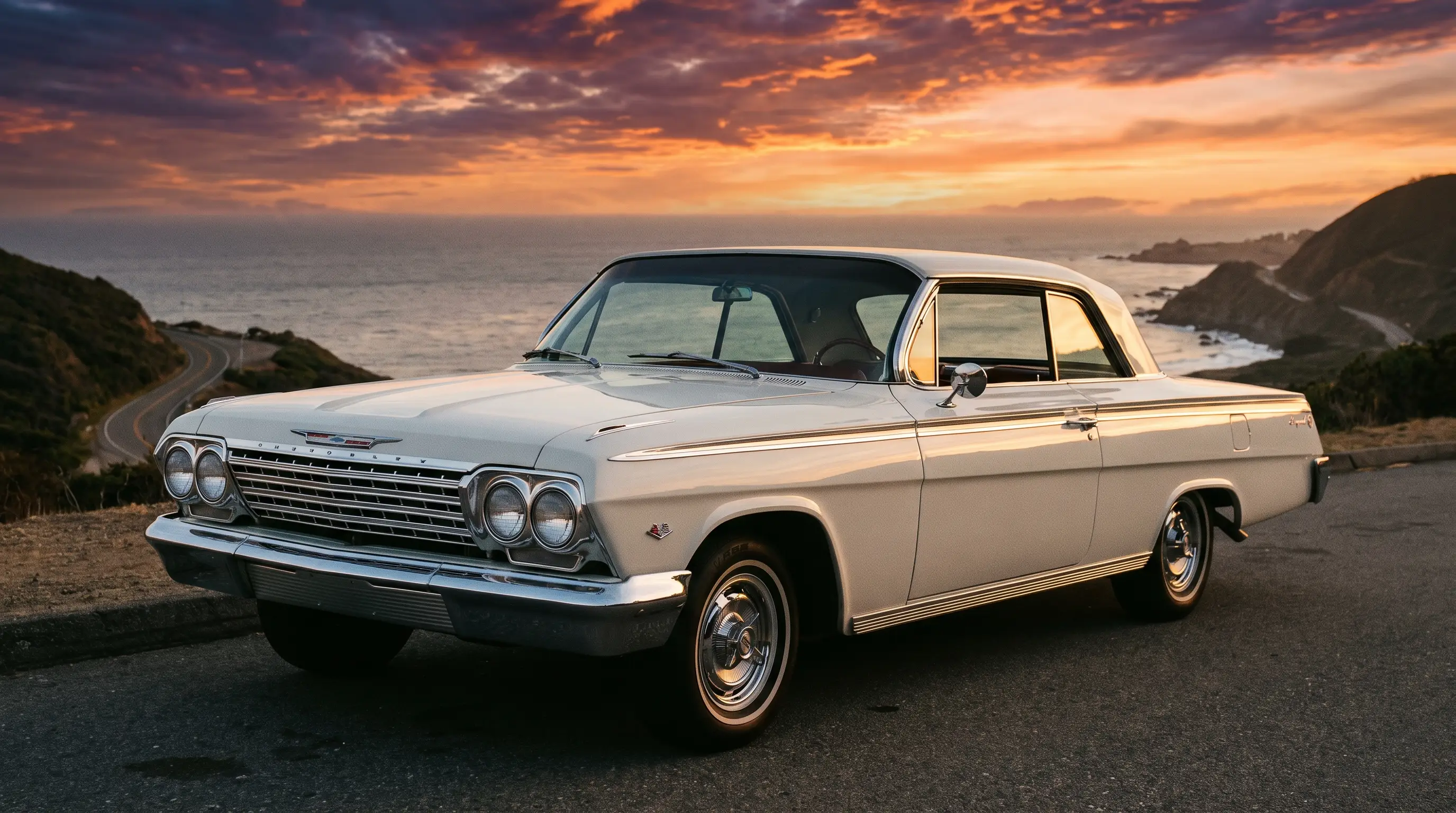
The 1962 Impala arrived at a strange moment for Chevrolet. The bubble top roofline that had defined the Impala Sport Coupe in 1961 was gone, handed down to the mid-tier Bel Air for one more season, while the Impala itself moved to a new formal notchback roof that made it look less like a jukebox and more like a bank president's car. Same body, same trim level, a completely different roofline strategy than the year before. That shuffle is what makes the 1962 Impala worth studying on its own, not just as a footnote between 1961 and 1963.
A cleaner face for a busier lineup
General Motors restyled the full-size Chevrolet for 1962, and the changes were mostly about restraint. The finned rear fenders of 1961 were smoothed down, the trim was thinned out, and the Impala's identity moved away from ornament and toward proportion. Where 1961 cars still carried some of the late-1950s habit of decoration for its own sake, 1962 models read as calmer and more confident. The grille kept the split look Chevrolet had used since the late 1950s, but the bumper and headlight treatment were tightened up for a squarer, more disciplined front end.
Impala remained the top trim in the full-size range, sitting above Bel Air, Biscayne, and the fleet-grade models. Buyers picking a 1962 Impala got more brightwork than the cars beneath it: full wheel covers, extra chrome around the taillights, and Impala-specific badging on the rear fenders. Inside, upholstery patterns and door panel trim carried the Impala name in a way the lesser trims did not bother with. Chevrolet wanted the top-of-the-line badge to be obvious from across a parking lot, and in 1962 it still was.
One roof, a deliberate break from 1961
The bubble top two-door hardtop, the curved, thin-pillar roofline everyone associates with the early-1960s full-size Chevrolet, was the Impala Sport Coupe's look for 1961. For 1962, Chevrolet moved the Impala to a new formal notchback roof, with a shorter, more upright rear window and a crisper deck line, styled to echo the lines of a folding convertible top in the up position. The old bubble top curve did not vanish from the lineup that year; it was handed down to the Bel Air Sport Coupe for a final season, while Impala buyers got the new, more formal look exclusively. Chevrolet was drawing a sharper line between its trim levels, giving the flagship a roofline the cheaper cars did not share. The notchback theme carried the Impala Sport Coupe through 1964, and it sold close to 400,000 units in 1962 alone, evidence that buyers liked the more formal look. If you want the fuller picture of how that decision played out across the whole generation, read the background on the 1961 to 1964 cars as a set.
Engines: the year the 409 got famous
Under the hood, 1962 is remembered for one number more than any other: 409. The 409 cubic inch V8 had debuted in small numbers for 1961, but 1962 is when it became culturally unavoidable, helped along by the Beach Boys song that used the engine's displacement as its title. The 409 was rated at 380 horsepower in single four-barrel form and 409 horsepower with dual quads, an output figure that lined up neatly with the engine's name and made for an easy marketing line even though Chevrolet did not need to invent one.
Most Impala buyers in 1962 were not ordering the 409, though. The volume engines were the 283 and 327 cubic inch small blocks, which offered strong performance without the insurance and fuel consumption headaches of the big block. The base six-cylinder was still on the order sheet for buyers who wanted an Impala's trim and comfort without the V8 premium, though very few collectors chase those cars today. Transmission choices ran from a three-speed manual up through Powerglide automatic, with a four-speed manual available behind the performance V8s for buyers who wanted to row their own gears.
| Spec | 1962 Impala |
|---|---|
| Base engine | 235 cid inline six |
| Popular V8 | 283 cid / 327 cid |
| Performance V8 | 409 cid, up to 409 hp |
| Body styles | 2-door Sport Coupe (formal notchback roof), convertible, 4-door sedan and Sport Sedan hardtop |
| Trim rank | Top of the full-size Chevrolet range |
Why the 1962 gets overlooked
Sandwiched between the 1961's clean-slate redesign and the 1963's more sculpted follow-up, the 1962 Impala tends to get treated as a transition year. That undersells it. The move to a formal notchback roof, exclusive to the Impala that year, is historically significant because it set the direction the whole full-size lineup would follow through 1964. The 409 press coverage is real and dates specifically to this year. And the trim details, from the wheel covers to the Impala script, were never repeated exactly the same way again. Collectors who focus only on 1961 for the bubble top's last full-lineup year or 1964 for the model's final year in this body generation sometimes skip over 1962 cars that are just as well built and, in some cases, easier to find in good original condition because fewer people are hunting for them specifically.
Body style choice matters more than people expect when comparing survivors. The Sport Coupe, whichever roof it wears, commands more attention than the sedan, and the convertible sits above both. If you are cross-shopping the year, it is worth a look too to see how the body styles actually broke down and which ones are scarcest today.
"People remember 1962 for the 409 and forget that Chevrolet was quietly rewriting the roofline that same year. The notchback option is the one factory decision from this model that actually changed the shape of every full-size Chevy that followed it."
- Tom Ramirez
Buying and valuing a 1962 today
Condition and originality drive value on these cars more than raw engine size, though a documented 409 will always bring a premium over a small block car. Body style matters too: a convertible or a well-optioned Sport Coupe will outsell a four-door sedan by a wide margin at auction. Buyers should look closely at trim completeness, since Impala-specific brightwork and interior pieces are harder to source than the shared Bel Air and Biscayne parts underneath. A car with matching numbers and its original color combination is worth chasing even if the price is higher up front, because reproduction trim for this generation is not as complete as it is for later muscle-era Chevrolets.
For anyone actively shopping, current inventory turns over regularly and good original 1962 cars do not sit unsold for long once buyers recognize what they are looking at. It is worth taking the time to shop classic Impala listings and compare a 1962 against its 1963 and 1964 siblings before deciding which year and body style fits what you actually want to drive.
Sources and notes
- Automobile Catalog: 1962 Impala Convertible 409 V-8 specs
- Automobile Catalog: 1962 Impala Sport Coupe 409 V-8 specs
- Mac's Motor City Garage: Inside the Chevy 409 V8
- Over-Drive Magazine: Chevrolet's W-Series Engine Specifications 1958-1965
- Engine Facts: Chevy 409 V8 Engine Information
- Mac's Motor City Garage: The Ragtop Look, 1962-64 Impala Sport Coupes
- Wikipedia: Chevrolet Impala