An older man at a car show once told me the first thing he does when he opens a 1964 Impala's door is smell it, not look at it. He said a real one smells like vinyl and time, not like a parts store. Then he sat down, put both hands on the wheel, and did not say anything for a while. That is the kind of reaction the 1964 Impala interior still pulls out of people who remember sitting in one new.
What the Super Sport trim actually gave you
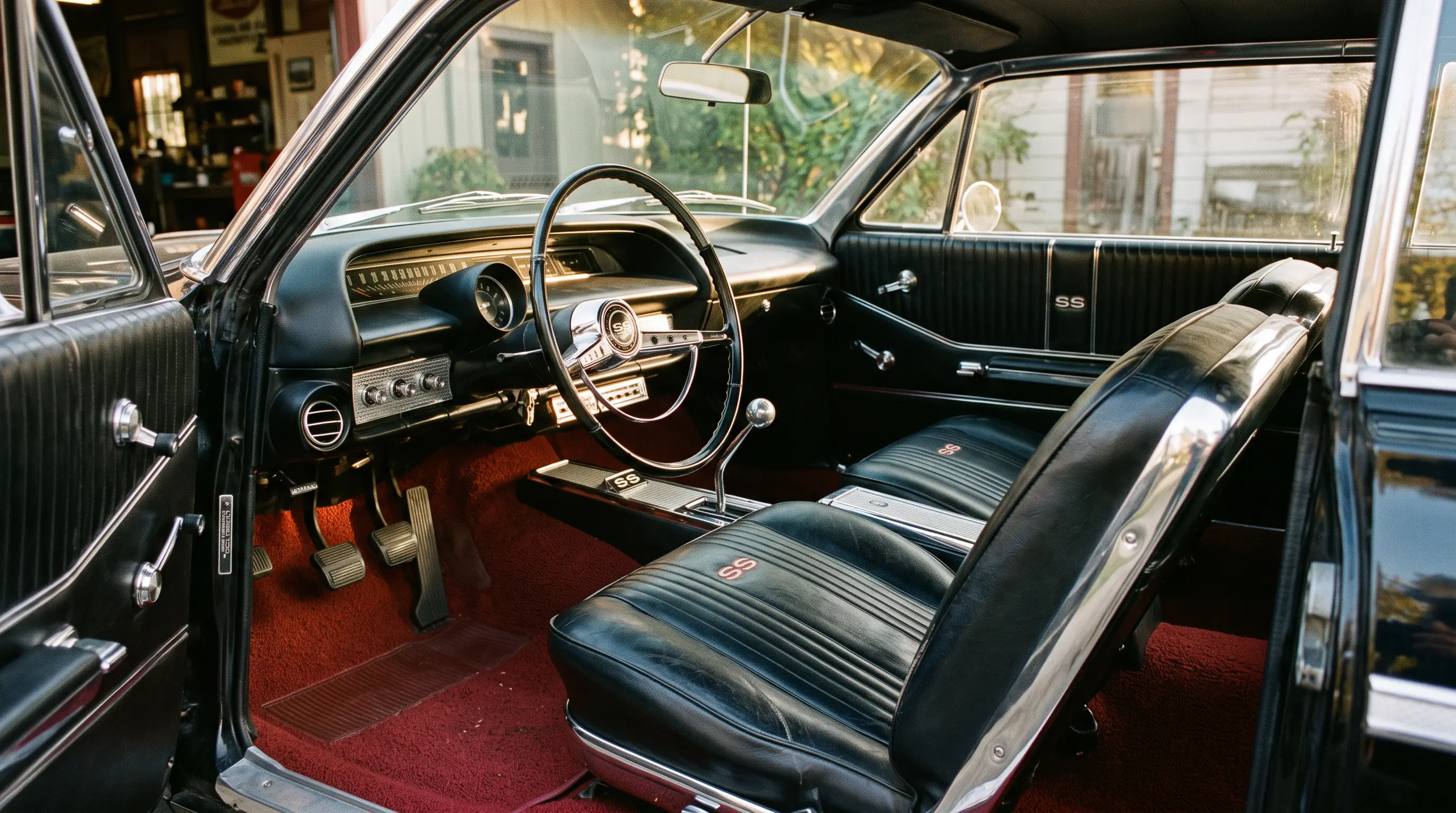
The Super Sport package on the 1964 Impala meant bucket seats up front with a center console running between them, a detail that turned a family sedan's front bench into something that felt closer to a sports car. The console housed the shifter for cars ordered with a manual or the Powerglide automatic, and it gave the cabin a divided, purposeful feeling that the standard bench seat Impalas did not have. Chevrolet dressed the SS interior in specific trim, including unique door panels and a dash appliqué that set it apart from a standard Impala at a glance.
The instrument cluster on SS cars carried a more complete set of gauges than the base trim, giving the driver actual information instead of just idiot lights. Small detail, but it changes how the car feels to sit in. A gauge cluster that tells you something makes the whole cabin feel more serious, more considered.
Color and texture, remembered
Interior color choices for 1964 ran through a range that included deep reds, blues, and the two tone combinations that photograph so well in period brochures. Vinyl was standard on most trims, with cloth and vinyl combinations available depending on the exact package ordered. The steering wheel on SS cars often carried a woodgrain style appliqué on certain trim levels, a detail that reads as a small luxury touch inside a car that was still, underneath all of it, a family size Chevrolet built to move a household comfortably. That tension between practical sedan and dressed up interior is part of what makes the 1964 cabin interesting fifty years later. It never fully decided whether it wanted to be luxurious or sporty, so it borrowed a little of both.
Anyone tracing how the Impala got to this particular interior should look at where this started, since the cabin details evolved steadily across the early sixties rather than arriving all at once in 1964. The bucket seat and console layout did not spring up overnight. It was built on choices Chevrolet made in the years just before.
"People remember the shape of a car from photographs, but they remember the inside of a car from their own bodies. Where their hands rested. What it felt like to sit down after a long day. That is why the 1964 interior still gets a reaction nobody expects at a show."
- Nora Beckett
What survives, and what does not
Vinyl and cloth from 1964 do not age gracefully without care. Sun damage to dashboards is common on surviving cars, and door panels with the original vinyl grain intact are genuinely rare after sixty years of use, storage, and the occasional careless owner. Restorers working on these interiors often have to source reproduction material rather than salvage anything usable from a donor car, and the reproduction quality has improved enough in recent years that a careful restoration can come close to matching what left the factory, even if the man at the car show would probably still tell you it smells different.
The bench seat cars, the ones without the SS package, carried their own simpler charm. A family that bought a standard Impala in 1964 got a wide, comfortable front seat built for three across, a different kind of interior story than the bucket seat SS cars but no less a part of how people actually lived with these cars. For more from this era, the body style choices Chevrolet offered a couple years earlier shaped a lot of what carried forward into 1964, inside and out.
What the dashboard actually said about the driver
Chevrolet's dash design for 1964 leaned toward a horizontal sweep of trim across the width of the cabin, a look that made the car feel wider from the driver's seat than its actual dimensions suggested. The SS gauge package included a speedometer, fuel gauge, and additional readouts depending on exact configuration, presented in a cluster that faced the driver more directly than the flatter, more passenger friendly dash treatments on lower trims. It is a small thing, angling instruments toward the driver, but it tells you who Chevrolet imagined behind the wheel of an SS trimmed car. Not necessarily a racer. Someone who wanted to feel like the car was paying attention to them specifically, not just to whoever happened to be sitting up front.
Door panel design carried the same logic. SS cars got more sculpted door panels with additional trim and, on some configurations, integrated armrests positioned to match the bucket seat height rather than a compromise position meant to work for a bench seat too. Every one of these choices was small on its own. Together they built a cabin that felt considered rather than assembled from a shared parts bin, which is exactly the impression Chevrolet wanted a buyer stepping up to the SS trim to walk away with.
Sitting in one today
A well preserved or carefully restored 1964 Impala interior is not just a collection of correct parts. It is a small time capsule, one that still does what it did in 1964, which is make a person pause for a second before starting the engine. For anyone who wants to feel that for themselves rather than just read about it, there are places to find a classic Impala with an interior worth sitting in, whether the goal is a full SS build or a simpler bench seat family car.
The man at the show eventually did start talking again, mostly about his mother's Impala from when he was a kid, not this specific car at all. That is what a good interior does. It is not really about the vinyl or the console. It is about what it lets a person remember.
I have talked to a lot of owners at shows over the years, and the ones who linger longest by a 1964 Impala are rarely talking about horsepower. They are talking about a seat, a smell, a shifter under a hand that has since gotten older. The engineering behind that interior mattered enough that it still does its job sixty years later, quietly, without anyone at the show needing to explain why.
Sources and notes
- Hagerty Valuation Tools: 1964 Chevrolet Impala SS
- Barn Finds: Original Paint and Interior, 1964 Chevrolet Impala SS
- Fargo Automotive: Tissue Dispenser, 1964-65 Impala or Caprice or Bel-Air or Biscayne
- Classic Industries: 1964-65 Full Size Chevrolet Tissue Dispenser
- Volo Museum: 1964 Chevrolet Impala
- Wikipedia: Chevrolet Impala