
Short answer: no. Not the way most people mean it. The Boss 429 hemi claim shows up on car show placards and in plenty of forum threads, and it mixes up two things. One is a combustion chamber shape. The other is a Chrysler engine. The Boss 429 has a head that borrows the first idea. It has nothing to do with the second.
Car Features
7 min read
Is the Boss 429 a Hemi? The Semi-Hemi Explained
The Boss 429 runs a semi-hemi crescent-chamber head built to beat Chrysler's 426 Hemi in NASCAR. It is not a Hemi.
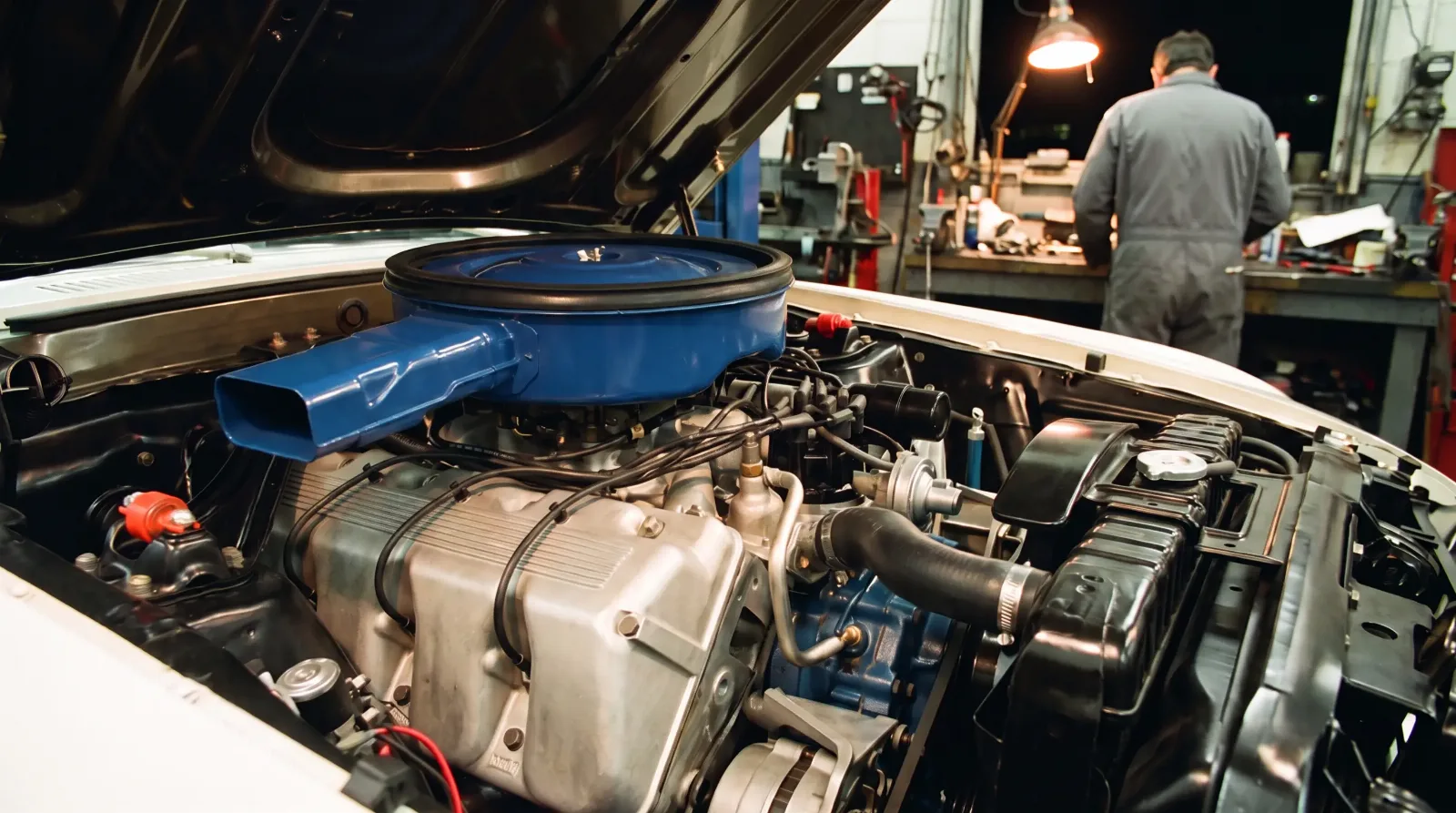
Ford's own name for the chamber was "crescent." The street name is semi-hemi. Both are closer to the truth than "Hemi," and the difference is worth a few minutes, because it explains why the engine exists at all. It is one of several Mustang stories where the shorthand outran the record; read more here.
What makes a head a hemi
A hemispherical combustion chamber has a roof shaped like half a dome. The intake valve sits on one side of the dome and the exhaust valve on the other, both tilted away from each other. The spark plug goes near the top. The payoff is room: big valves and a short, direct path for the air, so the chamber breathes hard at high rpm. The cost is a wide, heavy head and a complicated valvetrain to work valves pointed in two directions.
Chrysler built its race program around that layout and called the engine the 426 Hemi. Capital H. It was the engine everybody in stock car racing had to beat in the late 1960s, and it is the reason the word "hemi" still sells cars.
A semi-hemi keeps the opposed, canted valves but does not use a true half-sphere. The dome is shallower and the chamber shape is cut down. You get much of the breathing benefit in a more compact package. That is the family the Boss 429 belongs to.
Where the Boss 429 hemi label comes from
The label comes from the job the engine was built to do. The Boss 429 existed to homologate a new engine for NASCAR, and the engine was designed to go after Chrysler's 426 Hemi. NASCAR's rule said an engine had to be sold to the public in a production car, at least 500 of them, before it could race. Ford put that engine in a Mustang to meet the rule.
So the Boss 429 was the Hemi's answer, it had canted valves, and its displacement number was even bigger than the Hemi's. It did not take long for people to start calling it Ford's hemi. Sellers like it because the word carries money. It is still wrong. The heads are Ford heads with a crescent chamber, and no part of the engine is Chrysler's.
There is a practical side, too. Order Hemi parts for a Boss 429 and you get Mopar parts. Ask a machine shop to "do the hemi heads" and they need to know which hemi. The word costs you time the moment you take it off the placard and into the shop.
The crescent chamber and the hardware around it
The heads were aluminum with the semi-hemispherical crescent chamber. Underneath, the engine was built like a race piece that happened to get a VIN. The block used four-bolt main caps. The crank and rods were forged. The deck was a dry-deck design, with block and head coolant kept separate. Valvetrain changed by year: hydraulic lifters in 1969, solid lifters in 1970.
Not every Boss 429 engine is the same engine. The early S-code engines, with magnesium valve covers and almost no emissions hardware, are said to be the strongest, with later T and A versions following. On the VIN, the Boss 429 is a Z-code car for both 1969 and 1970. That letter is the first thing to check on any car wearing the decals.
| Item | Boss 429 (1969 to 1970) |
|---|---|
| Chamber | Semi-hemispherical, Ford "crescent" design |
| Heads | Aluminum |
| Rated output (SAE gross) | 375 hp at 5,200 rpm |
| Rated torque (SAE gross) | 450 lb-ft at 3,400 rpm |
| Carburetor | 735 cfm Holley four-barrel |
| Bottom end | Four-bolt mains, forged crank and rods |
| Deck | Dry-deck, separate block and head coolant |
| Lifters | Hydraulic (1969), solid (1970) |
| VIN engine code | Z |
| Engine install | Kar Kraft, Brighton, Michigan; KK numbers 1201 to 2558 |
| Production | 859 (1969), 499 (1970) |
What the numbers say
Ford rated the Boss 429 at 375 hp at 5,200 rpm and 450 lb-ft at 3,400 rpm, SAE gross, on a 735-cfm Holley. Those are the brochure numbers. The legend says they were sandbagged, the way every big-block of the era was supposedly sandbagged.
The one period dyno test that usually gets cited does not back the legend. Crane Cams ran engines that were stock except for tube headers in place of the cast-iron manifolds, a test reported by Terry Cook in Car Craft in January 1970. The 1969 hydraulic-lifter engine made 352.0 hp and the 1970 solid-lifter engine 366.5 hp, both at 5,500 rpm. That is below the rating, with headers. If those figures hold, the street Boss 429 was not a secret 500-horse engine. It was a race engine detuned for the street, with a top end that wanted far more rpm, cam and carburetor than the showroom car got.
The rated peak sits at 5,200 rpm and the Crane peaks sit higher still. This was an engine laid out to live at speed on a superspeedway, not to win a stoplight sprint. If you want to know how fast they really were against the rest of the lineup, the period tests tell it straighter than the folklore does.
A street car built for a race it never ran
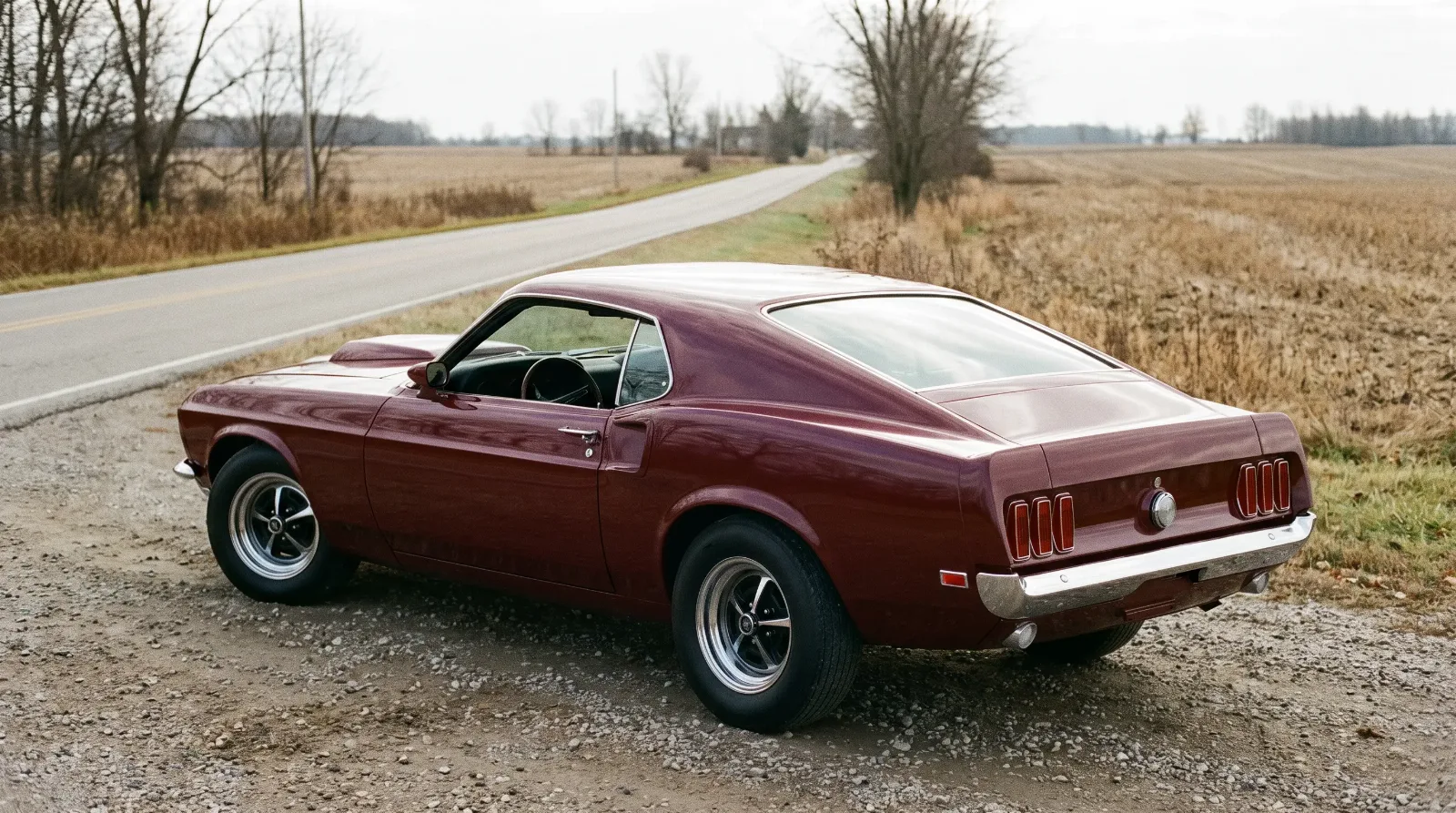
That is the part people miss. The Mustang was the homologation vehicle, not the race car. Ford needed the engine in public hands, and the Mustang was the car it used to get there. The race program ran on the bigger intermediates.
Getting the engine in was not simple. Ford sent the cars to Kar Kraft in Brighton, Michigan, which installed the engines. The wide heads did not fit a stock Mustang engine bay, and the shock towers had to be reworked to make room. Each car got a Kar Kraft number, from KK 1201 on the first to KK 2558 on the last. Production ran 859 for 1969 and 499 for 1970. The 1970 base list price was $4,087, against $2,872 for a base SportsRoof, before a single option. When Ford widened the 1971 body, one stated reason was to fit a 429 without that kind of shock-tower surgery.
It sits at the far end of the factory muscle Mustangs: the rarest Boss, and the one with the least to do with how the others were meant to be driven.
"Call it a hemi at a car show and nobody gets hurt. Call it a Hemi on a parts order and you get the wrong parts. The head is a Ford crescent chamber and the rating is 375 gross. Everything past that is a sales pitch."
Dan Reeves
So the answer depends on how loose you want to be with a word. In the engineering sense the Boss 429 runs a semi-hemi head, close kin to a hemi. In the brand sense it is not a Hemi, never was, and was built specifically to beat one.
Sources and notes
- Wikipedia: Boss 429 Mustang (cites the Car Craft, January 1970 Crane Cams test)
- FordMuscle: the Boss 429, Kar Kraft and the crescent-chamber heads
- Street Muscle: Rare Rides, the 1969 Ford Torino Talladega
- Wikipedia: Ford Torino Talladega
- MustangSpecs: 1970 Ford Mustang prices and specifications
- Over-Drive: 1970 Ford Mustang fact sheet
Related Reading


About the author
Dan Reeves
Performance engine builder from North Carolina's motorsports corridor, focused on swaps, forced induction and making real, repeatable power.
Related Listings - Ford Mustang




Comments
Be the first to comment on this article.