
I had a fella at a club meet swear up and down that his 1971 CJ-5 and his buddy's 1972 CJ-5 were "basically the same truck." I let him finish, then walked him around both trucks parked nose to tail. Same truck, sure, until you looked at where the front axle sat relative to the firewall. That gap is the whole story of the jeep cj cj5 wheelbase stretch, three inches that changed how the CJ-5 rode, handled, and got talked about for the rest of its life.
Car Features
7 min read
The Inch That Mattered: Stretching the CJ-5 in 1972
In 1972 AMC stretched the CJ-5's wheelbase and reworked its frame, trading a little trail agility for a lot more truck underneath.
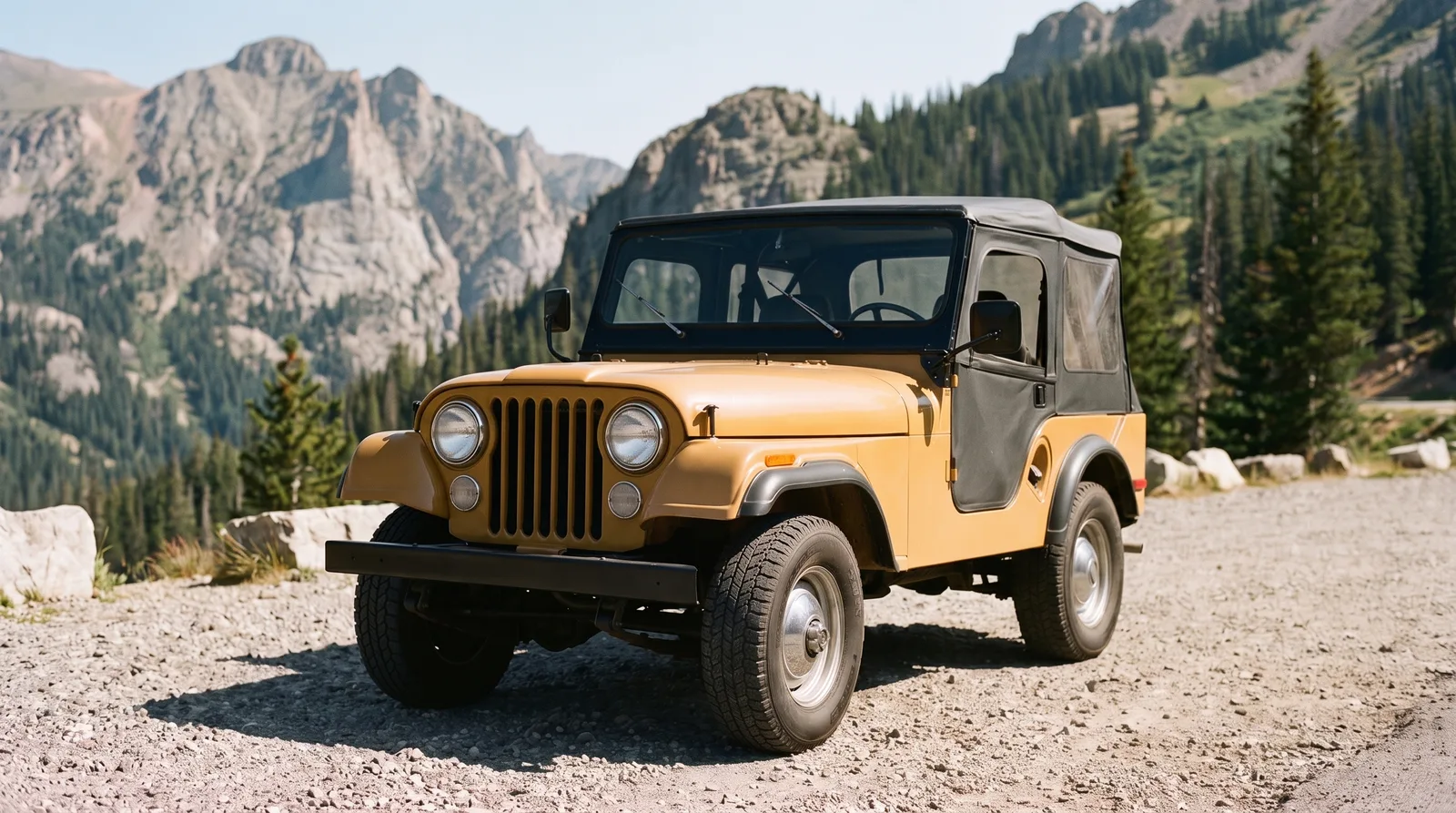
Eighty-one inches for seventeen years
From its 1954 introduction all the way through the 1971 model year, the CJ-5 rode on an 81-inch wheelbase. That short, stubby stance was part of the truck's whole identity going back to the original Korean War era M38A1 military Jeep it descended from. Short wheelbase means tight turning, easy maneuvering in brush and rock, and a ride that bounces you around plenty on pavement. Nobody bought a CJ-5 in 1965 expecting a smooth highway cruiser, and the short wheelbase was exactly why. It was built to turn on a dime in a fence row, not glide down an interstate.
What changed in 1972
For the 1972 model year, with AMC now running the show after buying Kaiser Jeep in 1970, the CJ-5 got stretched to an 84-inch wheelbase. Three inches doesn't sound like much until you've driven both trucks back to back. The longer wheelbase came bundled with other changes AMC was pushing through at the same time, including a stronger frame and the Dana 30 front axle that became the new standard. AMC also opened the door to bigger engines that year, most notably the 304 cubic inch V8, which needed the extra room under the hood that the stretch helped provide. This wasn't a cosmetic update. It was AMC re-engineering the CJ-5's whole front end to handle more weight and more power than the Kaiser-era chassis was designed around.
The ride nobody expected
Here's what surprised the old-timers at the time. A longer wheelbase generally means a smoother, more planted ride, and the 1972-and-later CJ-5s did settle down some on the highway compared to their short predecessors. But three inches on an 81-inch base is proportionally a bigger change than three inches on a longer truck, and CJ-5 owners noticed the shift in the truck's manners almost immediately. Some liked it, especially guys putting highway miles on their Jeep between trailheads. Others grumbled that the CJ-5 was losing a little of the tight, flickable feel that made the short-wheelbase trucks so good in tight trails. Both opinions were right, honestly. You gain highway composure, you give up a hair of trail agility. That trade-off is baked into every wheelbase decision any 4x4 maker has ever made, and the CJ-5's 1972 stretch is a textbook example.
What the stronger frame actually bought you
The wheelbase stretch got most of the attention, but the frame work AMC did alongside it mattered just as much for how the truck held up under real use. A longer wheelbase without a stiffer chassis underneath it would have just meant more flex and more stress on the body mounts, especially once heavier AMC engines started going into these trucks. The reinforced frame introduced in 1972 gave the CJ-5 more margin for towing, plowing, and the kind of farm and job-site work that a lot of CJ-5 owners actually used their trucks for day to day, not just weekend trail runs. That's an easy detail to overlook next to a flashier story like the Golden Eagle package, but it's arguably the more consequential change for owners who worked their Jeeps hard.
The Dana 30 front axle that came standard with the stretch was itself a meaningful upgrade over what the shorter pre-1972 trucks carried, offering better durability under the added weight of the bigger available engines. Put the longer wheelbase, the stronger frame, and the tougher front axle together, and you get a truck that could genuinely handle the 304 V8 option without feeling like the chassis was fighting the engine bolted into it. Earlier CJ-5s simply weren't built with that kind of powertrain in mind, and it shows in how much better the post-1972 trucks cope with real load and real power compared to their short-wheelbase predecessors.
Why it matters when you're looking at one today
If you're shopping and somebody tells you a pre-1972 CJ-5 and a post-1972 CJ-5 are interchangeable trucks, that's not quite right, and it matters for parts as much as for feel. Frame components, some suspension pieces, and driveline parts sized for the 84-inch chassis aren't a direct swap onto the 81-inch trucks and vice versa. Restoration shops know this, but plenty of casual buyers don't, and it's the kind of thing that trips people up when they're mixing and matching parts from different years. Know which chassis you're working with before you go shopping for anything structural.
"Guys will argue all night about which wheelbase is the 'real' CJ-5. I tell them both are real, they're just answering different questions. One's built for the tightest trail you can find, the other's built to actually get you there without rattling your fillings loose."
- Wayne Coburn
Part of a bigger picture
The wheelbase stretch was one piece of a much longer run for the CJ-5, which stayed in production for nearly three decades and went through plenty of other changes before it was done. For the full story of how the model evolved from its 1954 debut through the final 1983 trucks, that broader history puts the 1972 stretch in context alongside everything else AMC did to keep the CJ-5 relevant into the 1980s. And if three inches of extra wheelbase sounds like exactly the kind of detail you want to see in person, plenty of both short and long chassis trucks turn up when you go looking for classic CJ for sale listings.
A change that outlasted the decade
What's easy to miss is that the 84-inch chassis didn't get revised again before the CJ-5 left production in 1983. AMC set that dimension in 1972 and stuck with it for the rest of the model's run, which tells you the company got the stretch right the first time. Compare that to how many other design elements changed across those same years, trim packages, engine options, badge treatments, and the wheelbase stands out as one of the few genuinely permanent decisions AMC made about the CJ-5's fundamental architecture.
Three inches, whole different truck
It's easy to wave off a wheelbase change as a footnote next to bigger stories like new engines or trim packages, but the 1972 stretch reshaped how the CJ-5 drove for the rest of its production run. Every Dana 30 front axle, every V8-powered example built after that year exists because AMC decided the old 81-inch chassis had run its course. That's not a footnote. That's the moment the CJ-5 became a different kind of truck, even while keeping the same name on the tailgate.
Sources and notes
Related Reading

About the author
Wayne Coburn
Longtime Corvette owner, judge and club figure who knows the cars, the records and the people behind them.
Related Listings - Jeep CJ







Comments
Be the first to comment on this article.