
Anytime somebody brings up the jeep cj cj5 rollover controversy, I ask them one question first: are you talking about the truck, or are you talking about the TV segment. Those are two different conversations, and most people who've heard the reputation never actually watched the footage or read the test results that started it. The short version is that the CJ-5 got hammered publicly right around 1980, and it never fully shook the reputation, fair or not.
Car Features
7 min read
The CJ-5 Under Fire: The Rollover Reputation Story
Around 1980 the CJ-5 got hit hard by national media scrutiny over rollover risk, a reputation that stuck to the model long after the headlines faded.
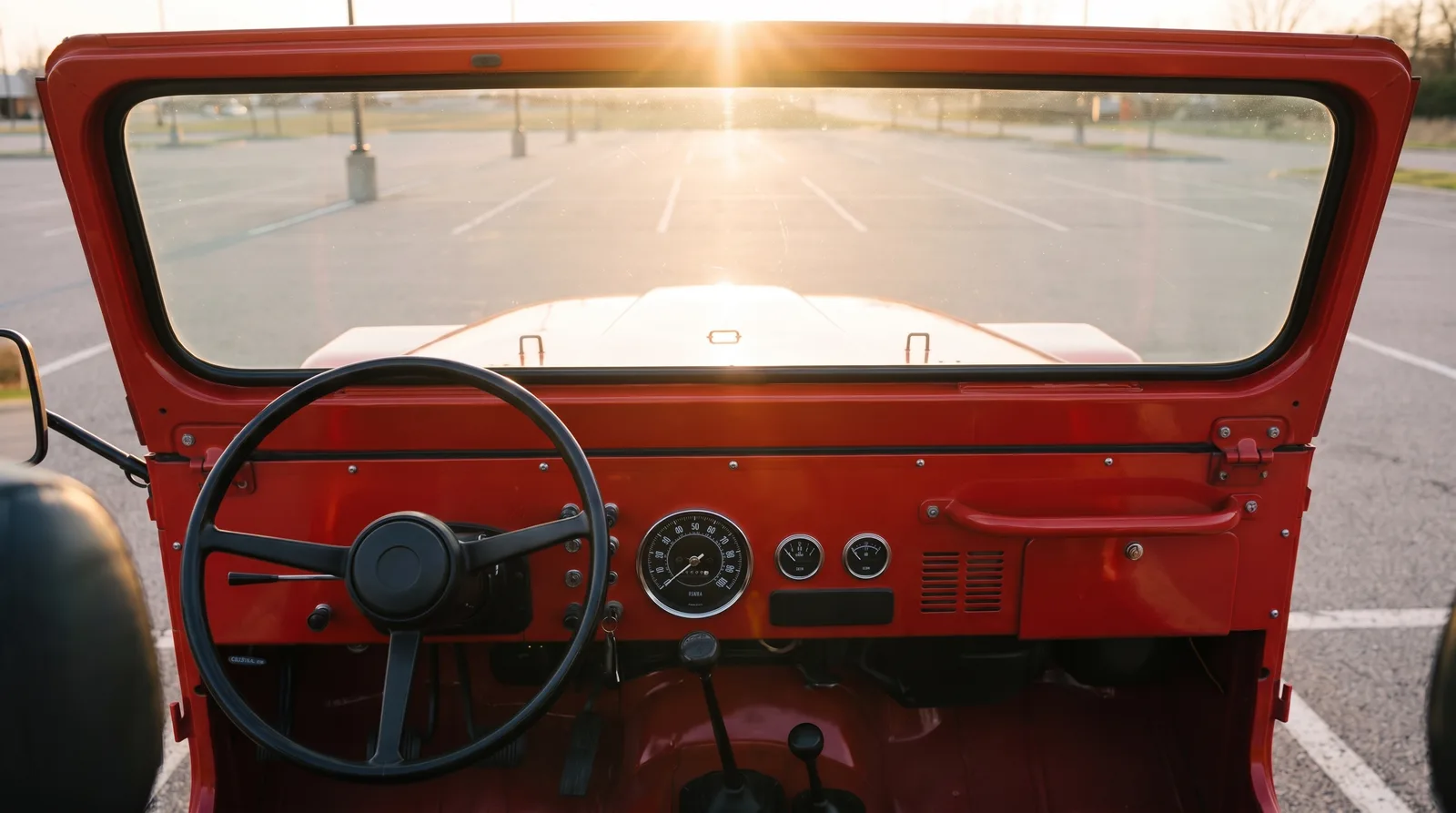
How the story broke
The controversy hit national attention when CBS's 60 Minutes ran a segment on June 21, 1980, examining rollover risk in short-wheelbase utility vehicles, with the CJ-5 front and center. The segment leaned on rollover test footage from the Insurance Institute for Highway Safety, which had run hundreds of test maneuvers on the CJ-5 and come away with harsh conclusions about the truck's stability during sharp turns and emergency maneuvers. Put a national news magazine show and a widely trusted consumer publication on the same story within a short window of each other, and you get a reputation that spreads fast and sticks even faster. This wasn't a slow-burn rumor. It was a fast, loud hit that landed right as AMC was trying to keep the CJ line relevant against newer competition.
The physics underneath the headlines
Here's what gets lost when people just repeat "the CJ-5 flips over." Every vehicle with a short wheelbase, a narrow track, and a high center of gravity carries more rollover risk in an aggressive turn than a longer, wider, lower vehicle does. That's not unique to Jeep. It's basic physics that applies to plenty of off-road-focused trucks and SUVs built through the 1970s and into the 1980s. The CJ-5, especially in its short 81-inch wheelbase form before the 1972 stretch, was built for tight trail maneuvering, not high-speed lane changes, and it was never marketed as a highway commuter. That doesn't excuse a truck from safety scrutiny, but it does explain why the testing found what it found. You're comparing a farm-and-trail vehicle's emergency handling against passenger car expectations, and the numbers were never going to look good under that lens.
What it actually cost Jeep
The fallout wasn't just bad press. Insurance premiums on CJ-5s climbed in the wake of the coverage, sales took a hit, and the reputation followed the model into showrooms right as AMC was trying to sell CJ-7s and Scramblers alongside it. Lawsuits related to CJ-5 rollover accidents were already working through courts before the media coverage, and the national attention gave those cases a much bigger spotlight, with AMC paying out settlements in a number of them over the following years. It's worth saying plainly that some of those accidents were real, with real injuries and real families affected, and no amount of physics explanation erases that. But the scale of the public reaction, and how permanently it attached to the CJ-5's name, went well beyond what the actual accident numbers alone would have generated.
Not the only short-wheelbase truck to face this
It's worth stepping back and noting that the CJ-5 wasn't alone in facing this kind of scrutiny. Nearly a decade later, the Suzuki Samurai went through a strikingly similar public battle with Consumer Reports over rollover stability in emergency turns, and that later controversy followed almost the same pattern, aggressive testing methodology, a damning published verdict, and a reputation that stuck to the vehicle for the rest of its market life regardless of how the manufacturer responded. Seeing the CJ-5 story repeat itself with a different truck a decade later is useful context. It suggests the issue was less about any single model's specific flaw and more about how short-wheelbase, high-clearance vehicles as a category get evaluated against test methods built around passenger car expectations.
That pattern doesn't excuse either controversy, and it doesn't mean the underlying handling characteristics weren't real. It does mean that anyone treating the CJ-5's rollover reputation as a uniquely damning mark against that one specific truck is missing the bigger picture of how an entire vehicle category got evaluated during this stretch of automotive history. AMC's engineers weren't building a flawed product by the standards their competitors were also being held to. They were building a short-wheelbase off-road truck in an era when testing methodology for that category was still catching up to how popular these vehicles had become with everyday buyers.
Living with the reputation decades later
Ask around at any CJ-5 club meet today and you'll still hear the rollover story come up, usually from somebody who's never driven one but heard about it secondhand. Owners who've actually spent time behind the wheel will tell you a different story: drive it like what it is, respect that it's a short, high-riding truck, don't throw it into a sharp turn at speed like you're in a sedan, and it behaves the way any vehicle of its type and era does. The controversy shaped how the CJ-5 is remembered more than it changed how the truck actually drives when handled sensibly. That gap between reputation and reality is worth understanding before you write off a truck you might otherwise want to own.
"People act like the rollover story means the truck is dangerous sitting still in a driveway. It's not. It means drive it like a short-wheelbase truck from 1975, not like your daily commuter. Simple as that."
- Mike Sullivan
How this fits the full CJ-5 story
The rollover controversy is one chapter in a much longer run, and it hit at a specific moment in a production life that stretched from 1954 all the way to 1983. For our complete history of the CJ-5, including the engineering changes and market pressures that led up to this era, that fuller context matters if you want to understand why the controversy landed as hard as it did. If you're looking past the reputation and actually want to shop, plenty of well-sorted examples turn up when you go browse classic CJ listings, and a properly maintained CJ-5 remains exactly what it always was: a capable, honest trail truck that asks you to drive it with a little respect.
The verdict, for what it's worth
Was the CJ-5 more prone to rollover than a passenger sedan in an emergency swerve? Yes, and that's true of most short, tall, narrow-track vehicles from that era, not a unique CJ-5 flaw. Did the media coverage permanently color how the model is remembered, far beyond what the raw accident data alone would justify? Also yes. Both things can be true at once, and understanding that is the whole key to getting past the headline and seeing the truck for what it actually is.
Sources and notes
- Highway Loss Reduction Institute Status Report on CJ Rollover Tests, December 1980
- Jeep CJ Rollover Safety Research Report Index (Center for Auto Safety)
- AMC Hands Out Millions in Jeep Crash Suits (UPI Archives)
- 1980 60 Minutes Show on the Jeep CJ (Jeep Forum discussion)
- The 90s Scandal Consumer Reports Hopes You Forgot About (MotorBiscuit)
- Jeep CJ (Wikipedia)
Related Reading

About the author
Mike Sullivan
Detroit-area muscle car enthusiast and restoration specialist with three decades of hands-on experience working on American iron.
Related Listings - Jeep CJ





Comments
Be the first to comment on this article.