
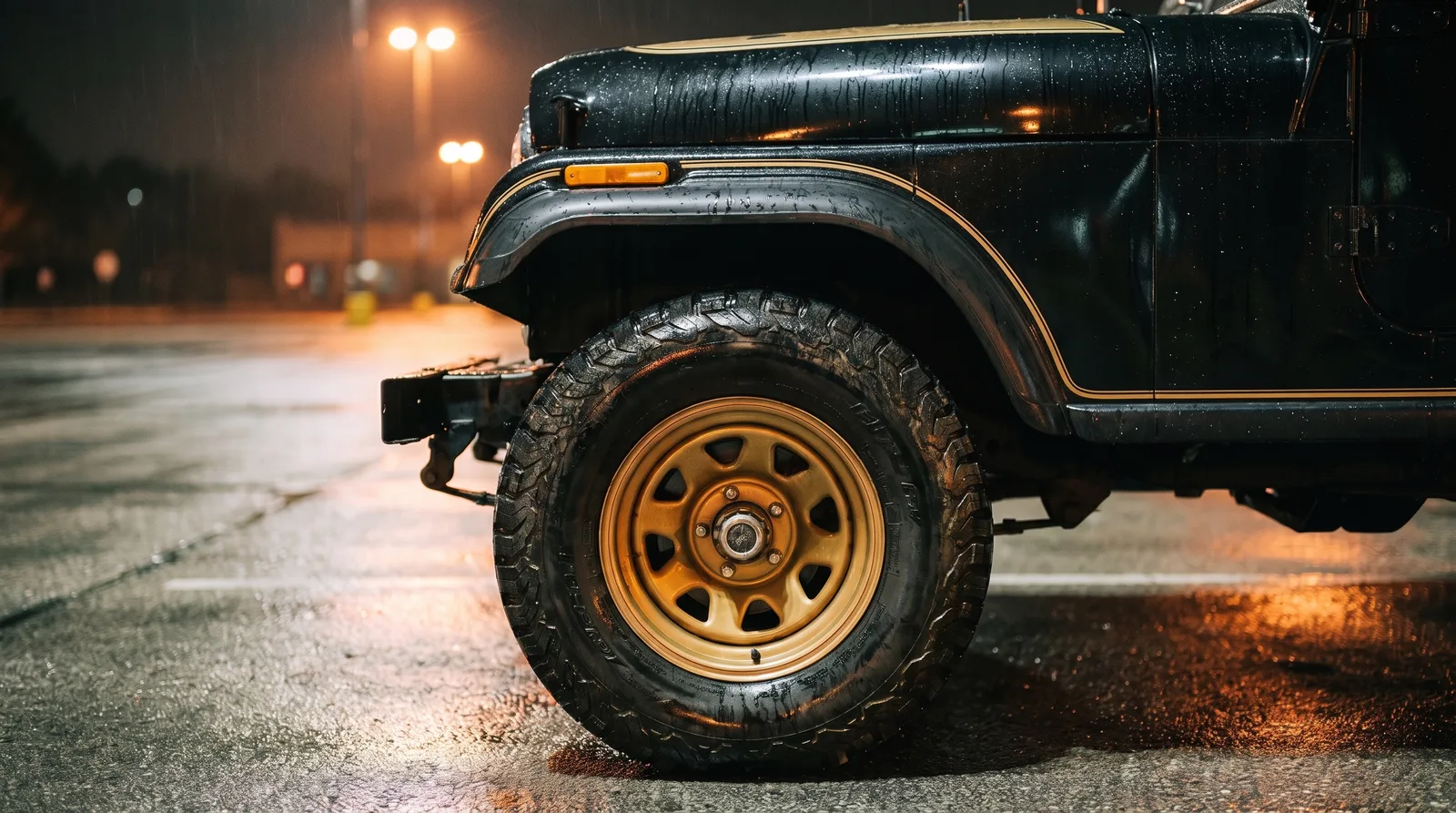
You know a jeep cj cj7 golden eagle before you know anything else about it, because the hood tells you first. A massive eagle decal, wings spread across the entire panel, talons wrapped around what usually reads as an arrow or bolt, done up in gold, black, and a burst of color depending on the year. I have wrenched on three of these over the years and every single owner started the conversation the same way: "wait till you see the hood."
Car Features
7 min read
Golden Eagle Rises Again: The CJ-7 Edition
The Golden Eagle package put a massive gold eagle decal across the CJ-7's hood, and the graphic is still the single biggest factor in what one of these trucks is worth today.
Where the eagle came from
Golden Eagle showed up as a CJ-7 appearance package starting in 1977, a year after the CJ-7 itself launched, and it followed a design language AMC had already been using elsewhere in its lineup. AMC liked a big graphic. The Hornet had one, the Gremlin had variants of the same idea, and when it came time to give the CJ-7 its own flashy special edition, the eagle motif got the call. It was not subtle, and it was not supposed to be.
Underneath the graphics, Golden Eagle worked the same way Renegade did: it was primarily a trim and appearance package layered onto the standard CJ-7, not a mechanically distinct model. Buyers got the big hood decal, gold-accented pinstriping running down the body, alloy wheels in the years those were offered, and usually a roll bar and tow hooks as part of the bundle. Engine choices stayed within the normal CJ-7 range, the AMC 258 six or the 304 V8, whichever the buyer specced separately.
Why the graphics matter more than people admit
I have had customers ask me to "fix" a rough Golden Eagle hood decal like it is a scratch to buff out, and I have to explain every time that the decal is not an accessory, it is the whole reason the truck is worth what it is worth. A Golden Eagle with a sun-faded, cracked, or missing hood graphic is functionally a base CJ-7 wearing a costume that fell apart. Reproduction decals exist and they are good, but getting the eagle's proportions, the gold shade, and the year-correct detailing right takes some homework before you order.
That is not a knock on the truck underneath. It is a straight fact about what collectors are paying for. Nobody shops a Golden Eagle for a mechanical spec sheet that differs from a plain CJ-7, because it mostly does not. They shop it because AMC, for one brief stretch, decided the CJ-7 should look like it belonged on a rock concert poster, and it worked.
| Spec | Detail |
|---|---|
| Package type | Appearance and trim package, not a distinct drivetrain |
| First offered | 1977 model year |
| Signature feature | Full-hood gold eagle decal |
| Typical extras included | Roll bar, pinstriping, alloy wheels in later years |
| Engine options | AMC 258 I6 or AMC 304 V8, same as standard CJ-7 |
How the eagle motif evolved over the years
The Golden Eagle graphic was not one static design frozen in time. Across its run on the CJ-7, the artwork shifted in small but noticeable ways, wing shape, the object gripped in the talons, the exact gold tone used against the black background. Some years leaned into a more angular, aggressive eagle. Others softened the linework. None of these changes were documented with the kind of clarity a modern automaker would provide, which means a lot of what enthusiasts know comes from comparing surviving trucks and period brochures side by side rather than reading it off a factory spec sheet.
That ambiguity is part of what makes the package fun to research and frustrating to authenticate. A shop doing a correct restoration has to treat the decal artwork almost like an art history problem, dating a truck by its graphic style the way you might date a poster by its typography. I have settled arguments at the shop with nothing more than a stack of old dealer brochures and a magnifying glass.
The honest wrench-turner's take on ownership
Mechanically, a Golden Eagle CJ-7 asks nothing different of an owner than any other CJ-7 of the same year and engine combination. Same six or V8, same transfer case options, same suspension. If you are buying one to drive and wheel, treat it exactly like you would treat a plain CJ-7 in the same condition, because underneath the decal, that is exactly what it is.
Where I tell people to slow down is the body. That hood decal was applied at the factory or by a dealer over factory paint, and thirty-plus years of sun exposure does what it does to any vinyl graphic. Bubbling, cracking, and fading are near-universal on unrestored trucks. If the decal is original and intact, that is worth protecting, not stripping for a repaint. If it is already gone, a quality reproduction from a company that has actually measured an original is the move, not a generic "eagle decal" ordered off a size chart.
"I've had guys bring me a Golden Eagle wanting a full mechanical gone-through and a fresh coat of paint, and the first thing I ask is whether they're keeping the eagle. If the answer is no, they've basically bought the wrong truck."
- Mike Sullivan
Buying one today
Anyone chasing browse classic CJ listings for a Golden Eagle should treat the hood graphic as the single most important inspection point, ahead of frame rust, ahead of drivetrain wear. Check for consistent gold coloring, correct wing detail on both sides, and stitching-level care in how a repaint or repop was applied. A sloppy decal job on an otherwise clean truck is a red flag that someone cut corners somewhere else too.
The full story of the CJ-7 explains why AMC leaned this hard into special editions during the late 1970s, a period when the base truck needed a reason for buyers to pick the fancier trim over a cheaper competitor. Golden Eagle gave them one, and it has aged into one of the most recognizable graphics packages Jeep ever put on a hood. That is not nothing for a decal.
What I tell customers before they commit to a restoration
Anyone bringing me a Golden Eagle for a full restoration gets the same speech up front. Budget for the decal and paint work like it is its own project, separate from whatever mechanical freshening the truck needs. Getting the eagle right, correct gold, correct linework, correct placement, takes a shop that has actually done one before, not just a generic vinyl and sign shop working off a stock photo. Cutting corners here shows immediately to anyone who knows what an original looked like, and those people show up at every show.
The upside is that a properly restored Golden Eagle holds its value better than most CJ-7 special editions precisely because getting it wrong is so visible and getting it right is so rare. A buyer who does the homework, or hires a shop that already has, ends up with a truck that stands out in a parking lot full of plain CJ-7s for exactly the reason AMC intended back in 1977.
Sources and notes
Related Reading

About the author
Mike Sullivan
Detroit-area muscle car enthusiast and restoration specialist with three decades of hands-on experience working on American iron.
Related Listings - Jeep CJ

Comments
Be the first to comment on this article.