
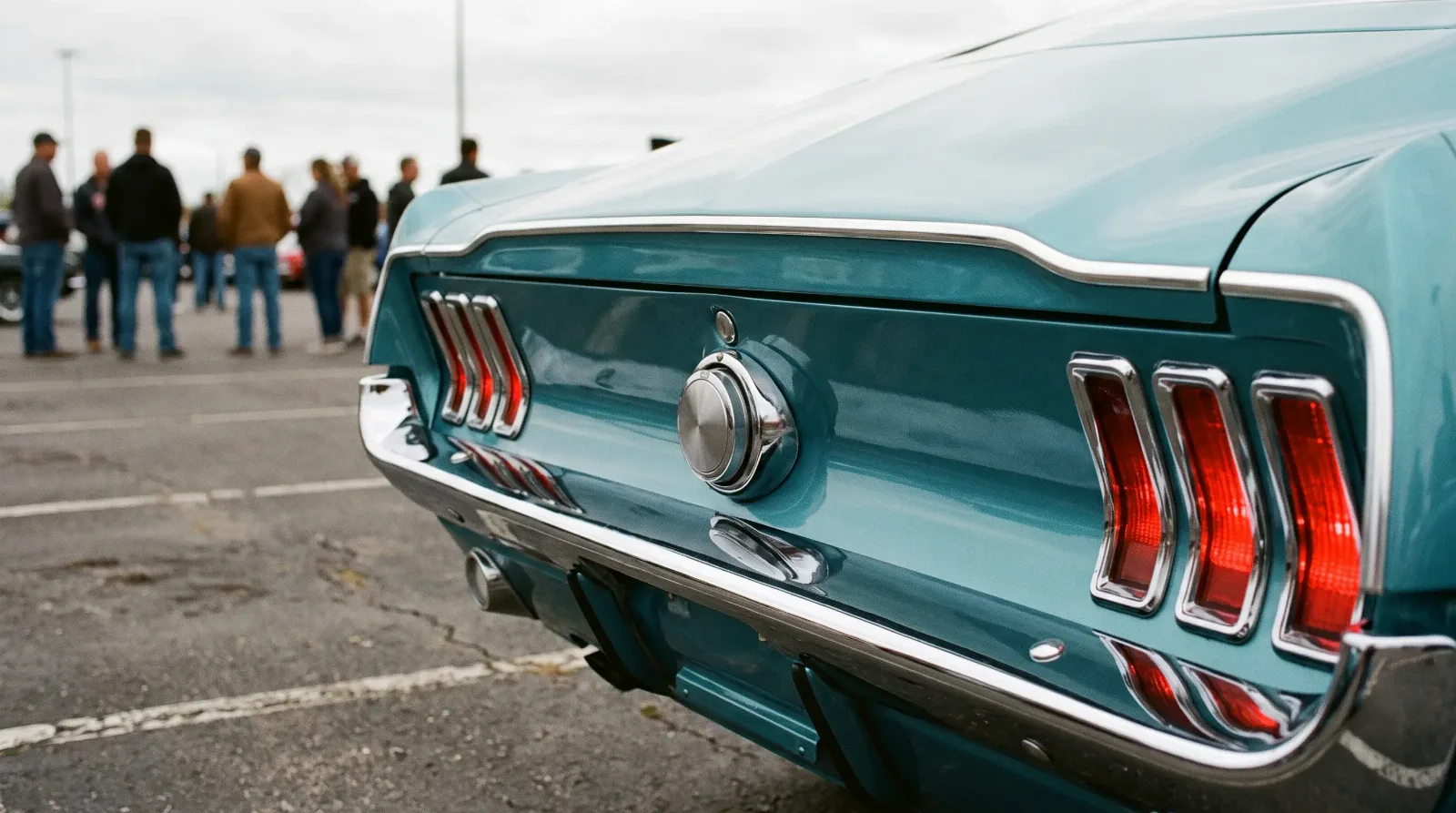
Walk up behind a 1965 to 1970 Mustang at night and you know what it is before you can read a badge. Three red bars on each side, standing upright. The Mustang three bar taillights were on the car before it ever reached a showroom, and from 1965 to 1970 Ford kept the idea while changing almost everything around it: the shape of the lens, the panel the lamps sit in, and the trim or scoop on the quarter panel ahead of them. That last part gets overlooked. To my eye the rear of the car and its flanks always read as one design, and they changed in step.
Car Features
8 min read
Tri-Bar Taillights, Side Scoops and the Concave Tail Panel
How the Mustang's three-bar taillights, side scoops and tail panel changed from 1965 to 1970, plus the Shelby sequential lamps and the 1994 return.
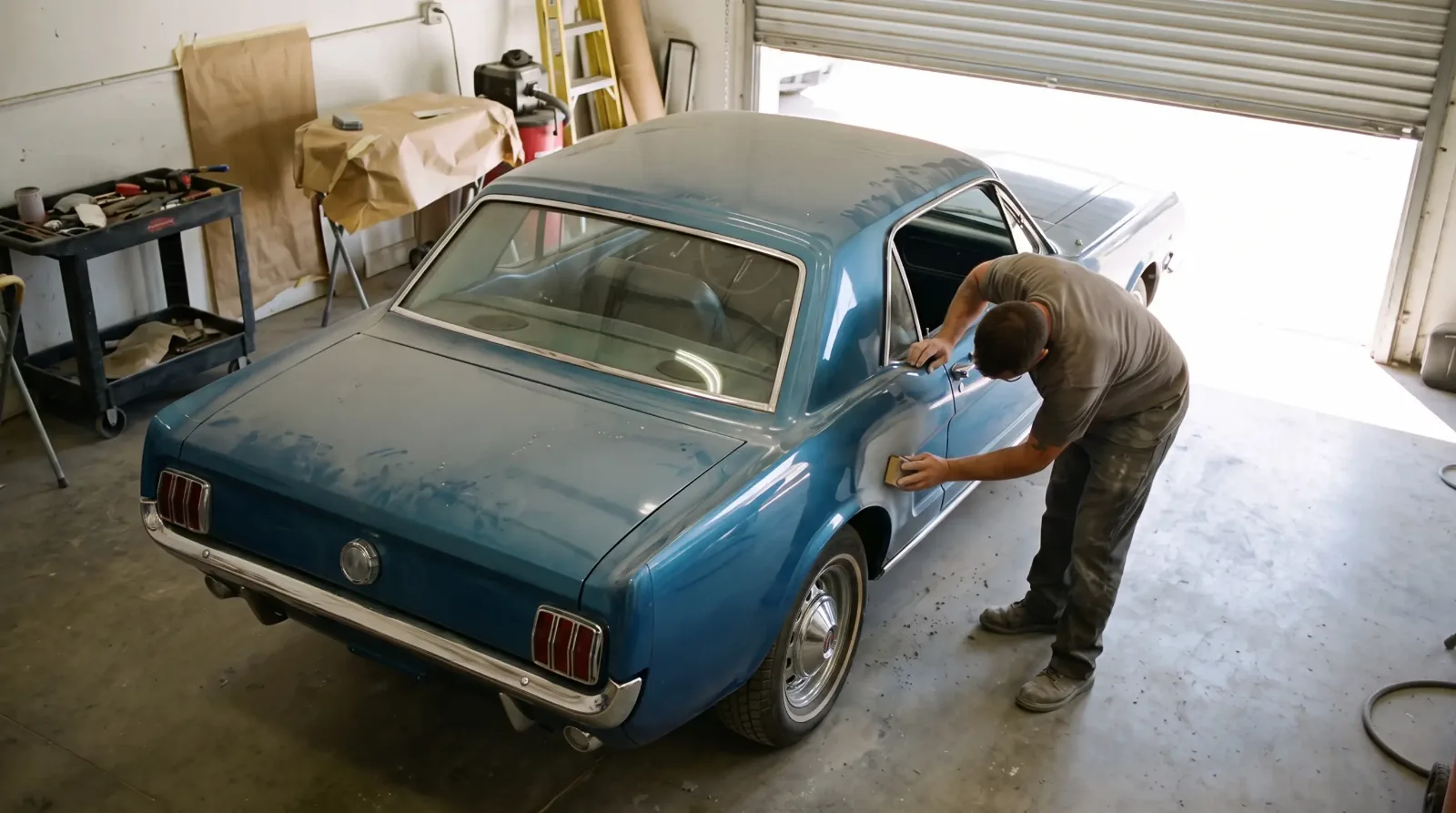
I come at these cars from the bodywork side. When you strip a tail panel, straighten it and put the lamps back, you learn the shape better than any brochure can teach you. This is one piece of the larger story of Mustang design, and it is the piece a body man ends up knowing by hand.
Where the Mustang three bar taillights started
The name Mustang first went on the 1962 Mustang I, a mid-engine two-seater with an aluminum body on a 90-inch wheelbase. It shares almost nothing with the car Ford sold. That car is its own story, and there is more on that here.
The taillights show up on the next show car. The 1963 Mustang II concept was built by Dearborn Steel Tubing on a pre-production Mustang body. They pulled the bumpers off, changed the headlamps and grille, and gave it a removable roof and white paint with blue stripes. What they left alone tells you a lot. The side sculpting stayed, and so did the tri-bar taillights. It was shown at Watkins Glen in October 1963, about six months before the production car's debut on April 17, 1964. By then the rear of the Mustang was settled.
That matters for anyone restoring an early car. The lamps were not a late styling add-on that got revised in a hurry. They were part of the body from the start, and the panel around them was shaped to suit them.
1965 and 1966: convex lenses and the side cove
On the early cars the lenses bulge outward, and the panel they sit in is not yet dished. The 1965 and 1966 cars share the same lens, which is why the restoration catalogs list one part for both years. It is a simple rear end. The interest is down the side of the car, where the sculpted cove runs back toward the rear wheel. On a 1965 car that cove carries a single vertical chrome molding shaped like a deep scoop. For 1966 Ford swapped it for a horizontal molding with three bars. I have always read that as the designers repeating the taillight theme along the flank, though that is my opinion and not something Ford put in writing.
Neither one moved any air. Both were simulated scoop ornaments, and the reproduction parts are still sold under that name. Behind the trim the cove is a styling line pressed into the quarter panel, which is why a dented cove is one of the harder repairs on an early car. You are restoring a crease and a curve at the same time, and the trim has to sit flat on it afterward.
Not every early car wears the molding. GT cars used a rocker stripe instead, and the 1966 Sprint 200 deleted the rear quarter ornaments. So a bare cove on a 1966 car is not proof that somebody lost the trim. Back-up lights were the other small change at the rear: optional in 1965, standard in 1966.
1967 to 1969: the concave panel and the scoop
The 1967 restyle is where the rear end got its character. The taillight lenses and the panel around them were now concave, curving inward instead of bulging out. The cove picked up a proper scoop shape ahead of the rear wheel, and on the fastback the roofline now ran all the way to the tail. Put those together and the car looks lower and longer from behind, even though the changes are small.
From a body man's side, the concave panel is a different job. A flat panel forgives a little. A dished one shows every ripple, and it catches light along the curve so a low spot jumps out once the color is on. Getting the lamps to seat evenly in a panel that has been pulled and filled takes patience. Most of the bad ones I see were straightened by somebody working to a flat-panel mindset.
| Model year | Rear panel | Taillight lenses | Quarter-panel treatment |
|---|---|---|---|
| 1965 | Not dished | Convex | Single vertical chrome cove molding |
| 1966 | Not dished | Convex | Three-bar horizontal molding (GT: rocker stripe) |
| 1967 | Concave | Concave | Side scoop ahead of the rear wheel |
| 1968 | Concave | Concave | Chrome side ornament; side marker lights added |
| 1969 | Concave | Three separate lamp units | SportsRoof: scoop high on the rear quarter; other bodies: rear-facing scoop |
| 1970 | Flat | Flat, recessed, in black panels with chrome bezels | Quarter scoops deleted |
For 1968 the scoop gave way to a chrome side ornament, and federal rules added side marker lights front and rear. The 1969 car kept the concave panel but broke each taillight into three separate units. On the SportsRoof the quarter scoop moved high on the rear quarter, while the other bodies got a rear-facing scoop. The Boss 302 went the other way and deleted those fake quarter scoops altogether. The tri-bar moved up front that year too: the pony emblem and its tri-bar went off center to the driver's side of the grille, which ties in with the story of the grille and corral.
Shelby lamps and the sequential question
Here is the one I get asked about most. No regular Mustang had sequential taillights from the factory in this era. The cars that did were the Shelbys and a Shelby-derived special.
The 1967 Shelby got its own fiberglass side scoops, a ducktail and Mercury Cougar taillamps. Whether those Cougar lamps were sequential on the 1967 Shelby is still argued, and the sources do not agree. The 1968 Shelby is not in doubt. It used sequential lamps from the 1965 Thunderbird. Those same Thunderbird taillights went onto the 1968 California Special, a coupe-only package with a fiberglass decklid and spoiler, end caps, taillight panel and side scoops, all made by A.O. Smith in Ionia, Michigan.
The Shelby scoops were also the ones that did a job. The 1966 GT350 carried rear brake cooling scoops, and the 1967 Shelby had functional rear brake-cooling quarter scoops. On a regular Mustang the quarter scoop was a shape. On a Shelby it fed the brakes.
"A concave tail panel will tell on a bad body man faster than anything else on the car. Park it under a streetlight and every wave in the metal shows up across the curve. If the lamps sit right and the light runs clean across that panel, somebody knew what they were doing."
Jim Vasquez
1970 goes flat, and what came after
The 1970 car flattened the rear. The concave panel was gone, replaced by a flat taillight panel with the lamps recessed into it, set in black panels with chrome bezels. The Mach 1 got a black honeycomb panel. On the sides the rear-quarter scoops were deleted, and the simulated intakes moved up front beside the headlamps. It is a cleaner car, and I think a less interesting one from behind. The bigger 1971 to 1973 cars kept the idea in a looser form: each lamp became one wide lens split into three vertical sections, set into a flat rear panel.
The tri-bar lamps were dropped with the Fox body for 1979. The side scoop had a stranger afterlife: the Ghia-designed Mustang II hatchback carried molded-in faux side scoops, which to my eye is a callback to the 1967 shape on a very different car. When the SN95 arrived for 1994, Ford brought back C-shaped side scoops and three-element taillights, laid horizontally. For 1996 the taillights were turned vertical again, and the 1999 New Edge restyle redrew both the side scoops and the taillights once more. When Ford launched the 2005 car, its own press release still listed C-scoops and three-element tail lamps among the heritage cues, which says plenty about how well the original idea held up.
Sources and notes
- Wikipedia: Ford Mustang (first generation)
- Wikipedia: Shelby Mustang
- The Henry Ford: the 1963 Mustang II, a not-so-missing link
- The Car Guide: 1967 Ford Mustang, convex to concave taillights
- OER Parts: 1964-65 Mustang simulated side scoop ornaments
- Ford press release (2004): heritage cues on the 2005 Mustang
Related Reading
#Ford Mustang
#1967 Mustang
#1969 mustang
#shelby mustang
#mustang design
#taillights
#side scoops
#classic Mustang styling

About the author
Jim Vasquez
Southern California hot rod and custom car builder with roots in the traditional kustom kulture scene.
Related Listings - Ford Mustang
Comments
Be the first to comment on this article.