
The ford bronco 1969 ranch truck reputation was not built on a marketing brochure. It was built on gravel lanes, cattle gates, and the kind of daily use that never made it into a Ford press photo. By its third model year the Bronco had settled into a role nobody at Dearborn had fully planned for. It was not just a rival to the Jeep CJ-5 or the International Scout. On working land across the West and the Plains states, it had become the truck that lived at the barn.
Car Features
6 min read
The 1969 Bronco as America's Ranch Truck
Long before it was a collector darling, the 1969 Ford Bronco earned its keep hauling feed, checking fence, and starting every cold morning on working land.
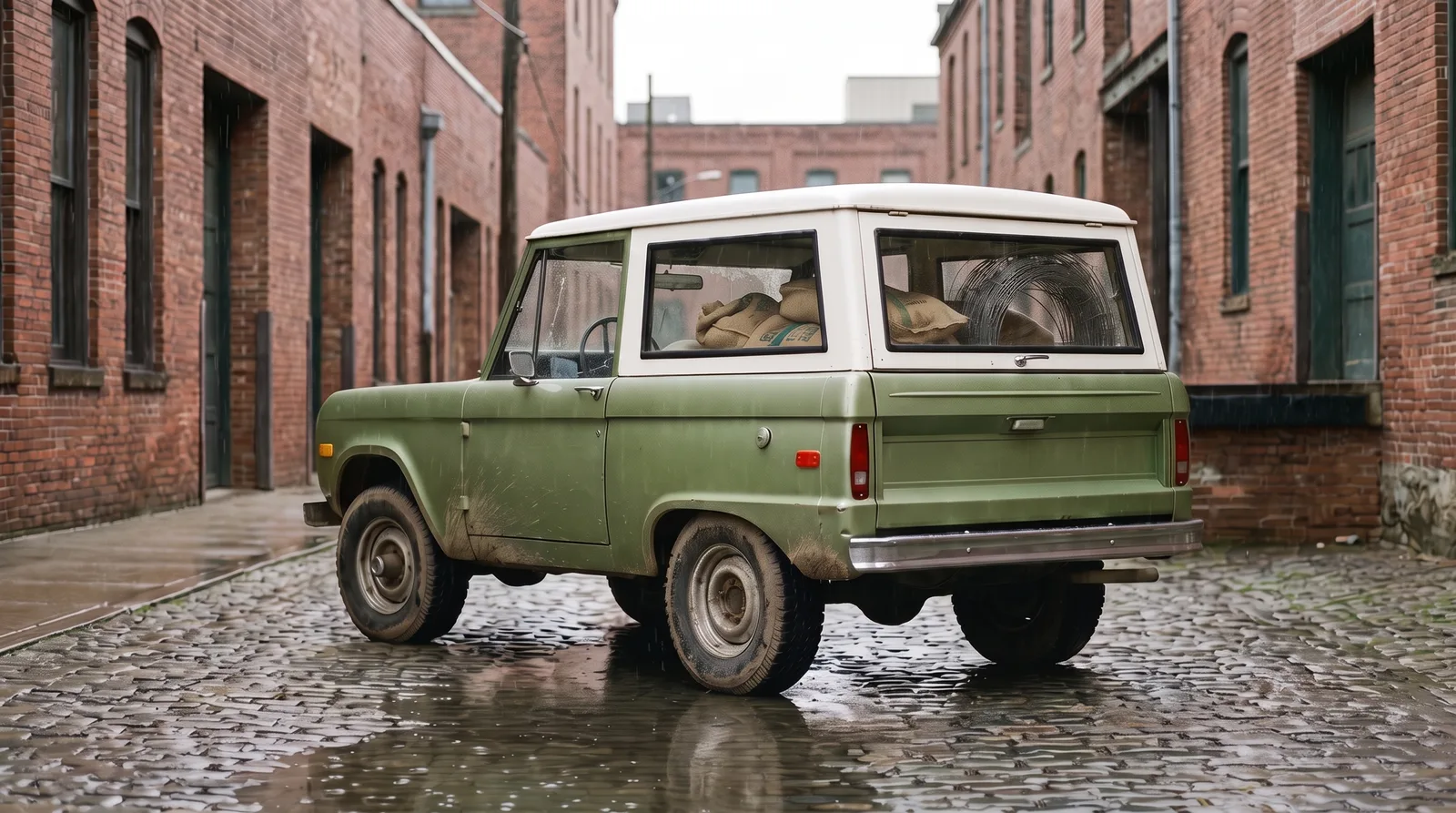
A working shape, not a styling exercise
The 1969 Bronco kept the compact, boxy proportions that had defined the line since 1966. A short 92 inch wheelbase, a tight turning circle, and a high seating position made it genuinely useful on a ranch in ways a full-size pickup was not. It could thread between fence posts, back up to a loading chute, and still carry a load of feed sacks without complaint. Ranchers did not care that the Bronco had started life as a passenger-adjacent recreational vehicle in Ford's lineup planning. They cared that the departure angle let it climb a rutted creek bank without dragging its tail, and that the coil-spring Mono-Beam front suspension, unusual for a solid axle in this class, gave a ride that did not beat a driver to pieces after a full day of checking fence.
By 1969 the model lineup had narrowed. Ford had dropped the open Roadster body after 1968, leaving the wagon and the half-cab pickup as the two Bronco choices, and that pickup variant is the one most closely tied to actual ranch duty. With its open bed behind the cab, it hauled tools, salt blocks, and fence wire the way a stock trailer never could on tight trails.
The engine that made it a real truck
1969 was the year Ford swapped the 289 cubic inch V8 for the 302, a change that mattered more on a ranch than it did on a showroom floor. The 302 offered a wider torque band at low revs, which is exactly what a truck needs when it is idling a hay baler's power takeoff or crawling in low range across a wash. Buyers who wanted simplicity could still order the 170 cubic inch inline six, and plenty did, since a six-cylinder Bronco was cheaper to keep running when the nearest Ford dealer was forty miles down a county road.
Four-wheel drive was standard, not an option, which set the Bronco apart from half-ton pickups of the era that often shipped two-wheel drive from the factory. On a ranch, that mattered every single winter.
Why the half-cab pickup earned its keep
The half-cab Bronco pickup of 1969 is often overlooked next to the wagon, but on working land it may have been the more honest expression of the vehicle. An open bed meant a rancher could toss in fence T-posts still crusted with dirt, or a leaking stock tank, without worrying about the interior. The wagon, by contrast, got used for feed runs and family errands in roughly equal measure, since it could seat a family on Sunday and haul dog food on Monday.
Neither body style was luxurious. Vinyl seats, rubber floor mats, and a heater that worked hard in January were the standard. That was the point. A Bronco that got muddy did not need babying, and a ranch family was not going to buy a truck it had to protect from itself.
Maintenance was another point in the Bronco's favor. A ranch mechanic working out of a pole barn could keep a 1969 Bronco running with hand tools and a stock of common Ford parts, since the drivetrain shared much with the F-Series trucks already on the property. That parts commonality meant a broken part rarely sidelined a truck for more than a day, which was the difference between finishing a chore before dark and losing an entire afternoon waiting on a dealer forty miles away.
"People forget the Bronco was cross-shopped against tractors and stock trailers as much as it was against other trucks. On a working spread, a vehicle earns trust by starting every morning, not by looking good in a magazine."
- Sarah Whitfield
Regional patterns in how it was used
In cattle country from Texas up through Wyoming, the Bronco's low range gearing and short wheelbase made it a favorite for moving between pastures where a standard pickup would have bottomed out. In the citrus and almond groves of California, growers used it for row access where a wider truck simply would not fit. These were not glamorous jobs, and most of those trucks were driven into the ground, which is a large part of why clean surviving examples with documented ranch history are scarce today. If you want to read the background, the fuller account of the 1969 model year covers the production and design side in more detail.
Survivors that do turn up with farm or ranch provenance, especially six-cylinder half-cab trucks with honest paint and a title trail back to a single family operation, carry a different kind of value than a restored show truck. Buyers who understand the ford bronco 1969 ranch truck story tend to pay attention to that history rather than just the odometer.
What collectors look for now
Originality matters more than shine for this category of Bronco. A truck with a period-correct 302, its original PTO or auxiliary hydraulic fittings if it had them, and unmolested sheet metal under the mud tells a story that a repainted, re-carpeted example cannot. Some buyers specifically seek out trucks that still wear their ranch dents, treating them as documentation rather than damage.
For anyone chasing that kind of history, it helps to find a classic Bronco with paperwork that ties it back to actual working use rather than a vague story from a previous owner. Bills of sale, brand inspection records, and old feed store receipts stuffed in a glovebox are worth more to a serious buyer than a fresh coat of paint.
There is also a practical case for choosing a ranch-history Bronco over a trailer queen. A truck that spent decades earning its keep on real ground has usually already revealed its weak points. Rust that was going to show up has shown up. A frame that was going to sag has sagged. What remains, if the truck was cared for at all, is a vehicle with fewer surprises than one that sat unused in a barn for thirty years and looks perfect until the first drive uncovers dry-rotted lines and a fuel system nobody serviced.
The 1969 Bronco was never trying to be a status symbol on a ranch. It was trying to start, climb, and haul, day after day, and that quiet competence is exactly why it still matters to people who understand what working trucks are supposed to do.
Sources and notes
Related Reading

About the author
Sarah Whitfield
Third-generation classic car collector specializing in pre-war American and European coachbuilt automobiles. Researcher and concours enthusiast.
Related Listings - Ford Bronco


Comments
Be the first to comment on this article.