
Walk a swap meet full of 1970s CJ-5s and you can tell the whole decade apart by the graphics alone. The jeep cj culture decal wars were not a single package or a single year. They were an era, roughly a decade long, when American Motors and its rivals raced to see who could put the boldest stripe, the biggest eagle, or the sharpest lettering across a hood, and the CJ-5 became one of the most decorated small trucks in American automotive history.
Car Features
7 min read
Stripes, Eagles and Spice: The CJ Decal Era
Through the 1970s, Renegade, Golden Eagle, Levi's and Super Jeep turned the CJ-5 option sheet into a decade-long competition of stripes, lettering and eagle artwork.
How it started
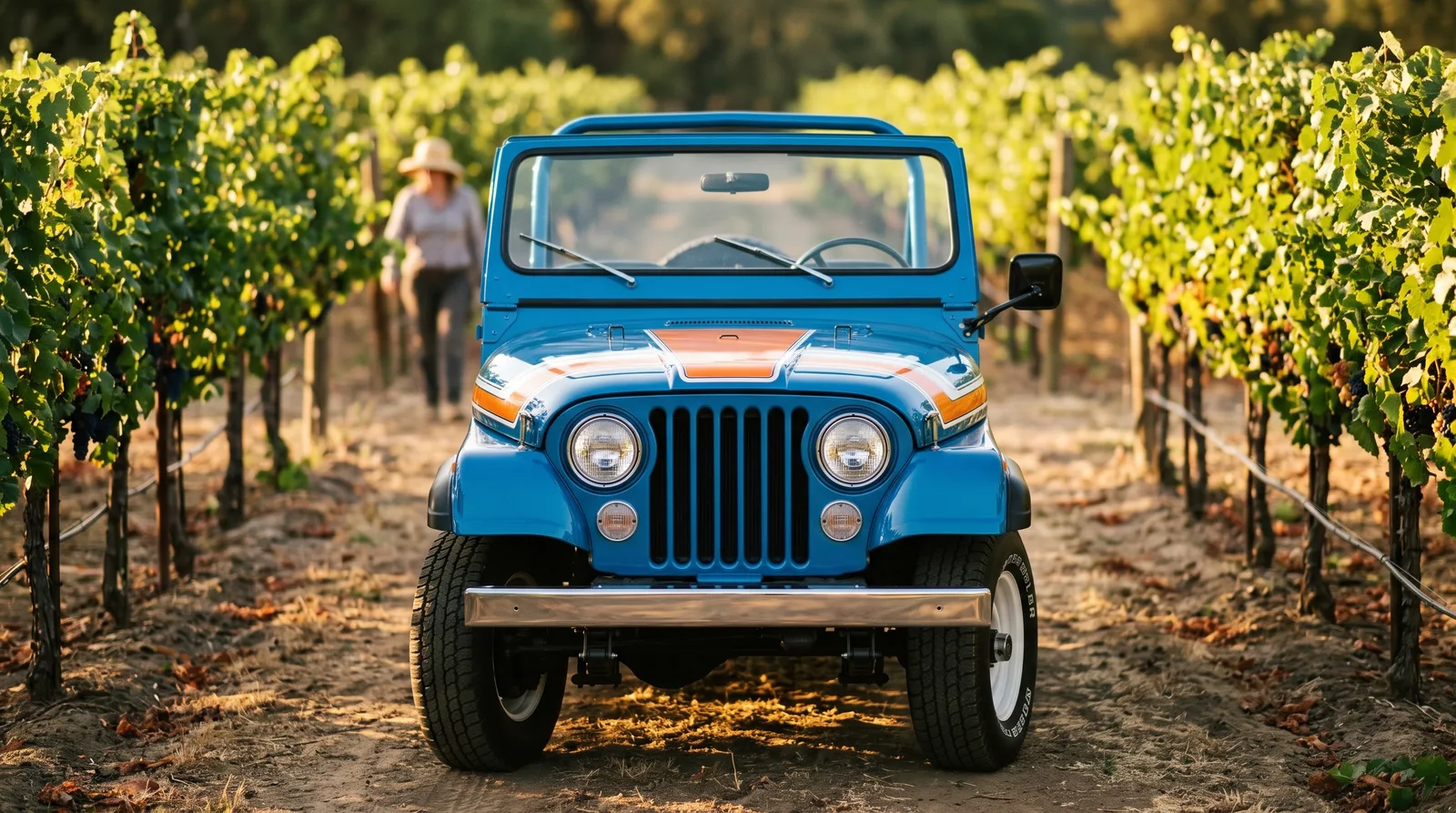
The opening shot came with Renegade in the early 1970s, a package that dressed the CJ-5 in wide stripes and mag-style wheels aimed squarely at a younger buyer who wanted a truck with attitude rather than just utility. Renegade proved the formula worked. A relatively small investment in graphics and trim could reposition a truck that had spent decades being sold to farmers and outdoorsmen, turning it into something a twenty-five-year-old wanted parked outside a college apartment.
Once Renegade demonstrated the appetite, the rest of the decade turned into a genuine competition of ideas. Super Jeep followed in 1973 with bold lettering and striping. The Levi's Edition brought denim-styled interiors and matching exterior graphics into the mix by 1974, proving the formula could extend past paint and decals into fabric and branding partnerships. Golden Eagle arrived in 1977 with the most famous single image of the entire era, a gold eagle spread across the hood that remains instantly recognizable to anyone who lived through the decade.
Why the eagle beat the field
Not every decal package achieved the same lasting recognition, and the reasons are worth examining rather than assuming. Golden Eagle worked because the image itself was strong enough to function as a standalone symbol, something a person could describe accurately from memory decades later without needing to see the truck itself. Renegade and Super Jeep leaned more on typography and stripe patterns, which are effective in person but harder to describe or remember as a single mental picture. The eagle became shorthand for the entire decal era in a way individual stripe packages never quite managed.
That said, dismissing the other packages would misread the period. Each one served a specific marketing purpose and found its own audience. Renegade signaled youth and attitude. Levi's signaled casual counterculture cool. Golden Eagle signaled boldness for its own sake. Together, they turned the CJ-5 option sheet into something closer to a fashion catalog than a traditional truck brochure, and buyers responded by ordering these packages in real numbers rather than treating them as novelty items.
What the decal wars actually accomplished
Beyond the visual spectacle, this era of competing graphics packages did real work for Jeep's business. It kept a fundamentally unchanged mechanical platform feeling fresh year after year without the expense of a full redesign, a trick automakers still use today, just with less flamboyant execution most of the time. It also broadened the CJ's buyer base considerably, pulling in customers who had no interest in the truck's off-road capability but liked what it said about them sitting in a driveway.
The competitive pressure came from outside Jeep too. Ford, Chevrolet, and International Harvester were all running their own appearance-package strategies on competing trucks and early SUVs during the same stretch, which meant Jeep's design and marketing teams were not just decorating a truck for fun. They were fighting for shelf space in a genuinely crowded small-truck market, and the graphics were a real competitive tool rather than an indulgence.
"Nobody planned to call it a decal war at the time. It just turned into one, package by package, until the CJ-5 option sheet looked like a catalog of competing personalities."
- Patrick Walsh
How dealers and buyers actually experienced it
Standing on a dealer lot in the mid to late 1970s, a customer shopping for a CJ-5 faced a genuinely different experience than a customer shopping the same truck a decade earlier. Instead of choosing mainly between engine and axle options, buyers were now flipping through brochure pages comparing eagle artwork against stripe patterns against denim upholstery samples, each package presented almost like a separate personality the buyer could try on. Salespeople adapted their entire pitch around these packages, often leading with the graphics rather than the mechanical specifications that had dominated CJ sales conversations in earlier decades.
That shift changed who walked onto Jeep lots in the first place. Magazine advertising from the period leaned heavily on lifestyle imagery, young people at concerts, at the beach, or simply cruising with the top off, rather than the farm and job-site photography that had defined earlier CJ marketing. The decal wars were not just a design trend confined to the vehicles themselves. They reflected, and arguably accelerated, a genuine repositioning of who Jeep believed its customer actually was by the back half of the 1970s.
Not every buyer welcomed the shift. Longtime Jeep owners who valued the vehicle's utility-first reputation sometimes viewed the graphics packages with real skepticism, seeing them as style over substance layered onto a truck that had earned its reputation through decades of honest work rather than showroom flash. That tension between the CJ's utilitarian roots and its increasingly image-driven marketing ran through the entire decal era, and it never fully resolved before the CJ line itself ended production in 1986.
The bigger picture
This entire stretch of CJ history connects directly to the wider story of how the CJ line's trims and special editions evolved across four decades of production. For read the background on how each individual package fit into that longer arc, from Renegade's early success through the Laredo and Limited trims that eventually pushed the CJ toward comfort rather than graphics, the full trim history connects the decal wars to everything that came both before and after them.
By the early 1980s the competition had shifted direction, moving from bold graphics toward the comfort-focused trims like Laredo and Limited, a sign that buyer tastes were changing even as the CJ itself neared the end of its production run. The decal wars remain the loudest, most visually memorable chapter of that longer story, and original examples from the era carry a real premium today precisely because so many decals faded, peeled, or were painted over long before anyone thought to preserve them.
Finding a survivor
A CJ-5 with original, correct graphics from this era is genuinely harder to find than the mechanical platform underneath it would suggest, since decals age far worse than sheet metal or a rebuilt engine. Buyers chasing an authentic decal-era CJ-5 should expect to inspect closely and ask real questions about whether graphics are factory original, professionally restored, or aftermarket reproductions. If the decal wars have you hunting for a survivor, you can find a classic CJ and start comparing what has actually made it through the decades intact.
Sources and notes
Related Reading


Have a
Jeep CJ
for Sale?
Reach thousands of serious classic car collectors across the US.
Sell It Here →
Selling a classic? Here's how: sell my classic car
Are You a Classic Car Dealer?
List your full inventory and connect with targeted classic car buyers.
Join as a Dealer →

About the author
Patrick Walsh
Automotive journalist covering classic car shows, events, and the enthusiast community across North America.
Related Listings - Jeep CJ




Comments
Be the first to comment on this article.