
Look closely at a badge on an early CJ and you will find a name that has mostly disappeared from memory, sitting quietly ahead of the model number that outlived it. The jeep cj culture universal name is the story behind that badge, the "Universal Jeep" designation Willys and later Kaiser used for decades to describe the entire civilian CJ family, a name that once meant more to buyers than "CJ" itself did.
Car Features
7 min read
The Universal Jeep: The Name Behind the CJ
Before Renegade or Golden Eagle, the CJ was sold to postwar America under a single reassuring name, Universal Jeep, promising a vehicle that could do anything.
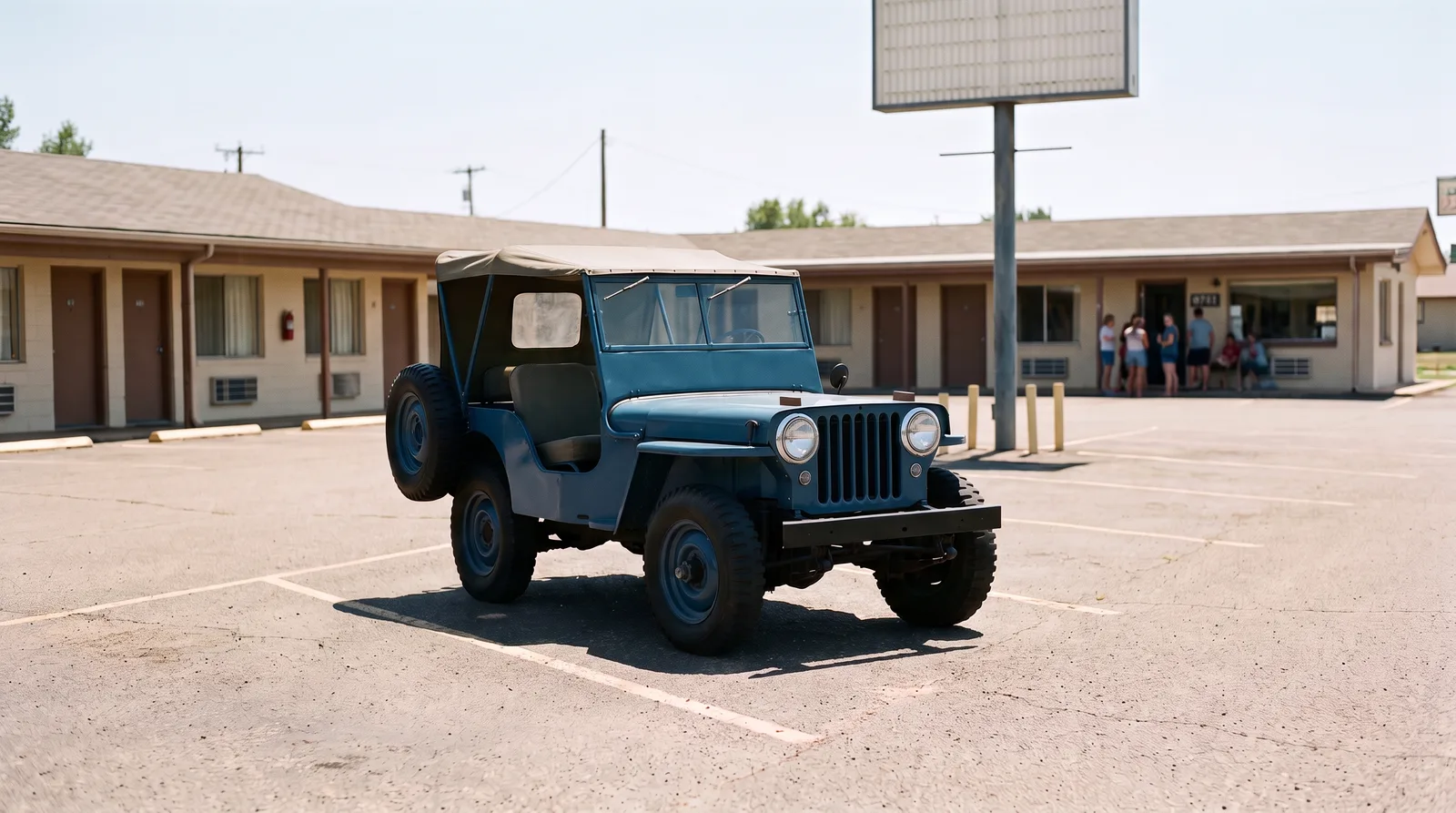
A name built for reassurance
When Willys-Overland began selling civilian Jeeps after the Second World War, the company faced a real marketing problem. The Jeep had built its reputation in combat, hauling soldiers and supplies across terrain no ordinary car could handle, and that reputation was valuable, but it was also narrow. Willys needed American farmers, ranchers, and small businesses to see the same vehicle as something they could use every day, not just a war-surplus curiosity. "Universal Jeep" was the answer, a name chosen specifically to signal versatility rather than a single narrow purpose.
The word "Universal" did real marketing work. It told a skeptical postwar buyer that this vehicle could plow a field in the morning, run a power take-off attachment by noon, and drive into town by evening, all without changing its fundamental character. That message mattered enormously in the late 1940s, when Willys was trying to convince a civilian audience that a vehicle designed for war could be just as valuable in peacetime, doing an entirely different set of jobs.
How the name lived alongside CJ
The CJ designation itself, standing for Civilian Jeep, had already been assigned internally to the early postwar models, starting with the CJ-2A in 1945. But "Universal Jeep" functioned as the public-facing name for years afterward, appearing in advertising, owner's manuals, and dealer literature well into the CJ-5 era. For much of the 1950s and into the 1960s, a buyer walking into a dealership was more likely to hear the vehicle described as a Universal Jeep than as a CJ-3B or CJ-5, even though internally the model codes were exactly what enthusiasts and historians reference today.
This dual naming reflects something true about how the CJ line was marketed across its early decades. The model codes existed for Willys and later Kaiser's own internal tracking and for the more technically minded buyer, but the Universal Jeep name did the actual selling. It was simpler, friendlier, and carried an implicit promise that mattered more to a working buyer than a code number ever could.
Why the name eventually faded
By the time American Motors took over the Jeep brand in 1970, the marketing landscape had shifted considerably. The CJ-5 and CJ-7 were being sold increasingly on personality and image, through packages like Renegade and Golden Eagle rather than through a blanket promise of do-anything utility. A name built to reassure a 1940s farmer made less sense to a 1970s buyer who wanted a truck with attitude, and "Universal Jeep" quietly faded from marketing materials as the CJ model numbers themselves became the primary way the vehicles were identified and discussed.
There is a certain irony in that shift. The versatility the Universal Jeep name promised in 1945 never actually went away. The CJ-5 and CJ-7 remained genuinely capable, multi-purpose vehicles through the end of production in 1986. What changed was the story Jeep wanted to tell about that versatility, moving from plain reassurance toward image and lifestyle marketing as the buying public's priorities shifted with the decades.
"Universal Jeep is a name that did exactly what it promised for twenty-five years, then stepped aside quietly once the CJ no longer needed to explain itself to a skeptical postwar buyer."
- Nora Beckett
Tracing the name through the paperwork
Original owner's manuals from the 1950s and early 1960s reference the Universal Jeep name consistently, usually alongside a specific model designation like CJ-3B or CJ-5 in smaller type below the primary heading. That layout choice, name first and model code second, tells you plainly which one Willys and later Kaiser expected the average buyer to actually care about when reading the cover of a manual pulled out of the glovebox. The model code existed for parts ordering and dealer service records. The Universal Jeep name existed to remind the owner what they had actually bought and why they had trusted the purchase in the first place.
Advertising from the same period reinforces the pattern. Print ads from farm publications and general-interest magazines throughout the 1950s consistently lead with the Universal Jeep name, often paired with illustrations showing the vehicle performing several different tasks in a single spread, plowing, towing, carrying passengers, running a belt-driven attachment, to visually reinforce exactly the versatility the name promised. This was deliberate, consistent messaging sustained across more than a decade of marketing material, not a passing slogan used for a single model year.
By the time Kaiser Jeep gave way to American Motors ownership in 1970, that consistent messaging had already begun to fade in favor of model-specific marketing, and the Universal Jeep name largely disappeared from mainstream advertising within a few years of the ownership change. Collectors and historians researching original literature today treat any document still carrying the Universal Jeep name as a useful marker for dating material to before that transition, one small but genuinely useful clue buried in old paperwork most casual buyers would never think to examine closely.
A name worth remembering
The Universal Jeep designation deserves more attention than it usually gets in casual CJ history, because it explains something important about how an entire generation of American buyers first came to trust a vehicle built originally for war. It is also a useful reminder that the CJ line's identity was never fixed. It shifted from a plain, do-anything work vehicle in the late 1940s to a personality-driven cultural object by the 1970s, and the name attached to it shifted right along with that transformation.
That transformation runs through nearly every trim and special edition the CJ ever wore, and understanding the Universal Jeep name early in the story helps make sense of everything that came afterward. For the whole picture of how the CJ moved from that early utility promise through decades of appearance packages, comfort trims, and cultural moments, the full trim history picks up the thread right where the Universal Jeep name leaves off.
Seeing it in person
Original literature, badging, and dealership materials referencing the Universal Jeep name are collectible in their own right, separate from the vehicles themselves, and they offer a genuine window into how Willys and Kaiser talked to their customers decades before Renegade or Golden Eagle ever existed. For anyone drawn to this earlier chapter of the CJ's story, the vehicles that carried the name are still out there. You can shop classic CJ listings to see what early CJs, the trucks that once wore the Universal Jeep name on their badges and in their brochures, are currently available.
Sources and notes
- Wikipedia: Jeep CJ (Universal Jeep naming and ownership history)
- Jeep History in the 1970s (Jeep official archive)
- ExtremeTerrain: Identifying Jeep CJ-5, CJ-6, CJ-7 and CJ-8 Models and Years
- Hagerty Media: The Jeep CJ-5 Was Built Forever to Go Wherever
- Jeep-CJ.com: CJ model and badge identification discussion
Related Reading

Have a
Jeep CJ
for Sale?
Reach thousands of serious classic car collectors across the US.
Sell It Here →
Selling a classic? Here's how: sell my classic car
Are You a Classic Car Dealer?
List your full inventory and connect with targeted classic car buyers.
Join as a Dealer →

About the author
Nora Beckett
Automotive features writer and photographer who tells the human stories behind the cars, from show fields to cross-country road trips.
Related Listings - Jeep CJ





Comments
Be the first to comment on this article.