
Some special editions run for a decade. Some run for one model year and then vanish so completely that even longtime Jeep people need a photo to jog the memory. The jeep cj culture super jeep package belongs firmly in that second category, a 1973 CJ-5 special edition that came and went in a single year, leaving behind exactly the kind of scarcity that makes collectors pay attention decades later.
Car Features
7 min read
The Super Jeep: The One-Year Wonder
Offered for a single model year in 1974, the Super Jeep package previewed the bold graphics era that would soon define the CJ-5, then disappeared almost overnight.
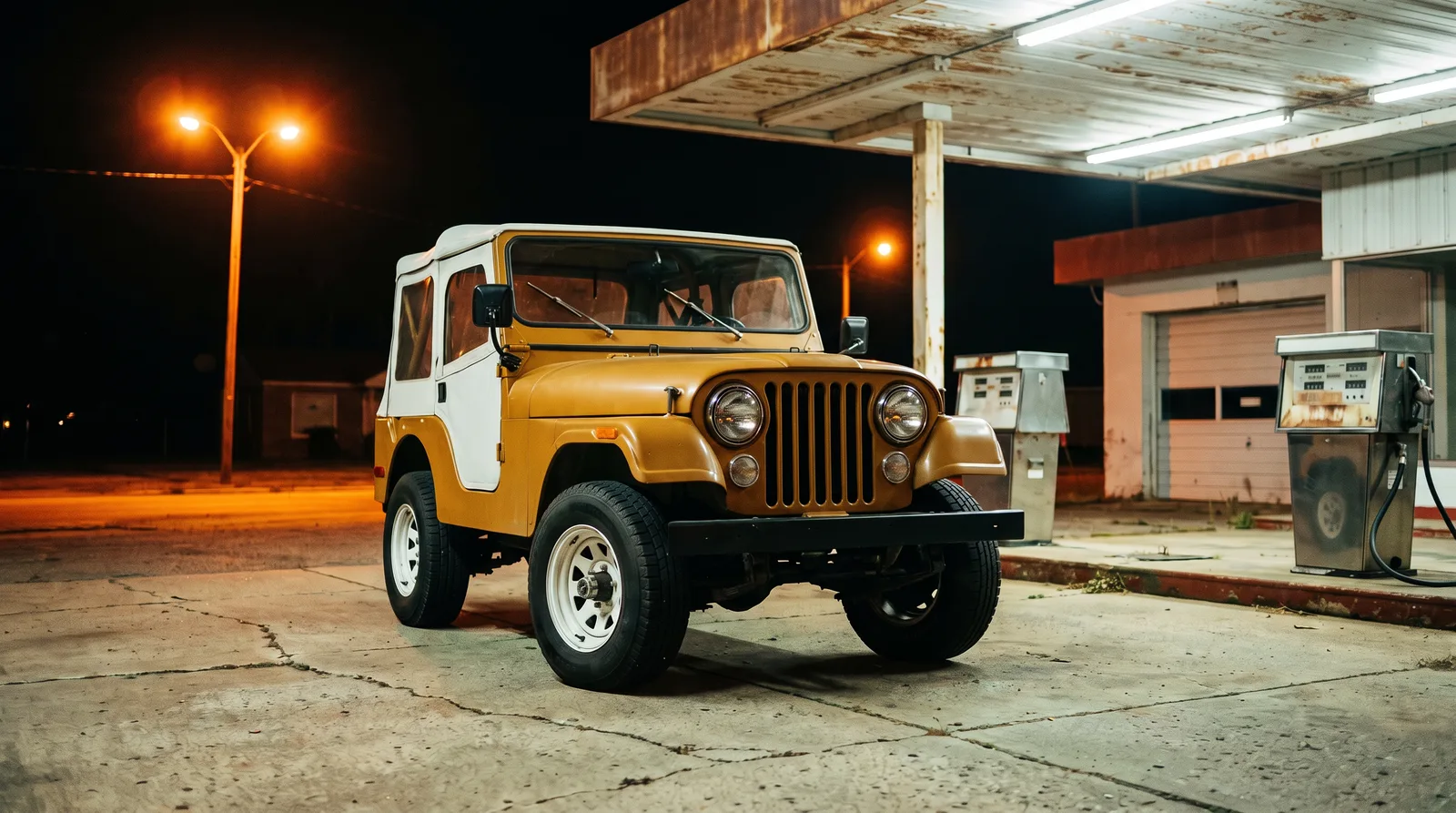
A bridge between two eras of graphics
Super Jeep landed in 1973, arriving because a shortage of the aluminum wheels needed for the CJ-5 Renegade left AMC with a gap to fill, and it came several years before the Golden Eagle. American Motors was still working out exactly how bold a graphics package could get on a small utility vehicle, and Super Jeep reads today like a rough draft for the louder, more famous packages that followed it. The name itself was almost defiantly simple, a straightforward declaration rather than a place name or a borrowed brand, and it fit the era's appetite for graphics that did not need much explaining.
The package centered on bold striping and Super Jeep lettering applied to the hood and body sides, paired with a limited selection of body colors chosen to make the graphics stand out. It was not subtle, but it was also not yet as elaborate as the full eagle artwork that would define 1977's Golden Eagle. Super Jeep occupies that in-between space in CJ history, past the plain work-truck era but not yet into the full decal wars of the later 1970s.
Why one year was enough
A one-year special edition is not automatically a failure. Sometimes it means a manufacturer was testing an idea before committing further resources to it, and the market response simply pointed toward refinement rather than repetition. Super Jeep's graphics and marketing approach clearly informed what came next. AMC kept experimenting with bold, named appearance packages on the CJ-5 through the rest of the decade, each one building on lessons from whatever preceded it, and Super Jeep sits at the front of that lineage even though its own run ended almost as soon as it began.
There is also a simpler explanation worth considering: automakers of the era cycled special editions quickly as a matter of course, using them to generate showroom traffic and press coverage for a season before moving on to the next attention-grabbing name. Super Jeep did its job, got people talking about a fairly ordinary CJ-5 for a year, and then stepped aside for whatever came next on the option sheet.
What buyers actually got
Underneath the graphics, a Super Jeep was mechanically identical to any other CJ-5 from the period, riding on the same solid front and rear axles, offered with the same engine choices buyers could get without paying for the special edition. The package was cosmetic through and through, which was entirely normal for this category of CJ special edition and not a criticism unique to Super Jeep. Buyers were not purchasing extra capability. They were purchasing a specific look, and a fairly rare one at that, whether they realized it at the time or not.
That cosmetic focus is exactly why the trim matters to collectors now rather than to trail drivers chasing capability. A Super Jeep and a plain 1973 CJ-5 will behave identically on a fire road. Only one of them carries the graphics package that a small number of buyers actually ordered that specific year, and that scarcity is the entire reason the name still comes up in conversations about CJ history.
"Super Jeep is the trim people forget existed until they see one in person, and then they cannot stop asking questions about it. One year is not much of a run, but it left a real mark."
- Patrick Walsh
Reading the graphics up close
Photographs and surviving brochure material show the Super Jeep lettering rendered in a bold, blocky typeface running along the lower body sides, paired with hood striping that swept back toward the windshield in a style typical of mid-1970s automotive graphics. The overall effect leaned closer to a muscle car's stripe kit than to the wildlife imagery Golden Eagle would introduce a few years later, which places Super Jeep stylistically closer to Renegade's approach than to the eagle artwork that eventually became the era's most famous image.
Color choices for the package were limited compared to what buyers could get on a standard CJ-5, a common practice for special editions of the period since it simplified production and kept the graphics reading clearly against the body color underneath. That kind of deliberate restriction is easy to overlook decades later, but it reflects how carefully AMC's design and marketing teams thought about how these packages would actually look driving down a street rather than just sitting in a brochure photograph under studio lighting.
Enthusiast forums and Jeep club newsletters occasionally surface photographs of Super Jeep trucks from private collections, and each new example tends to generate real discussion, since so few people have seen more than one or two in person across a lifetime of attending shows and swap meets. That scarcity, combined with genuine visual distinctiveness, is exactly why a package with a single model year keeps earning attention in CJ history circles instead of fading into a footnote the way some short-lived options eventually do.
Placing it in the bigger story
Super Jeep does not stand alone. It is one entry in a long run of CJ-5 and CJ-7 special editions that stretched from the early 1970s through the CJ line's final years in 1986, each package aimed at a slightly different buyer or a slightly different marketing angle. For the full story of how all these packages connected to one another across more than a decade of CJ production, the wider trim history shows exactly where Super Jeep fits as one of the earlier experiments in a much longer pattern.
Finding a genuine Super Jeep today takes patience, and verifying originality matters more here than on packages with longer production runs and better documentation, simply because there is less reference material available. Club registries and marque-specific enthusiast groups are often a better resource than general auction listings for confirming whether a given truck's graphics and trim match what left the factory in 1973, since sellers unfamiliar with the package sometimes mislabel later, more common special editions as Super Jeeps. Buyers interested in this specific slice of CJ-5 history should expect to do real homework before trusting a seller's claim, since a plain 1973 CJ-5 with reproduction graphics can look convincing to an untrained eye. If a genuine one-year special edition is what you are after, you can browse classic CJ listings and see what is currently available among the wider pool of 1970s CJ-5s on the market.
Sources and notes
Related Reading

Have a
Jeep CJ
for Sale?
Reach thousands of serious classic car collectors across the US.
Sell It Here →
Selling a classic? Here's how: sell my classic car
Are You a Classic Car Dealer?
List your full inventory and connect with targeted classic car buyers.
Join as a Dealer →

About the author
Patrick Walsh
Automotive journalist covering classic car shows, events, and the enthusiast community across North America.
Related Listings - Jeep CJ




Comments
Be the first to comment on this article.