
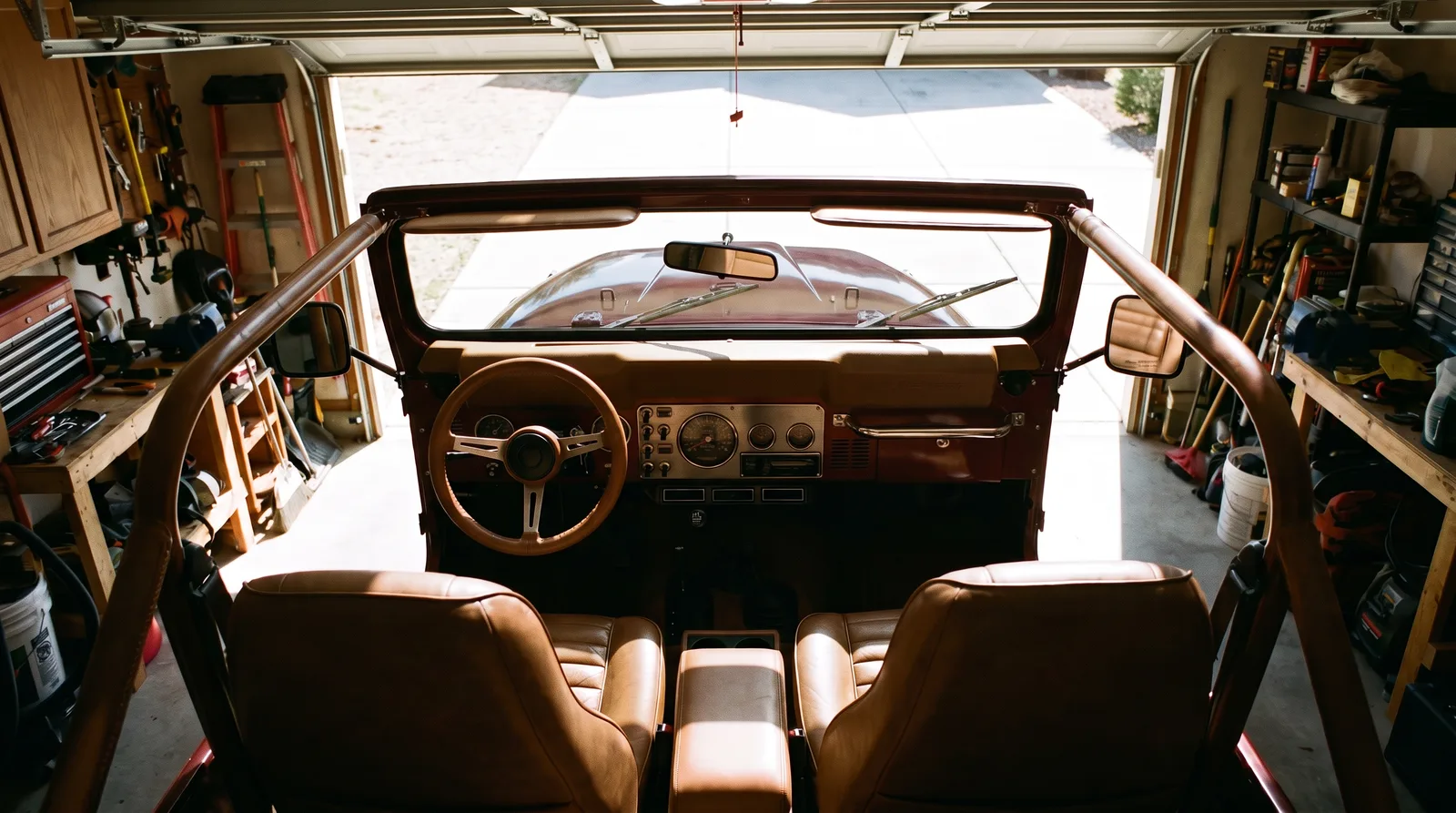
Somewhere in a garage in the Midwest sits a CJ-7 with leather seats, and the owner still has to explain to visitors that no, they are not mistaken, that really is factory leather in a Jeep from 1982. The jeep cj culture limited trim was the CJ line's furthest reach toward luxury, a two-year experiment that dressed the smallest, roughest vehicle in AMC's lineup in the trappings of a much more expensive car, and then quietly disappeared almost as soon as it arrived.
Car Features
6 min read
The Limited: The Most Luxurious CJ Ever Built
For two model years the Limited trim gave the CJ-7 leather seats and chrome trim, the furthest the CJ line ever reached toward true luxury.
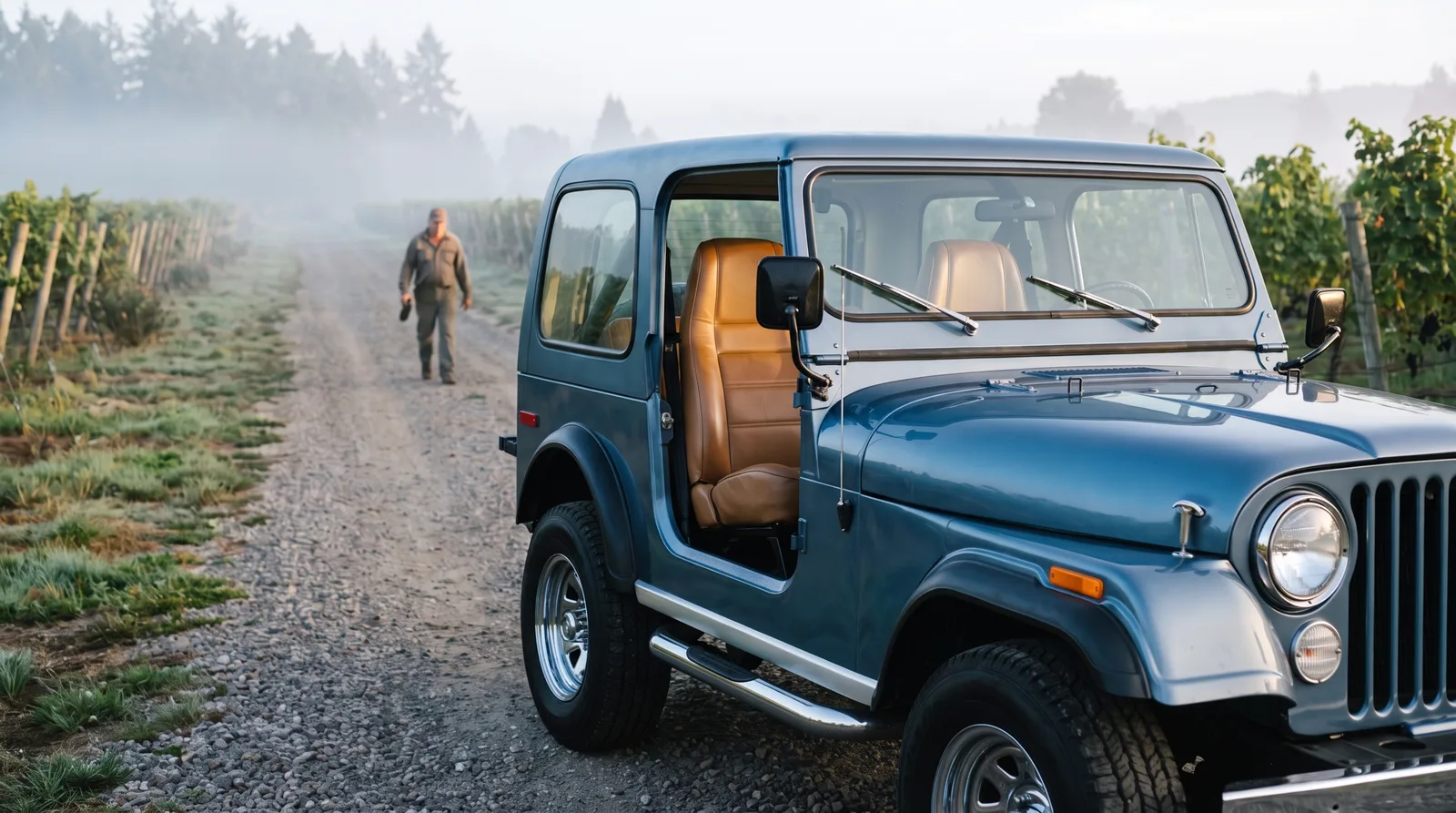
The last word in CJ comfort
The Limited package appeared for the 1982 and 1983 model years on the CJ-7, sitting one full step above Laredo in the trim hierarchy that had built up over the previous decade. Where Laredo had introduced comfort features and cowboy-town branding, Limited pushed further: an optional genuine leather seat upgrade, additional sound insulation, upholstered headliner, thicker carpeting, tilt steering, power steering and brakes, and a general fit and finish aimed at buyers who wanted the CJ's image without giving up much of the comfort they expected from a passenger car. It was, by CJ standards, about as plush as the platform ever got.
Exterior touches followed the same logic. Limited trucks wore chrome accents, distinctive badging, and styled wheels that separated them visually from lesser trims, so a buyer who paid for the top package could be certain everyone else on the road understood what they were looking at. The whole point of a limited-run luxury trim is visibility as much as comfort, and Jeep's designers understood the assignment.
Why it did not last
Two model years is a short run even by appearance-package standards, and the reasons are not mysterious. The CJ-7's basic architecture, an open-top or removable-hardtop utility vehicle riding on solid axles and leaf springs, was never going to compete gracefully with the genuinely quiet, insulated ride of a contemporary luxury sedan or even a full-size SUV. Leather seats in a vehicle with a canvas top and drafty doors is a compromise no amount of marketing could fully paper over, and buyers who wanted true luxury eventually looked elsewhere, even as buyers who wanted a rugged CJ often felt Limited was more truck than they needed to pay for.
The CJ line itself was also nearing its end. Production wound down in 1986 as the Wrangler YJ prepared to take over, and Jeep's broader strategy was shifting toward vehicles built from the ground up with more road manners, rather than utility platforms wearing luxury trim as an afterthought. Limited was arguably a preview of where Jeep's SUVs were eventually headed, just attached to a body style that could not fully deliver on the promise yet.
A quiet artifact of a changing Jeep
What makes the Limited trim worth revisiting is not its commercial success, since by most measures it was a modest, short-lived offering rather than a hit. It is worth revisiting because it marks a specific moment when Jeep was actively testing how far it could stretch the CJ's identity before the shape itself became the limiting factor. The company had already tried appearance packages built around counterculture cool with Levi's, cowboy imagery with Laredo, and now it tried outright luxury with Limited. Each attempt taught Jeep something about where its customers' patience actually ended.
That experimentation did not happen in isolation. It sat at the tail end of a decade defined by an entire family of CJ trims and special editions, each one aimed at carving out a slightly different buyer. For where this started, the fuller account of how these trims developed one after another across the 1970s and into the 1980s puts Limited into context as the last major step in that progression rather than an isolated curiosity.
"There is something almost tender about a truck trying that hard to be something it was never quite built to be. Limited never fully succeeded, and that is exactly why it stays interesting."
- Nora Beckett
How Limited compared to its stablemates
Placed next to Laredo, the Limited package makes the most sense as an escalation rather than a wholly separate idea. Laredo had already proven that CJ-7 buyers would pay for comfort features and cosmetic upgrades beyond what the base truck offered. Limited simply pushed that same logic further, swapping cloth or vinyl for leather and adding a further layer of sound insulation and trim work on top of what Laredo already provided. A shopper standing between the two on a dealer lot in 1982 was choosing a matter of degree rather than a fundamentally different vehicle philosophy.
That closeness in positioning may also explain why Limited never built the kind of separate identity that Renegade or Golden Eagle managed in the previous decade. Those earlier packages sold a clear, distinct personality, youthful rebellion for one, bold visibility for the other. Limited sold refinement, which is a harder thing to differentiate from Laredo's refinement one step down, and a harder thing to market with a single memorable image the way a hood decal could be marketed. The package succeeded on its own modest terms without ever becoming a cultural touchstone the way some of its louder predecessors did.
Jeep's own sales literature from the period leaned heavily on comparisons to full-size luxury trucks and early luxury SUVs rather than comparing Limited to other CJ trims directly, a sign that the company understood exactly who it was chasing with this package. Whether that customer ultimately bought a CJ-7 Limited or looked instead at a genuinely larger, quieter vehicle is a question the sales numbers from those two model years answer fairly clearly, since the package did not return for 1984.
What a Limited is worth today
Condition and originality drive value on these trucks even more than on other CJ trims, simply because the leather seating and additional trim pieces are harder to source and more expensive to restore correctly than a plainer vinyl interior would be. A well-preserved Limited with intact leather, functioning trim, and clean sheet metal represents a genuinely uncommon find, and buyers who understand the two-year production window tend to pay accordingly once they locate one.
Anyone drawn to the idea of a factory-luxury CJ should go in with realistic expectations about what forty years does to leather upholstery left in a truck with a removable top and imperfect weather sealing. Careful inspection matters more here than on almost any other CJ variant. If the idea of a factory-leather CJ-7 has caught your interest, you can look through classic CJ for sale listings to see how many genuine Limited trucks are actually surfacing on the market, and how their condition compares to the CJ-7s wearing simpler trim.
Sources and notes
Related Reading
Have a
Jeep CJ
for Sale?
Reach thousands of serious classic car collectors across the US.
Sell It Here →
Selling a classic? Here's how: sell my classic car
Are You a Classic Car Dealer?
List your full inventory and connect with targeted classic car buyers.
Join as a Dealer →

About the author
Nora Beckett
Automotive features writer and photographer who tells the human stories behind the cars, from show fields to cross-country road trips.
Related Listings - Jeep CJ





Comments
Be the first to comment on this article.